
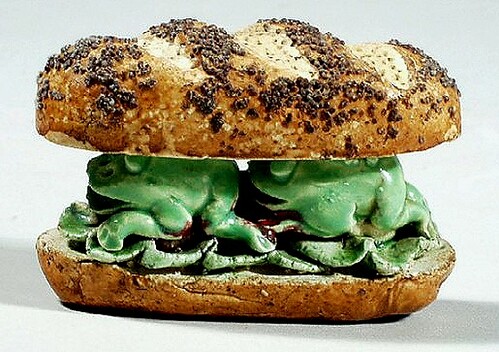
David Gilhooly, American (Auburn, California, 1943 – 2013, Newport, Oregon), Mini Frog Sub, 1980, hand-built, glazed low-fire whiteware, 2 ¼ x 1 3/8 inches, Arkansas Arts Center Foundation Collection: Gift from the Diane and Sandy Besser Collection, 1987.043.003.
POP! Out of the Vault, on view February 19 through July 7, 2019 at the Arkansas Arts Center, features more than 50 works from the Arkansas Arts Center Foundation Collection by some of Pop Art’s most influential figures, including Andy Warhol, Roy Lichtenstein, Claes Oldenburg, and Mel Ramos.
In 2013, the Arkansas Arts Center received a book of Polaroids by Andy Warhol as a gift from the Warhol Foundation. Throughout his career, Warhol was fascinated with Polaroids. In the 1970s, long before digital photography, these photographs that instantly developed themselves were a wonder – and very convenient for artists. The “Prince of Pop Art” made hundreds of Polaroids as sketches for his Pop Art portraits. The Arts Center’s 1975 Little Red Book #9 (Warhol produced hundreds of such books) features images of Easha McCleary. The Polaroids served as source material for a portfolio of prints related to a suite of 105 paintings, both titled Ladies and Gentlemen and commissioned by an Italian art dealer.
To show Warhol’s Polaroids of drag queens and transgender women of color in context, the curators of the Arkansas Arts Center went to the vaults in search work by of Warhol’s peers. They found a treasure trove of Pop Art and art from related movements.
POP! Out of the Vault will feature some rare examples of the first iterations of Pop Art, which arose in Britain in the 1950s. There, the artists of the Independent Group created collages that used American magazine pictures to mock the commercialism of contemporary life. Eduardo Paolozzi, a leading Independent Group artist, made collages, but also gathered popular imagery in prints, drawings, and sculptures like the Arts Center’s Triple Fuse.
In the early 1960s, young American artists created their own, independent version of Pop Art as they turned away from the hyper-expressive Abstract Expressionist works that had dominated American art through the 1940s and 1950s. Lichtenstein, Warhol, Oldenburg, and Ramos were among the first American Pop artists. They shocked art critics by making fine art paintings and sculpture that appropriated mass-produced commercial images.
Lichtenstein used the colorful, hard-edged visual language of commercial art to reimagine a procession of different artistic subjects and movements from comic books to Cubism. Warhol mass-produced his paintings and prints of soup cans and celebrities using silkscreen – a process previously only used to print posters and packaging. Oldenburg turned the dignified tradition of monumental sculpture on its head with his giant hamburgers and clothes pins. Ramos, who was working in California while the others worked on the East Coast, appropriated images of Superman, Wonder Woman, and other heroes before he began creating his signature paintings pin-up advertising women and his sendups of famous art works.
At about the same time that American Pop artists were beginning their work, other artists found their own ways of reacting against Abstract Expressionism. In England, painter and printmaker Patrick Caulfield found an elegant modernist approach to every-day subject matter. Often referred to as a Pop artist, Caulfield abhorred the label. In California’s San Francisco Bay Area, an irreverent approach to art took the form of self-depreciating, ironic Funk Art. Funk artist David Gilhooly even founded his own ceramic amphibian-based planet – The FrogWorld.
POP! Out of the Vault is organized by the Arkansas Arts Center.
 Little Rock Culture Vulture