
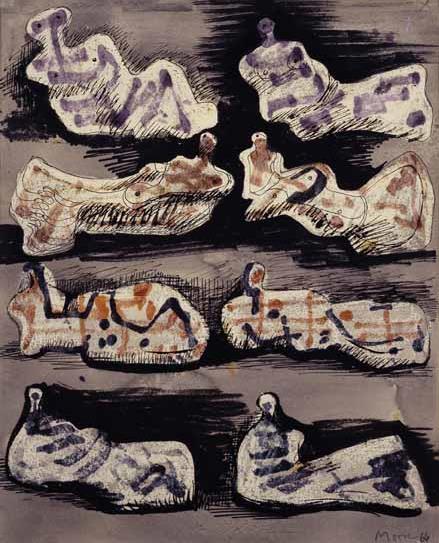
Henry Moore, Eight Reclining Figures No. 1, 1966, ink and watercolor on paper,
If an artist from the Treasures of Kenwood House exhibition were to time travel to the twentieth century, he would no doubt be shocked at the revolutions that had transformed the art of his native Britain, Netherlands, or Flanders (now part of Belgium).
Abstract and surreal art seems to break with nearly every precept of classically-based seventeenth- and eighteenth-century art. Yet the twentieth-century artists whose works have been selected from the Arts Center’s collection for this exhibition did not turn completely from their past.
In the 1980s, Dutch artist Anneke van Brussel (born 1949) drew asparagus in much the same naturalistic manner as seventeenth-century Dutch still life artists. The powerful British realist painter Lucian Freud (1922 – 2011) created an intimate figure drawing inspired by the work of eighteenth-century French artist Antoine Watteau (1684 – 1721). The British modernist sculptor Henry Moore (1898 – 1986) looked back even farther in his series of lithographs portraying the ancient British monument known as Stonehenge. Moore’s many reclining figures, sculpted and drawn, reflect both classical Greek and Roman figural sculpture and ancient Mayan stone carvings.
The great traditions of drawing, painting and sculpting human figures, animals, still lifes, and landscapes take on different guises from year to year, but they are never forgotten. The past provides the solid ground from which visions of the future take wing.
The exhibit runs through August 4.

 Little Rock Culture Vulture