Turkey Day Football in LR – Catholic High takes on NLR from 1958 to 1978

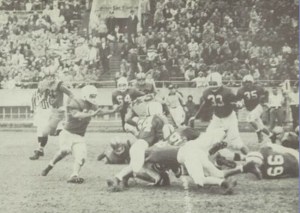
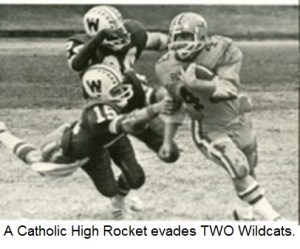
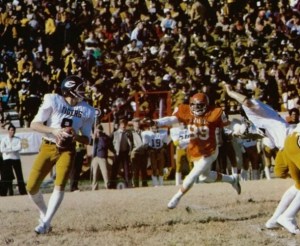
cath-nlrhs-grid-1971Following the demise of their Turkey Day rivalry with Little Rock High School, North Little Rock set their Thanksgiving sights on Little Rock Catholic.  In 1958, they started a 21-year tradition of meeting on the fourth Thursday in November.  (Previously Cathlolic had not been in a regular Thanksgiving rivalry. In fact, they sometimes did not even play on that day.)

The 1958 game, held at Wildcat Stadium, started where NLR’s previous Thanksgiving series had left off. A Little Rock team, now the Rockets of Catholic High, achieved a lopsided win over the NLR Wildcats.  The final score was 26-0, in favor of Catholic.

The next several years saw close games. Sometimes Catholic would win, other times NLR was the victor.  In 1960, Catholic lost the game, but won the conference championship (which was tantamount to a state championship at the time) due to results of other games.  In 1965, NLR won the game AND the conference/state championship.

From 1966 to 1969, NLR ran up a string of convincing victories over Catholic High.  This streak ended in 1970.  That year, NLR had been ranked number 1 heading into the game.  They lost the game to Catholic by a score of 21 to 16.  This also marked the first meeting of the teams to take place at the Catholic home field of War Memorial Stadium.  All previous meetings had been at NLR’s Wildcat Stadium.

Starting in 1970, they alternated hosting the game at their respective home stadium.  In 1971, Catholic again won the game and a state championship. The following year, NLR won both the game and a championship.  By that time, the northside school bore the name Ole Main to distinguish it from the new NLR high school: Northeast.  The 1972 game would be the final time that the game between the Rockets and Wildcats had championship implications.

From 1973 through 1978, Catholic and NLR alternated winning the game with the home team coming out on top.  Due to conference realignment, Catholic High dropped from AAAAA to AAAA starting with the 1979 football season. With that, they no longer played NLR on Thanksgiving Day.

Though in 1970 NLR had acquired its own cross-town rival with the opening of NLR Northeast, the creation of an all-NLR Thanksgiving Day tradition was never started. Likewise, Catholic did not start playing the new Little Rock high school, Parkview, on Turkey Day. Both would have probably created stronger Thanksgiving Day rivalries, but by this time, the Arkansas Activities Association was trying to discourage the tradition of playing on Thanksgiving.  Having a game that late in the season interfered with postseason playoffs.  The AAA had actually tried to dissuade teams from playing on the holiday as early as 1961, but were rebuffed by the larger schools who saw no need to give up the tradition.

In 1958, there were at least 23 high school football games played throughout the state on Thanksgiving.  By 1965, that number had shrunk to 13. In 1970, there were only two games: Hall v. Central and NLR v. Catholic.

The final tally of Thanksgiving meetings between NLR and Catholic was NLR 12 wins, Catholic 8 wins and one tie.  Catholic twice shut out NLR, and the Wildcats blanked the Rockets three times.  The northside team scored 267 points over 21 years, while the southsiders earned 223 points.


Year NLR Catholic
1958 0 26
1959 6 0
1960 20 14
1961 14 7
1962 7 14
1963 0 14
1964 6 6
1965 14 7
1966 33 0
1967 19 7
1968 40 13
1969 21 12
1970 16 21
1971 6 21
1972 7 6
1973 25 7
1974 3 8
1975 9 6
1976 7 14
1977 7 0
1978 7 20

Turkey Day Football in LR – Little Rock High vs NLR

lrhs-nlrhs-grid-1957After 20 years of playing a variety of schools on Thanksgiving, in 1934 Little Rock High School had started the new tradition of playing the North Little Rock High School Wildcats.  These cross-river rivals had played a few games previously in the 1910s and early 1920s. The competition was resumed in 1931, but was not on Thanksgiving Day until 1934.  With that game, the Tigers of Little Rock would begin a 49-year tradition of taking on their biggest rival on Turkey Day.

For much of the 1920s and 1930s, a Thanksgiving Day game for Little Rock High School meant rain.  That was the case in the 1934 meeting at Kavanaugh Field. (Located at the current spot of Quigley Stadium, it was a baseball field on which football games could also be played.  In 1936, the current stadium opened.)  The Tigers and Wildcats played to a 2-0 win achieved by the southside Bengals of Earl Quigley.

Another notable matchup was the 1938 game.  Little Rock won 12 to 7. With that win, it captured its first official state football championship. (Though the Arkansas Activities Association does now credit LRHS with several prior championships.)

The 1939 edition took place on Arkansas Thanksgiving.  That November featured five Thursdays.  President Roosevelt issued a proclamation that Thanksgiving would be the fourth Thursday, as it traditionally was. However Arkansas and a few other states chose to observe it on the final Thursday.  Little Rock won 6 to 0, but it was a messy game. Some sports fans joked that the game was FDR’s revenge on Arkansas for ignoring him regarding Thanksgiving.

In 1941, only a few days before the US would be plunged into World War II, North Little Rock achieved its first Turkey Day win over Little Rock.  The score was 26 for the Wildcats and 0 for the Tigers.  This was only the third ever loss for the Tigers on a Thanksgiving Day.  The Tigers were so dominant on Turkey Day games, a student had once remarked to a Gazette reporter that the matchup against Pine Bluff should be moved to Thanksgiving since the Tigers always seemed to win on that day.  (Pine Bluff was the state’s other football powerhouse at the time and often gave the Tigers fits in games.)

North Little Rock repeated as winner in the 1942 game, this time with a 31 to 12 score.  Writing for the Gazette, Orville Henry wondered if this would be the final meeting for the duration of the war.  He opined that many of the players might be in a different type of uniform for future games and that rubber might be needed for the war effort instead of athletic equipment.  While some colleges and high schools did drop football during the war, neither LR nor NLR did.

The Tigers were back on top in 1943 by a 13-7 score.  (It would be the last football game for the NLR coach who had been drafted.)  The 1944 game also featured a 13-7 score, but this time it was flipped and the Wildcats were winners.  The 1945 edition ground to a 13-13 tie.

In 1947, both teams were undefeated heading into the Turkey Day classic.  The inky wretches and scribes were predicting another evenly matched slugfest.  Instead Little Rock owned the game and came out with a 13-0 win.

The teams met eight times in the 1950s on Thanksgiving.  Little Rock won seven of the eight, losing the 1951 game by one point (13 to 14).

With the anticipation of a second Little Rock high school to be opened in a few years, Little Rock High School was rechristened as Little Rock Central High in 1954. The new school, named Hall High, opened in 1957 but played much smaller schools for its first year on the gridiron.  Plans were underway for Hall and Central to meet on Turkey Day in 1958, so the 1957 meeting of Little Rock and North Little Rock would be the final time the two teams would meet on Thanksgiving Day.

Little Rock Central High had dominated world headlines in September and October 1957 with the integration of the Little Rock Nine.  The sports coverage of this game however belied all the drama off the field. News reports focused on Turkey Day as the final game between the longtime rivals and on the fact that it had a morning start time instead of the traditional afternoon start time.  In the end, the Tigers had the same result as they did in the first Turkey Day meeting: a win.  The Bengals scored 40 while the Cats only managed 7.

After 24 meetings on Thanksgiving Day, Little Rock had 19 wins, 4 losses, and one tie.  Seven times they shut out the Wildcats, and one time the northern team blanked them.  The fewest total points scored were 2 in the 1934 game, while the 1950 game produced a cumulative total of 71 points (LR 64, NLR 7).  The Tigers scored a total of 517 points over 24 games and gave up only 203.

RobinsoNovember: Art Porter Sr.

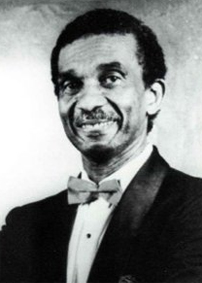
bhm art srAs part of the new Robinson Center, nine Little Rockians (Little Rockers?) have been enshrined by having spaces in the building named after them.  One of those is Art Porter Sr.

Arthur Lee (Art) Porter Sr. was a pianist, composer, conductor, and music teacher. His musical interest spanned from jazz to classical and spirituals.

Born on February 8, 1934 in Little Rock, he began his music education at home. He played in church at age eight; played his first recital at twelve; and, by fourteen, hosted a half-hour classical music radio program on KLRA-AM. He earned a bachelor’s degree in music from Arkansas AM&N College (now UAPB) in May 1954. The next year, he married Thelma Pauline Minton. Following his marriage, he pursued graduate study at the University of Illinois, University of Texas and Henderson State University.

He began his teaching career at Mississippi Valley State University in 1954.  When he was drafted into the Army, his musical talents were responsible for him being assigned as a chaplain’s assistant in New York.  In the late 1950s he returned to Little Rock and taught at Horace Mann High School, Parkview High School and Philander Smith College.

He also started playing piano jazz in the evenings. This led to the creation of the Art Porter Trio, which became THE music group for events.  Many musicians who came to Arkansas to perform in Little Rock or Hot Springs would often stop by and join in with Porter as he played.  From 1971 to 1981 he hosted The Minor Key musical showcase on AETN.  His Porterhouse Cuts program was shown in 13 states.

Often encouraged to tour, he instead chose to stay based in Arkansas.  He did, from time time, perform at jazz or music festivals.   He also performed classical piano with the Arkansas Symphony Orchestra, founded the Art Porter Singers, and created a music group featuring his four oldest children.  Though Porter received many honors and awards, he found particular satisfaction in the “Art Porter Bill” enacted by the state legislature, which allowed minors to perform in clubs while under adult supervision. Porter’s children thus were able to perform with him throughout the state. Governor Bill Clinton, at the time a huge fan and friend of Porter, often joined Porter’s group on his saxophone.

In January 1993, Porter and his son Art Porter, Jr., performed at festivities in Washington DC for the Presidential Inauguration of his friend Bill Clinton.  In July 1993, he died of lung cancer.  Today his legacy lives on in the Art Porter Music Education Fund as well as in the lives of the many musicians and fans he touched.  He was posthumously inducted into the Arkansas Black Hall of Fame in 1994.

AMERICAN PRINCES at Lost Forty on DECEMBER 22

american-princes-lost-fortyThis December Lost Forty Brewing will celebrate 2 years of creating craft beer for Arkansas with one helluva party. There is no better way to celebrate this milestone than rocking out with one of Little Rocks most beloved bands – American Princes. Join us for an incredibly special AMERICAN PRINCES REUNION concert in the brewhouse to benefit The Lost Forty Project foundation and to celebrate all things local.
CONCERT in the BREWHOUSE:
• Doors to the brewhouse open at 6:00pm.
• Welcome from Lost Forty & Arkansas Natural Heritage Commission at 6:30pm
• Show starts at 7:00pm-ish
• Beer and Snacks served in the brewhouse from 6:00pm – 9:30pm
• Show ends at 9:00pm-ish
(yeah… we said “ish” a few times … don’t be lame and get all wrapped up in the details, just come party with us.)
• All ages welcome (not recommended for anyone under 14)

NO COVER:
There will not be a charge for the show, however a $5 donation for the Lost Forty Project Foundation in partnership with the Arkansas Natural Heritage Commission is suggested.

Turkey Day Football in LR – Beating a Variety of Opponents from 1914 to 1933

Turkey Day 1921From the first Thanksgiving football game for Little Rock High School in 1914 until 1933, the Tigers played a variety of opponents.  They faced off against other Arkansas high schools, out of state high schools, a college and a team of soldiers.  Their record in these twenty games was 18 wins and 2 losses.  While the opponent may have varied, each year the Tiger eleven lined up against their foes at home in Little Rock. The team had enough of a reputation that they could invite opponents and never had to travel.

Playing games on Thanksgiving had become a tradition by the time Little Rock joined in the fray in 1914. Their first Thanksgiving Day opponent was Texarkana High School.  The Tigers won by a score of 20 to 0. The crowd of 1,500 at West End Park (now the site of Quigley Stadium) not only witnessed the high school game, but also saw Arkansas College (now Lyon College) defeat Little Rock College (no association with UALR) by a score of 40 to 0.  With their win, Little Rock captured the state championship – their fourth since 1907.

By the next Thanksgiving Day, the field at West End Park was known as Kavanaugh Field. It would have that name until it was replaced by Quigley Stadium in 1936.  From 1915 until 1933, Little Rock would defeat three Arkansas high schools Van Buren, Benton and Hot Springs as well as high schools from Oklahoma, Mississippi, Louisiana, Texas, Alabama, Kansas, Illinois and Missouri.  Three of their out of state opponents returned for a second time, so even though these schools were generally overwhelmed by Little Rock High, it was obviously viewed as a positive experience.  Playing out of state teams garnered other benefits. In 1920, they played Tupelo Military Institute, which held the Mississippi-Alabama championship. By defeating them, Little Rock High School claimed the state championship of four states: Arkansas, Alabama, Tennessee and Mississippi.

In 1917, they beat the college team of Arkansas State Normal School (now UCA) by a score of 45 to 0. (The Tigers so overpowered State Normal that the Gazette mused that the extremely muddy field was all that kept LR from scoring more than 45 points.)

The Tigers’ only two defeats came in 1918 and 1924.  The first Thanksgiving Day defeat came in 1918 when Little Rock played a team of soldiers from Camp Pike. The soldiers were an average of 20 pounds heavier than the Tigers. They used that weight to their advantage to defeat the high schoolers by a score of 42 to 0.  This was at the height of the US involvement in The Great War. So this game was certainly part of Little Rock’s war effort as the City worked to extend hospitality to soldiers. The Tigers’ 1924 defeat was at the hands of Atlanta Tech High School by a score of 35 to 7.

While the Thanksgiving games were serious business for the Tigers and their fans, they also provided for moments of entertainment.  In 1923, the Gazette reported that the Tigers had hosted a dance at the Capital Hotel for the visiting Ensley High football team from Birmingham, Alabama.  One wonders if there were a motive to their hospitality considering that the next day the Tigers won by a score of 20-7. Perhaps distracting the opposing players the night before the game was all part of Coach Earl Quigley’s strategy.  On Thanksgiving 1929, Little Rock hosted previously undefeated Soldan High from Saint Louis. At halftime of the game (which would end with LR scoring 26 to their opponent’s 6), there was a performance by the Little Rock High School band as well as a group of girls called Quigley’s Quackers.

Based on their reputation as a powerhouse, Little Rock would continue to play teams from other states. But after 1933, Little Rock would play a close rival: first North Little Rock (1934-1957) and then Hall High (1958-1982).  During the two decades of playing various teams, the Little Rock Tigers achieved ten shutouts and suffered one shut out.  The Tigers scored 492 points and gave up 133 points.

1914 Little Rock 20 Texarkana 12
1915 Little Rock 40 Muskogee Central High 0
1916 Little Rock 46 Van Buren 0
1917 Little Rock 45 Arkansas State Normal 0
1918 Little Rock 0 Camp Pike 42
1919 Little Rock 52 Benton 0
1920 Little Rock 6 Tupelo Military Institute 3
1921 Little Rock 21 New Orleans Warren Easton High 3
1922 Little Rock 7 Bryan (TX) High 0
1923 Little Rock 20 Birmingham Ensley High 7
1924 Little Rock 7 Atlanta Technical High 35
1925 Little Rock 6 New Orleans Warren Easton High 0
1926 Little Rock 18 Birmingham Ensley High 6
1927 Little Rock 37 Wichita Central High 0
1928 Little Rock 18 Chicago Lindblom High 0
1929 Little Rock 26 Saint Louis Soldan High 6
1930 Little Rock 33 Chicago Lindblom High 13
1931 Little Rock 31 Dallas Woodrow Wilson High 0
1932 Little Rock 6 Saint Louis Cleveland High 0
1933 Little Rock 13 Hot Springs 6
  • Muskogee Central High has been known as Muskogee High since the 1970 integration of the formerly all-white school with an African American high school.
  • Tupelo Military Institute existed from 1913 to 1937.
  • Warren Easton High is Louisiana’s oldest high school. After Hurricane Katrina it is now a charter high school.
  • Bryan High School was replaced by Stephen F. Austin High School, which was replaced by a new Bryan High School.
  • Ensley High in Birmingham closed in 2006.
  • Atlanta Technical High closed in 1947. A charter school with the same name operated from 2004 to 2012.
  • Wichita Central High has been known as Wichita East High since 1929. It is the largest high school in Kansas.
  • Chicago Lindblom High now educates under the name Lindblom Math and Science Academy.
  • Saint Louis Soldan High now educates as Soldan International Studies High School
  • Woodrow Wilson High School continues to operate in the Lakewood neighborhood of East Dallas.
  • Saint Louis Cleveland High now educates as Cleveland Junior Naval Academy and is no longer in the longtime Grover Cleveland High School building.

Turkey Day Football in LR – An Overview

thanks-grid-lrc-lrh102 years ago, Little Rock High School (then located on Scott Street) kicked off a 69-year tradition of playing football on Thanksgiving Day.  (Though the date of Thanksgiving floats anywhere from the 22nd to the 28th, Thanksgiving Day 1914 was on November 26.)

From 1914 until 1933, the Little Rock High School Tigers played a variety of different schools.  Then from 1934 until 1957, they played North Little Rock. From 1958 until 1982, the Little Rock Central Tigers took on the Warriors of Little Rock Hall.

Thanksgiving Day football was a tradition not just for high schools in Little Rock but also all levels throughout the state and country.  The Friday after Thanksgiving, newspapers carried stories and scores for professional, college and high school football.  It was probably the only day of the year to see all three levels of football covered in the paper, and often high school games received the most ink.  This mix of football continued for decades.  In 1969, there were four football games played in Pulaski County on Thanksgiving Day: Little Rock Hall vs. Little Rock Central, Little Rock Catholic vs. North Little Rock, Horace Mann vs. Scipio Jones, and the Arkansas Razorbacks vs. Texas Tech.

By the 1970s, both high school and college football games on Thanksgiving were on the wane.  While college games on Turkey Day have regained some popularity, they are nowhere near approaching the level they once had.  High school football on Thanksgiving disappeared in Arkansas following the 1982 game between Hall and Central.  That rivalry had been the final series on Turkey Day to still be played.

While they lasted, Thanksgiving Day high school football games were civic focal points. They were about bragging rights.  For students who had grown up attending the games, the chance to play or cheer in a Turkey Day classic was a rite of passage.  Alumni home from college or visiting the family for Thanksgiving would descend on the stadium ensuring the largest attendance of the season.

High school football on Thanksgiving Day in Little Rock tells the tale of not just football; it reflects changes in the city and society.  What started out as two small high schools from neighboring cities changed as both schools grew. The addition of a second Little Rock high school reflected the city’s growth.  (Indeed the 1954 Little Rock High School yearbook, in discussing the school’s new designation as Central High, mentions vaguely that the second high school would be built at some yet to be determined location in “west” Little Rock.)

The presence of segregated high schools in separate but unequal football rivalries (lasting nearly two decades after the Supreme Court’s Brown v. Board decision) is an indictment of an unjust parallel education system.  As Little Rock continued to grow and diversify, the two high schools playing on Thanksgiving were no longer always the predominant schools in football – or other activities.  With state championships once again on the line, the last few years of the Hall and Central Thanksgiving rivalry were, in a way, a return to the halcyon days of the early faceoffs (though this time, thankfully, with fully integrated teams). In addition to trading the top spots in football, the two schools were piling accolades. In fact, all three Little Rock public high schools had achieved a stasis that inadvertently rotated areas of excellence academically, athletically and artistically fairly equally among the three.

There were undercurrents at work that hinted at future instabilities to come.  Indeed by 1982, the same year of the final game, Little Rock had filed suit against the North Little Rock and the Pulaski County Special School Districts claiming the schools in those neighboring districts were siphoning off white students from the Little Rock schools. The ensuing realignment of schools and districts would probably have brought an end to Central vs. Hall games even if athletic reclassification had not.

Central is now much larger than Hall, Parkview is a magnet school, two formerly county high schools (and several elementary schools and junior highs) were brought into the LR school district in the late 1980s.  Where once the Little Rock high schools were roughly equal in enrollment, they now are so varied they play in three different classifications.

It is up to the alternative historians to envision what continued Turkey Day classics would have looked like after 1982. Little Rock has grown and diversified. There are six public high schools and five private high schools playing football within the Little Rock city limits each season. With all these competing interests it is unlikely to envision the same citywide level of interest in one football game.

But back in the day…

RobinsoNovember: Gail Davis

gail_davisGail Davis is another of the former Little Rock artists honored at Robinson Center.  She was born Betty Jeanne Grayson on October 5, 1925. Her mother was a homemaker and her father, W. B. Grayson, was a physician in McGehee (Desha County), which did not have a hospital, so her birth took place in Little Rock (Pulaski County).

When her father became the state health officer, the family moved from McGehee to Little Rock, where Grayson attended Little Rock Senior High School. Grayson rode horses and was a tomboy growing up. Grayson also held various beauty titles in high school and college, and she sang and danced in local shows from the time she was eight.

While studying dramatics at the University of Texas in Austin, she married Robert Davis in 1945, with whom she had a daughter, Terrie (the couple divorced in 1952). After World War II, they moved to Hollywood, where she worked as a hatcheck girl until being discovered by an agent who obtained an MGM screen test for her. She was signed to a contract, with her first appearance in 1947’s The Romance of Rosy Ridge, starring Van Johnson.

She worked steadily in movies, including fourteen films with Gene Autry in the late 1940s and early 1950s. He was impressed with her, changed her name to Gail Davis, and cast her as the star of the Annie Oakley TV show, which he produced. The show ran for eighty-one episodes from 1954 through 1956.

At just over five feet tall and under 100 pounds, Davis was a charming heroine on Annie Oakley who wore pigtails and stopped criminals by outsmarting them or shooting the guns out of their hands. She rode horses and did many of her own stunts. She was the first woman to star in a TV western. Many young women later said they were influenced by watching Gail Davis as Annie Oakley, a female character in a traditionally male role. In the show, Gail took care of her younger brother, Tagg, in the fictional town of Diablo and solved crimes with handsome deputy sheriff Lofty Craig.

After her TV series ended, she appeared as Annie Oakley in the 1959 film Alias Jesse James starring Bob Hope. In that film, she appears in an uncredited role along with such other stars, also uncredited, as Gary Cooper, Bing Crosby, Roy Rogers, James Garner (as Bret Maverick), and Fess Parker (as Davy Crockett).

Her television appearances include guest roles on The Lone Ranger, The Gene Autry Show, The Cisco Kid, and Death Valley Days, as well as a 1961 episode of the Andy Griffith Show (Episode 37, “The Perfect Female”), her final appearance as a performer and in which she demonstrated her trademark sharpshooting.

Gail toured with Gene Autry’s Wild West show and made appearances as herself on TV programs such as Wide, Wide World: “The Western” (1958) with fellow Arkansan Ben Piazza. For her work in television, she was awarded a star on the Hollywood Walk of Fame, located at 6385 Hollywood Boulevard, and in 2004, she was inducted posthumously into the National Cowgirl Hall of Fame.

Gail Davis died of cancer in Los Angeles on March 15, 1997, and is buried in Hollywood’s Forest Lawn cemetery.  In 2007, she was posthumously inducted into the Arkansas Entertainer’s Hall of Fame.