Frampton Comes Alive Tonight in return to Little Rock

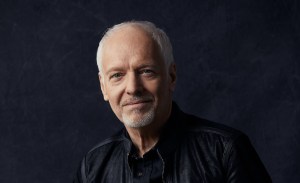
Tonight, Peter Frampton takes the stage in Little Rock as part of RiverFest.  It marks at least his fifth visit to the city.

In 1979, still riding the crest of the “Frampton Comes Alive” popularity, he played at Barton Coliseum on June 24.

He has appeared in Riverfront Park in May 1992, June 1998 (opening for Lynyrd Skynyrd), and at the 2013 edition of Riverfest.  Yesterday was the fifth anniversary of that appearance.

Over the years he has also played concert venues in Northwest Arkansas and Hot Springs.

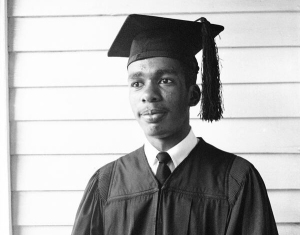
Little Rock Look Back: Ernest Green graduation from LR Central High

Last week, the Class of 2018 graduated from Little Rock Central High School.  Perhaps the most famous graduation ceremony in the long-storied history of Little Rock Central High took place on May 27, 1958.  It was on that date that Ernest Green became the first African American to graduate from the formerly all-white school.

Among those in the audience to witness this historic event was an up and coming minister named Dr. Martin Luther King, Jr.  A friend of L. C. and Daisy Bates, he attended the 1958 Central High School graduation to witness Green receiving a diploma. Each senior only received eight tickets to the ceremony at Quigley Stadium.   Dr. King was in the state to address the Arkansas AM&N (now UAPB) graduation.  Because he was going to be nearby, Dr. King wanted to witness the history.  Green did not know that Dr. King was in the stands until after the conclusion of the ceremony.  Later that evening, Dr. King gave Green a graduation present of $15.

Ernest Green, Dr. King and Daisy Bates share a relaxed moment — which was probably rare for the three in 1958

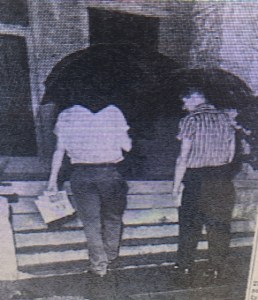
Because of fears about the event becoming a media circus, the Little Rock School District limited the press on the field to one Democrat and one Gazette photographer. Other press were limited to the press box normally filled with sportswriters covering the gridiron exploits of the champion Tigers.  There were photos taken of Green prior to the ceremony as well as during the ceremony.

During the graduation rehearsal, there had been concerns that some students or other people might try to disrupt the practice.  But it went off without a hitch.  Likewise, the ceremony itself went smoothly.  Local press reported that some members of the class briefly chatted with Green during the ceremony.  That the event took place without incident was a relief on many levels to City leaders.  Also in the class of 1958 were a son of Little Rock Mayor Woodrow Mann and a daughter of LRSD Superintendent Virgil Blossom.

Little Rock Look Back: The Aftermath of the Recall

The day after the recall election, there was still uncertainty.  The results were not uncertain – even the two boxes from Woodruff Elementary which were not counted until the the day after did not change the outcome.

The uncertainty stemmed from the process.  The School Board recall law which had been hastily passed by the Arkansas General Assembly (to be used as a tool against integration), had many glaring omissions. Written by Attorney General (and avowed segregationist) Bruce Bennett, it did not indicate when recalled members lost their seats – was it after election results were announced? After they were certified? Or after the new members were appointed?

In addition, the Election Commission was prepared to certify the results, but did not know to whom they were issuing the certification.  Because it was a citizen-initiated recall for a school district race, none of the pre-existing rules applied.  And again, the Bennett bill did not spell it out.

The Pulaski County Board of Education had to wait for the results to be certified before they could appoint the three new members.  Each of these new members would stand for re-election in December at the next School Board election.

In the interim, the School Board had a scheduled meeting set for two days after the election.  But with its membership uncertain and no pressing matters, the three retained members (Everett Tucker, Russell Matson and Ted Lamb) were considering postponing the meeting.

In the coming days, the Election Commission would meet and certify the results.  They ended up sending them to the County Judge.  One of the three members appointed to fill the vacancies was ineligible (he did not live in the district).  But by the end of June, the Little Rock School Board was back to six members.

A court ruling over the summer which struck down the law allowing the closure of schools, cleared the way for Little Rock high schools to reopen as integrated in the fall.  There would be much more legal wrangling in the weeks, months and years to come.  The rate at which the Little Rock public schools were integrated was much more focused on the word “deliberate” than on “speed.”

But on May 26, 1958, those matters were for another day.  The supporters of the fired 44 teachers and the three school board members who defended them were left to savor their victory.

A look at the voting by the City’s five wards shows that while individual precinct totals varied, Messrs. Lamb, Matson and Tucker all fared well in Wards 1 and 5 as well as in Cammack Village and Absentee voting.  Ben Rowland and Bob Laster fared well in Wards 2, 3, and 4 as well as the unincorporated area around Wilson Elementary.  Ed McKinley was supported in Wards 3 & 4 as well as the Wilson Elementary environs.

Here is a breakdown of the voting locations in each Ward to give a sense of the geographic location:

Ward 1 – 16th & Park, 14th & Pulaski, 15th & State, 28th & Wolfe, 23rd & Arch

Ward 2 – 316 E. 8th, 12th & Commerce, 424 E. 21st, 1101 E Roosevelt, 6th & Fletcher

Ward 3 – County Courthouse, 1116 W Markham, 11th & Ringo, 9th & Battery, Deaf School, 7th & Johnson, Cantrell Rd in Riverdale

Ward 4 – 4710 W 12th, 3515 W 12th, 24th & Garland, 22nd & Peyton, Broadmoor Methodist

Ward 5 – Markham & Elm, Kavanaugh & Beech, Cantrell & Pierce, Kavanaugh & Harrison, Kavanaugh & McKinley, 7524 Cantrell, H & Hayes

Little Rock Look Back: Opening of La Harpe Boulevard

Knoop, Parkin and Remmel in this DEMOCRAT staff photo

Not all events in Little Rock on May 25, 1959, were school-related.

On that day, Harry W. Parkin, a member of the Arkansas Highway Commission was joined by Little Rock Mayor Werner Knoop and Pratt Remmel, a former mayor of the city,  in a brief ceremony.

With Mayors Knoop and Remmel standing by, Mr. Parkin snipped the ribbon to officially mark the opening of LaHarpe Boulevard in Little Rock.  Owner of Parkin Printing Company in LR, he had been appointed  to the Highway Commission in 1957.

Mr. Knoop was the current mayor of the City, having been chosen by his colleagues on the initial City Board in November 1957. He was re-selected in January 1959 to a second stint as mayor.  Mr. Remmel had been mayor in 1952 when Little Rock voters approved bonds to pay for their portion of the $3million project.

In February 1957, the street was named in honor of the explorer Jean-Baptiste Benard de La Harpe, who had first claimed the area for the French.

Little Rock Look Back: 1959 Recall Election Day

The triumphant trio who were retained by Little Rock voters.

May 25, 1959, was not only the Recall Election Day, it was the last day of school for the Little Rock School District’s elementary and junior high students.  The results of that day’s vote would determine whether the ninth grade students would be in class come fall, or joining their older friends and neighbors in sitting out a school year.

While expectations that a new record of turnout would be set were off, over 25,000 of the 42,000 registered voters DID cast ballots in the May 25, 1959, Recall Election.

As the precinct results started coming in, some unexpected trends developed.  Some of the boxes in the more affluent, western neighborhoods which had been expected to be strongly in favor of keeping Everett Tucker, Russell Matson and Ted Lamb were not providing the anticipated overwhelming numbers.  Likewise, some of the more working class neighborhoods which had been projected to be strongly in favor of keeping Ed McKinley, Ben Rowland and Bob Laster were more receptive to keeping Tucker, Matson and Lamb.

As the night rolled onward, only Everett Tucker looked like a sure thing to be retained on the School Board.  At one point in the evening it appeared that the other five members would be recalled.  By the time they were down to four boxes still uncounted, the three CROSS-backed candidates were guaranteed to be recalled, but the status of Lamb and Matson was still undetermined.  Finally, with only two boxes remaining, there was a sufficient cushion to guarantee Matson and Lamb would continue as board members.

Two boxes from the Woodruff school were uncounted at the end of Monday. They had 611 votes between the two of them, which was not enough to change any outcomes.  They were being kept under lock and key to ensure there was no tampering with them.

Once it became apparent that Tucker, Lamb and Matson were retained, the STOP watch party erupted.  Six young men hoisted the triumphant three on their shoulders and paraded them through the crowd.  Dr. Drew Agar enthusiastically announced to the crowd, “Mission completely accomplished.”

At around 11:00 p.m. William S. Mitchell addressed the crowd.  “This is a great awakening of our home town…I have never seen such a wonderful demonstration of community spirit.”  He later went on to thank the thousands of people who volunteered in the effort.

At the CROSS headquarters, Ed McKinley and Rev. M. L. Moser were sequestered in a room poring over results.  When it appeared that 5 of the 6 might be recalled, McKinley issued what turned out to be a premature statement.

Back at the STOP party, the celebration continued.  While people knew that much work was still ahead, the men and women in attendance were enjoying a rare moment of joy after nearly two years of strife.

Little Rock Look Back: Sermons, TV Shows Dominate Final Day of 1959 Recall Campaign

A rainy Sunday afternoon did not stop STOP canvassers on May 24, 1959.

Sunday, May 24, 1959, was election eve for the Recall Campaign.  As such, the election figured into some Sunday morning sermons.  Reverend M. L. Moser Jr. spoke from the pulpit of his church and described the issue of segregation as Biblical. As many had before him, and would after him, he used the story of Noah’s three sons as a way to justify segregation of the races.

(Supposedly one of the sons was the father of the white race, one the father of the African American race, and one the father of the Asian race.  In this narrative, no explanation is given for other variations such as Native Americans and other indigenous people or persons from the sub-continent of India.  Also excluded is the likely race of everyone in the story – those who live in the Middle East.)

At Trinity Episcopal Cathedral, Dean Charles A. Higgins prayed for the schools but did not tell his parishioners how to vote.  Rev. Aubrey G. Walton at First Methodist Church spoke about the schools needing to be free from politics and pressure groups.  (Though Rev. Walton did later appear that evening on a STOP sponsored TV show.)

Embattled School Board president Ed McKinley refused requests from the media and others to divulge his plans for the future of the Little Rock School District.  Earlier he had stated he had an idea on how the schools could be reopened and segregated, but still remain in compliance with the courts.  Across the river, segregationists were planning a rally in North Little Rock to head off any plans for future integration on the north side.  Congressman Alford had already agreed to speak at this rally.

In paid time on TV, Governor Faubus spoke at length in a criticism of the Arkansas Gazette. He called the fired teachers pawns in a larger game.  He noted in his remarks that he did not expect to sway any votes by this point.

Not to be outdone, STOP was on all three TV stations. Sometimes the program was aired on more than one station simultaneously.  In an appearance sponsored by STOP, William S. Mitchell noted that May 24 was coincidentally Children’s Day.  He noted that never before in Little Rock history had so many people volunteered for a cause as those who had worked on STOP and with STOP.  The Women’s Emergency Committee, PTA Council, labor unions, and numerous other organizations had come together to raise money, knock on doors, and otherwise get the word out.

Finally, it was all over but the voting.  Nineteen days of outrage, exasperation, and hyperbole was coming to an end.  When dawn broke, it would be election day.

Little Rock Look Back: Wilbur D. Mills

While later known more as a punchline due to personal fallibilities, for decades Wilbur D. Mills was one of the most powerful men in the world.  As the chair of the House Ways and Means Committee from 1958 to 1975, he was the architect not only of an overhaul of the tax code, but also determined ways to finance Medicare, Medicaid, and many other federal programs of the Eisenhower, Kennedy, Johnson, Nixon and Ford years.

Wilbur Daigh Mills was born in Kensett on May 24, 1909.  When Mills went to Congress at the age of 29, he was the youngest man elected to that time.  A scant four years later he joined the Ways and Means Committee.

Because Mills rarely had an opponent (only 1942, 1966, and 1974), he was able to focus on learning the ins and outs of the tax code. As long as he delivered some federal dollars to his largely rural district every so often, he did not have to preoccupy himself with the daily issues many in Congress face.  It was not until 1963, when Arkansas lost two of its six congressional seats, that Mills had Little Rock in his district. Prior to that, Searcy had been the largest city he represented.  (There had been concern that Rep. Dale Alford, who had upset incumbent Brooks Hays in 1958 before losing his seat due to reapportionment four years later might challenge Mills. But Alford opted to retire instead of taking on the powerful Mills.)

President Kennedy’s visit to Little Rock and Greers Ferry in October 1963 was the result of bargaining with Congressman Mills over some tax policy.  Mills gave in to JFK a bit, and JFK agreed to come to Arkansas to speak in Little Rock and at the dedication of two dams.  In recognition of his national clout, Mills was briefly considered a contender for the 1972 Democratic nomination for President.

Though he probably struggled with alcoholism for years, he had been able to keep his behavior in check until 1974 when his car was stopped in Washington DC for not having its headlights on. Though Mills was not driving, he was inebriated.  Another occupant of the car, a stripper with the stage name Fanne Fox ran from the car and frolicked in the Tidal Basin.  It became fodder for worldwide headlines.

The incident happened about a month before Election Day, when Mills was facing Republican Judy Petty.  A contrite Mills spent the remaining days in the campaign in Arkansas and won re-election by 59% of the vote.  (Though later in November, he again was in the headlines when Fox pulled him on stage with her at a club in Boston.) In January 1975, he stepped down as Ways and Means Chair.

In 1976, he opted to retire from Congress and did not seek another term.  In retirement, he practiced law in Washington DC before eventually moving back to Kensett full-time.  He died in 1992.