Heritage Month – Knoop House

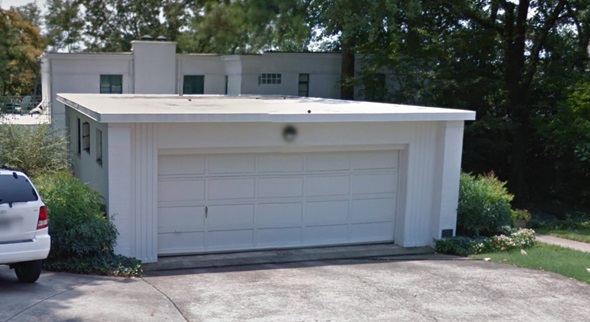
Knoop HouseToday’s historic property is unique for Little Rock.  It is one of the only (if not the only) Art Moderne style residences in Little Rock.

The Knoop House was built in 1936-1937 in Hillcrest for Werner and Faith Knoop. Designed by the architectural firm of Brueggeman, Swaim & Allen, the Art Moderne style of the house departed dramatically from, the mere typical period revival styles of the Hillcrest neighborhood. The Knoop House was (and still is) an outstanding Modernistic architectural statement in an area filled predominantly with English Revival, Colonial Revival, American Four Square, and Bungalow styles.

The house was built by Werner and Faith Knoop in 1936-1937.  In 1948, the original garaged was enlcosed and a new garage was added to the front of the house. Mr. Knoop was a mechanical engineer and founding principal in what is now the Baldwin & Shell Construction Company.  After having served on the school board, in 1957 Mr. Knoop became the first Mayor of Little Rock under the “new” city manager form of government and continued to serve the City on various committees even after his term as Mayor ended. Faith Yingling Knoop was a well-published author of magazine articles, textbooks, and children’s books.

The Knoop House’s simple, restrained detailing is typical of the Art Moderne style, as is the emphasis upon large uninterrupted expanses of smooth wall surface, the preference far a light palette and the selection of such modern materials as metal casement windows and glass block.

The Knoop House was added to the National Register of Historic Places in August 1990.

Heritage Month – Villa Marre

villamarreThe Villa Marre is located at 1321 Scott Street. The Second Empire-style Villa Marre was built in 1881 by Italian immigrant and Little Rock saloonkeeper Angelo Marre, who also served on the Little Rock City Council.

The distinctive home features a mansard roof covered in patterned slate, a central tower topped by wrought-iron cresting, and hood molding above the doors and windows. Marre died in 1889, and his widow, Jennie, remained in the house until about 1900. Arkansas Governor Jeff Davis rented the house for a few years, and in 1905, the home was purchased by E. B. Kinsworthy, former state senator and attorney general of Arkansas.

It is probably most famous today for being the outdoor exterior of Sugarbakers design firm in the CBS sitcom “Designing Women.”  For several years, it was the home of the Quapaw Quarter Association. It later returned to a private residence.  Currently it is a venue for weddings and other events.

It was added to the National Register of Historic Places on June 15, 1970.

Heritage Month – Van Frank Cottages

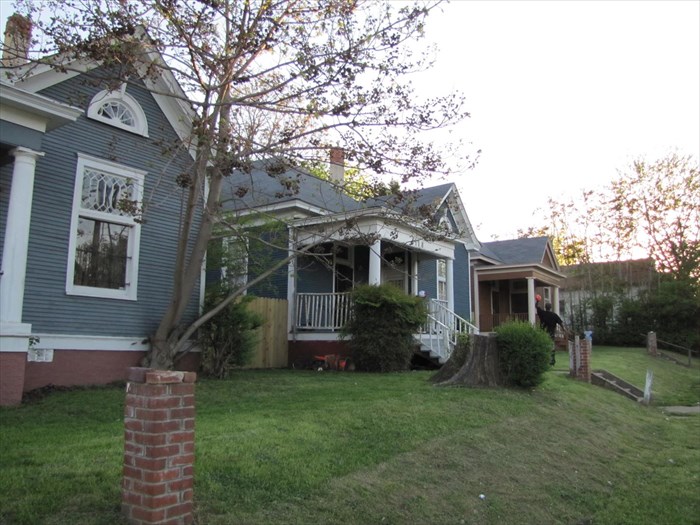
Van FrankToday’s historic property is actually four separate structures that are linked by the design and builder.  The Van Frank cottages are significant architecturally. Located between the MacArthur Park Historic District, to the immediate north, and the Marshall Square Historic District, a few blocks to the southeast, the Van Frank cottages represent a transition between the two.

While typical of the scale and speculative nature that characterizes the Marshall Square Historic District, the Van Frank cottages are reflective of the MacArthur Park Historic District in stylistic detail and in the ancestry and occupations of their owners and occupants.

Built in 1908, the cottages were the rental property of Philip R. Van Frank. They are the only existing historic houses associated with this civil engineer, who was instrumental in the improvement of Arkansas’ rivers.

Each of the four cottages is simply,  yet finely crafted with Colonial Revival details. In their unaltered state they are typical examples of the period. The cottages have been the residences of many individuals of diverse backgrounds.

The four cottages were added to the National Register of Historic Places in October 1985.

Heritage Month – Lincoln Viaduct

ahpp_nom_lincolnaveviaduct_largeToday kicks off the start of the Memorial Day weekend.  Since Memorial Day grew out of the Civil War-based Decoration Day, today’s property is named for a Civil War leader: Abraham Lincoln. The Lincoln Avenue Viaduct is traversed by thousands of cars each day, with most having no idea the name of the structure.  The Lincoln Avenue Viaduct is the arched bridge connecting LaHarpe with Cantrell Road which (literally) bridges downtown with the west along Highway 10.

The Lincoln Avenue Viaduct is a reinforced concrete rainbow arch bridge. It was opened at 2:05 p.m. on Friday, December 28, 1928, and, despite later alterations, it remains particularly well-preserved. The Missouri Pacific Railroad Company, considered the most important railroad company in the state, constructed the bridge amid a series of improvements in Little Rock made necessary by the damage wrought by the infamous spring floods of 1927.

Though the bride was constructed by the railroad, the City had to give authorization to do so, this was accomplished by the passing of Ordinance 4,335, at the May 28, 1928, City Council meeting.

Lincoln Avenue was one of several names for stretches of Highway 10 in Little Rock. By the 1960s, the areas west of the Lincoln Avenue viaduct were all renamed Cantrell in honor of the man who had developed much of the area west of the Heights. The longest stretch of the road already carried that name. There had been an effort to rename Highway 10 (including sections named Lincoln, Q, and Cantrell) in Little Rock for Senator Joseph Taylor Robinson in 1930. He declined the offer because he did not want to diminish the contributions of Mr. Cantrell.  Over time the entire stretch bore the name Cantrell.

The stretches east of the viaduct which involved a couple of names were renamed La Harpe Boulevard in honor of the French explorer who first saw the Little Rock.

Though the street has been renamed, the bridge still carries the name of the 16th President of the United States.

The Lincoln Avenue Viaduct was added to the National Register of Historic Places on April 9, 1990.

Heritage Month – Ten Mile House

Ten_Mile_fDeriving its common name from its distance from Little Rock at the time, the Federal-style Ten Mile House,  is a rare example of a largely intact rural home of the early nineteenth century.  In addition to the house, there are four nineteenth-century outbuildings surrounded by a large parcel of wooded property.

It was built by Archibald McHenry, and is sometimes known as the McHenry House or Stagecoach House (due to its presence on the Southwest Trail stagecoach line).  During the Civil War it served as a military outpost for Union troops.  David O. Dodd was held a prisoner in the smokehouse prior to his trial and execution.

Ten Mile House exhibits Early Georgian or Federal influence through the use of bridging between paired chimneys situated at each end of the house. Traits of the Federal style include simple, symmetrical proportions and large multi-paned windows. Ornamentation is minimal and is usually found around entries, windows, and cornice lines. A brick smokehouse, dairy house, well house, and kitchen house—all dating from the nineteenth century—remain on the property.

The Ten Mile House was listed on the National Register in June of 1970. Several families have owned the home since its early nineteenth century construction. It has served as a combination tea room/antiques store, a venue for public dinner parties and weddings, and a residence.

Heritage Month – Samuel P. Taylor Service Station

Today’s Heritage Month property is the Samuel P. Taylor Service Station.  Built in 1938, it embodies the distinctive characteristics of Art Deco architecture.

The Samuel P. Taylor Service Station is located at the corner of Cross Street and West Third Street in downtown Little Rock. The building was constructed in 1938 on a lot previously owned by the Cross Street Christian Church. The church built a basement in 1935 and had planned to construct a church on the site, however money could not be raised and the church disbanded circa 1937. The land was purchased from the church in 1938 and a man known as Mr. Saunders was hired to build a service station on its present day site. Later that same year the Samuel P. Taylor Service Station opened its doors to motorists.

The Samuel P. Taylor Service Station served motorists as garage and gas station from its opening in 1938 until 1947. In 1947 the building was purchased by Paul Williamson and the name of the business was changed to Cross Town Gulf Service Station. Mr. Williamson served as the owner and operator of the Gulf Oil Company franchise until the business went out of operation in 1972. The building was then purchased by the Safeway Corporation in 1973 and was used as storage by the Safeway Bakery Division located at 1111 West Third Street in Little Rock.  Although the building no longer serves as a service station it still greatly resembles its historic appearance and reminds those passing by of its original use.

It was added to the National Register of Historic Places on November 29, 2000.

Heritage Month – Luxor Apartments

Luxor ApartmentThe Luxor Apartments building is a two-story brick veneered structure designed in the Craftsman style, unique to the Little Rock area in its size.  Located at 1923 South Main, it remained popular for singles and young families from the 1920s to the 1970s because of its proximity to the downtown commercial district.  Now it is part of the South Main community, which is once again a hotbed of activity.

The Luxor Apartments Building was built by Samuel J. Storthz, Sr., member of a Jewish family prominent in the Little Rock business community.  At the time of its construction, the Luxor was considered a very desirable address.  The building featured a uniformed doorman, apparently something of an anomaly in Little Rock at the time.  At a time when most apartments had eight or fewer units, the Luxor Apartments contained 28 units.

Construction of the Luxor Apartment building in 1924 represents the rapid urbanization of Little Rock in the early decades of the twentieth century.  Attention to technology and “modern” conveniences were emphasized.

They were added to the National Register of Historic Places in April 1995.