Little Rock Look Back: W. W. Stevenson, Little Rock’s 2nd Mayor

LR sealOn this date in 1797, future Little Rock Mayor William Wilson “W. W.” Stevenson was born in South Carolina.

In 1811, he came to Arkansas when his family settled in Batesville.  An ordained Presbyterian minister, he married Ruana Trimble in 1821 and had two children.  After she died, he married Maria Tongray Watkins in 1831 and had two more children.

In 1831, he ran for Mayor in the first election for the office but was defeated by Dr. Matthew Cunningham.  The next year he ran to succeed Cunningham and was elected.  After leaving the Mayor’s office on December 31, 1833, he continued public service.  He was State Commissioner for Public Buildings in 1839.

In 1849, he delivered the funeral oration at the ceremony for Hon. Ambrose H. Sevier.  Later that year, he was hired as a geologist for the Little Rock and California Association which was created to take advantage of the gold rush.  He and his two oldest sons moved to California and never returned to Arkansas. He died in 1888.

No photograph or painting of Mayor Stevenson is known to exist.

Little Rock Look Back: Voters Approve Robinson Auditorim

10.+citylittlerock-2On January 26, 1937, Little Rock voters went to the polls to vote on three different municipal bond issues.  One of them was the construction of a municipal auditorium.

The bonds for the auditorium would be $468,000 in general obligation bonds which would be paid off between 1940 and 1971. This was toward a total cost of $760,000 for the entire project.

The official campaign for the auditorium was sponsored by the Little Rock Forward Committee which was led by W. H. Williams. In campaign advertisements it showed the value of conventions in New York City which was estimated at $100 per convention attendee. Little Rock organizers were estimating a $10 a day expenditure by visitors, which the committee stressed was very conservative. The campaign committee emphasized the importance of acting at that time due to the federal government money involved.

Various committees and organizations endorsed the auditorium project including the Little Rock Chamber of Commerce, Little Rock Federation of Women’s Clubs, and the Young Business Men’s Association.

The thrust of the campaign focused on the economic benefit to Little Rock as well as the fact that the auditorium would be for all citizens. This message was picked up in editorials by both the Democrat and Gazette. In editorials on January 23 and 25, the Democrat opined that the benefits of the auditorium would be distributed among all classes of the citizenry. The next day, both papers ran editorials which touted the economic boon an auditorium would bring through conventions and meetings.

The Democrat’s approach broke down the current value of conventions to Little Rock with, what it termed, the city’s “existing inadequate” facilities. The paper emphasized a conservative estimate of what the added value to Little Rock’s economy would be with the new auditorium.

In expressing support for the auditorium the Gazette stressed the values for local, statewide and national groups. “An auditorium would provide a more convenient and better adapted community center for all kinds of local gathering,” and continued that it would make Little Rock “the logical meeting place for state conventions of every sort.” In discussing the value of state, regional and national meetings the paper stressed that the outside money spent by convention attendees has an impact beyond stores, hotels and restaurants.

Both papers also echoed the importance of the federal government financing to make this possible. The Democrat noted that the Public Works Administration grant and federal low cost loan made this an ideal time.


On January 26, 1937, Little Rock voters approved the auditorium bond by a vote of 1,518 to 519. It passed in each of the city’s 23 precincts. Little Rock Mayor R. E. Overman expressed his pleasure at the outcome of the vote and extended his thanks to the voters.

After the election, a Gazette editorial commented on the low turnout for the special election by commenting that the weather had been nice and there were no other barriers to voting. The editorial writer opined that those not voting in the election must not have been opposed to the endeavor.

Little Rock Look Back: City Takes Possession of Robinson Auditorium

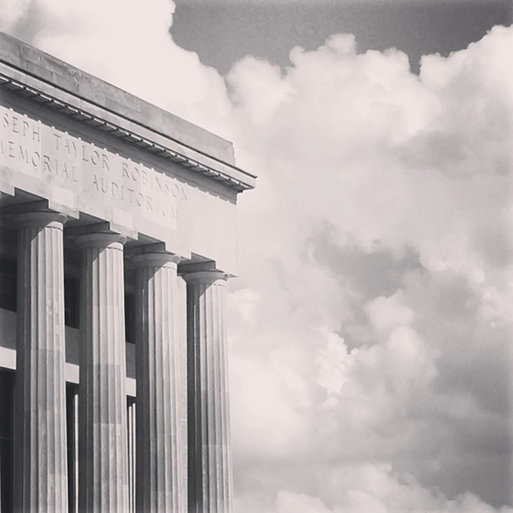
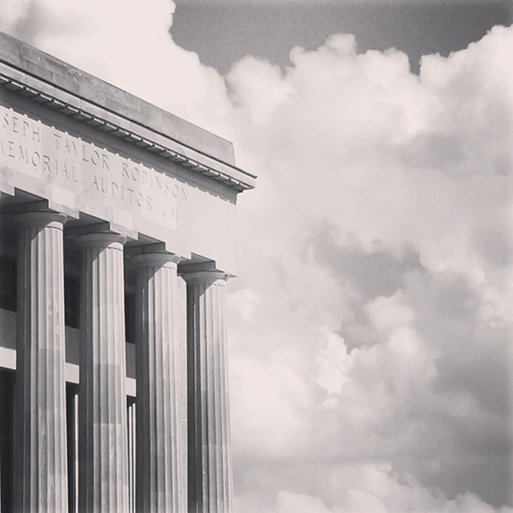
10.+citylittlerock-2On January 25, 1940, the City of Little Rock officially took complete possession of the Joseph Taylor Robinson Memorial Auditorium. By assuming custody of the structure from the contractor and the PWA, the City accepted responsibility for any of the remaining work to be completed.

E. E. Beaumont, the Auditorium Commission chairman stated that an opening date could not be set until more work was completed. A major unfinished task was the laying of the front sidewalk which had been delayed due to cold weather.

The night before Little Rock took possession, Robinson Auditorium had been a topic of discussion at the Little Rock Chamber of Commerce annual meeting. The new Chamber president Reeves E. Ritchie (who as an Arkansas Power & Light executive had been engaged in the lengthy discussions about the installation of the steam line and transformers of the building) pledged that the Chamber would work to bring more and larger conventions to Little Rock at the Joseph Taylor Robinson Memorial Auditorium.

Little Rock Look Back: Webb Hubbell, Little Rock’s 64th Mayor

https://i0.wp.com/www.webbhubbell.com/wp-content/uploads/2009/12/Webb_0951-240x155.jpgOn January 18, 1948, future Little Rock Mayor Webster “Webb” Hubbell was born. After playing football in high school, he played for the University of Arkansas Razorbacks.  He also received his law degree from the U of A.

At the age of 30, already a successful attorney, Hubbell was appointed to the Little Rock City Board of Directors to fill a vacancy in September 1978.  In 1980, he was elected to a four year term on the City Board.

In June 1979, there was a vacancy in the office of Mayor of Little Rock.  Hubbell was selected by his fellow City Directors to serve as Mayor until December 1980.  In January 1981, he was selected to serve another term as Mayor.  In June 1981, he stepped down as Mayor but continued to serve on the City Board of Directors.

In 1984, Hubbell was appointed to serve as Chief Justice of the Arkansas Supreme Court to finish out the term of Richard B. Adkisson.  Following his service on the court, he returned to the practice of law at the Rose Law Firm.  He later served as the Associate Attorney General in the Justice Department during the Clinton administration.

Hubbell resigned from the Justice Department due to an investigation of his billing practices at the Rose Law Firm, which stemmed from the Whitewater investigation.  Following conviction, he served time in prison.  Since his release he has been an author and management consultant.  His novel, When Men Betray, will be published by Beaufort Books in May 2014.

Little Rock Look Back: First Little Rock Council Meeting in 1832

TowncouncilplaqueOn January 16, 1832, Mayor Matthew Cunningham MD presided over Little Rock’s first council meeting. Since Little Rock did not yet have a government hall, the Mayor and his wife hosted the meeting at their house. The Cunninghams owned the entire block which was bordered by what is now Main Street, 3rd Street, Louisiana Street and 4th Street.

A plaque at 3rd and Main Street commemorates this meeting and was placed there in the 1930s. The Cunningham’s house was likely closer to the southwest corner of the block. The plaque is on the Fulk building which contains Bennett’s Military Supply. The block also includes the Mann on Main project, which is comprised of the buildings originally constructed for the Gus Blass Department store.

Little Rock was chartered as a town in 1831 and elections were subsequently held. Dr. Cunningham outpolled Rev. W. W. Stevenson to become the first Mayor.

Joining Mayor Cunningham at the first meeting were the original four Town Council members – Charles Caldwell, Benjamin Clemens, David Holt and John McLain.

In 1931 a plaque, as part of Little Rock’s Centennial, a plaque was erected to note the first meeting. The plaque erroneously implies that the first meeting was in 1831. This mistake is understandable since the first election was in 1831. The plaque also refers to the body as the City Council. It was, in fact, the Town Council. There would not be a City Council until 1835 when Little Rock was elevated to City status.

Little Rock Look Back: Martin Borchert, Little Rock’s 57th Mayor

https://i0.wp.com/www.ruebelfuneralhome.com/photos/img238.jpgOn January 16, 1916, future Little Rock Mayor Martin Borchert was born in Stuttgart.  After graduating high school he moved to Little Rock.  He started work at ACME Brick and spent 21 years there before engaging in other business interests.  Among these businesses were Martin Borchert Co., ASCO Hardware, Dtection Systems Inc. and Component Systems Inc.  In 2005 he was inducted into the Arkansas Construction Hall of Fame.

Mayor Borchert was elected to the Little Rock City Board of Directors in 1964 and served from January 1965 through December 1968. He chose not to seek a second term.  In 1967 and 1968 he served as Mayor of Little Rock. During this time, he laid out the vision for what has become Riverfront Park along the Arkansas River.

Other civic achievements included being a member of the Board of the Little Rock Chamber of Commerce, being on the Governor’s Citizens Advisory Committee, a member of the Pulaski County Quorum Court, vice chairman of the Arkansas Planning Commission, and being on the Little Rock Air Force Base Community Council. In 1967 he served on the President’s National Advisory Council to the Small Business Administration. Mayor Borchert served on the Little Rock Water Commission, including a tenure as chairman. In 1985, he was chairman of the Metropolitan Transit Policy Board and as chairman oversaw the transfer of the Central Arkansas Transit system to the Central Arkansas Transit Authority. One of the achievements of which he was very proud of was that he was one of the very first in Arkansas to receive an Adopt the Highway road.

Mayor Borchert was married for 57 years to Rosemary “Biddy” Branch Borchert.  They had two children, a son, John “Topper” Borchert and a daughter, Leslie Borchert Wilson.  He died on May 11, 2007.

Little Rock Look Back: Basketball Comes to Robinson Auditorium

Entrance to Robinson off Garland Street. Used to attend basketball games.

Entrance to Robinson off Garland Street. Used to attend basketball games.

While Joseph Taylor Robinson Memorial Auditorium is known today as a performance and meeting venue, in its early days it was also the home to sports. Seventy-four years ago tonight the first basketball game was played at Robinson.

One of the first regular activities which took place in the lower level exhibition hall was a series of boxing and wrestling matches.  Building on the success of this, basketball came to the convention hall in January 1940.

A series of games featuring Little Rock High School and North Little Rock High School were announced by Coach Earl Quigley to take place from January 11 through February 16, the official opening day for the facility.

At that time, neither high school had a gymnasium; therefore both schools played their basketball games on their school auditorium stages with fans seated in the audience. The convention hall offered a regulation size floor (made of pecan block parquet) with seating for over 1,300 people along the sidelines and in the balcony.  The first men’s basketball game in Robinson Auditorium took place between the Little Rock High School Tigers and the North Little Rock High School Wildcats on January 11, 1940.

The Tigers lost the game before a crowd estimated to be 1,300.  Earlier in the evening there had been an exhibition between two women’s basketball teams.  The cost for admission to the games was 35 cents for the reserved seating and 25 cents for general admission.