
Little Rock Look Back: Arkansas Territory Authorized 


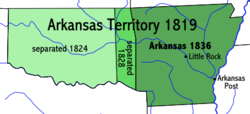
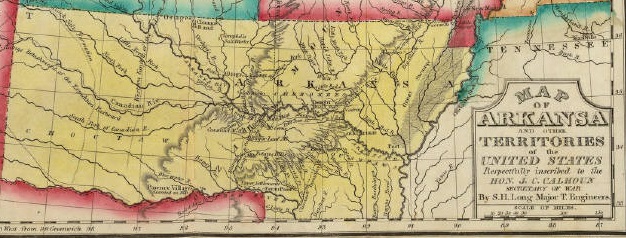
On March 2, 1819, the Arkansas Territory was authorized by an act of Congress, to take effect  on July 4, 1819.

The Arkansas Territory was created from the portion of the Missouri Territory. It originally encompassed all of what is now Arkansas and much of what is now Oklahoma. The westernmost portion of the territory was removed on November 15, 1824, a second westernmost portion was removed on May 6, 1828, reducing the territory to the extent of the present state of Arkansas.

The Territorial capital was Arkansas Post from July 1819 until June 1821. At that point in time it was moved to Little Rock. In 1819, there was no permanent settlement in Little Rock. It would my be until early 1820 that a permanent settlement would be established.  On 1818, the Quapaw Treaty had anticipated a future settlement in Little Rock. 
Little Rock Look Back: Little Rock becomes Capital of Arkansas

Arkansas TerritoryOn October 18, 1820, Territorial Governor James Miller signed legislation designating Little Rock as the new capital for Arkansas.  This was a mere 10 months after the first permanent settlement was established in Little Rock.

The Act provided that after June 1, 1821, the sessions of the Legislature and the Superior Court would be held at Little Rock.  This caused Arkansas Post, the first territorial capital, to fade from prominence.

The move was made based on the lobbying of Amos Wheeler, Chester Ashley and William Russell.  These men all owned land in the Little Rock area and would benefit from the move of the Capital to Little Rock. The official reason given was Little Rock’s geographical center to the Arkansas Territory and that it was elevated land less prone to flooding.

But as important, Messrs. Wheeler, Ashley and Russell promised to donate land for a capitol building and a guarantee of $20,000 for construction of a suitable building. (That would be the equivalent of $408,000 today.)

Around the time the legislation was approved, several members of the Territorial legislature purchased land around Little Rock.  When a subsequent effort to relocate the Capital upstream was launched, it failed due to the financial ties of these legislators to land in Little Rock.