Little Rock Look Back: FDR

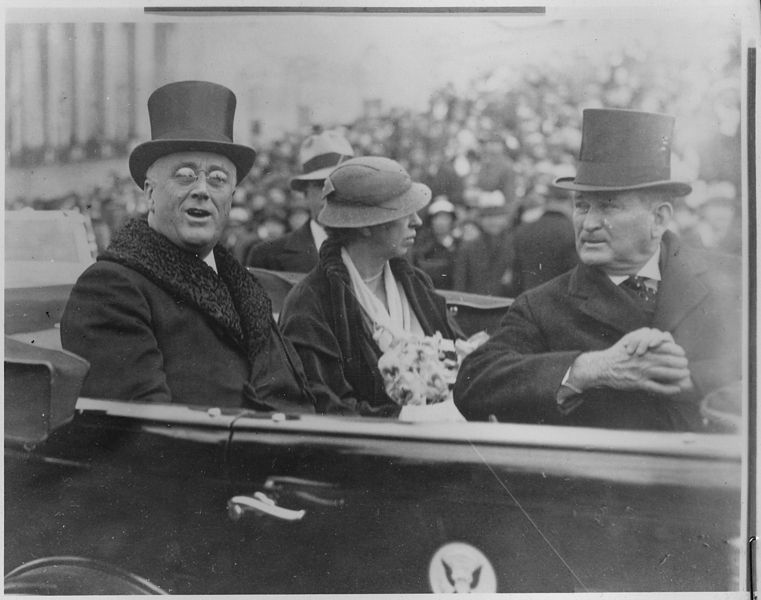
Gov. & Mrs. Roosevelt with Sen. Robinson en route to FDR taking oath as president.

Gov. & Mrs. Roosevelt with Sen. Robinson en route to FDR taking oath as president.

On January 30, 1882, future U.S. President Franklin Delano Roosevelt was born.  In 1936, he visited Little Rock as part of a statewide tour in conjunction with Arkansas’ Centennial celebration.  While in the state he spent time outside of Hot Springs at Couchwood, the vacation home of Arkansas Power & Light founder Harvey Couch, who was the chair of the Centennial activities.

In honor of President Roosevelt’s visit, a portion of Highway 365 in Little Rock was designated Roosevelt Road. He followed part of that road while in the Capital City before making a public appearance.

President Roosevelt’s address on June 10, recounted Arkansas’ territorial and statehood history. At the end he paid tribute to his Senator Joseph Taylor Robinson.  The Senator was a friend and confidant who often led the charge for FDR programs in congress.  Indeed, it would be New Deal programs which would allow for the construction of a municipal auditorium in Little Rock, which would be named in memory of Sen. Robinson after his death in the summer of 1937.  (As the Democratic leader of the Senate, it had been Robinson who accompanied FDR and Eleanor in the motorcade to the 1933 Presidential inauguration ceremony.)

FDR’s visit to Arkansas had political implications as well.  The late Senator Huey Long of neighboring Louisiana had been arguably FDR’s biggest adversary in Washington.  Long was very popular in rural areas of Arkansas and had campaigned for Hattie Caraway when she ran for re-election to the Senate, to the dismay of many of Arkansas’ Democratic establishment.  Harvey Couch had worked to bring about a detente between FDR and Long prior to the latter’s assassination in 1935.  But between a lingering mistrust of FDR by Long supporters and discontent from some sectors based on New Deal programs, it was important for FDR to shore up Democratic support in Arkansas.  At the time the state had nine electoral votes.

FDR would return to Central Arkansas in 1943 to review troops at the military facility named for Sen. Robinson.  That would be his final visit to Arkansas before his death in April 1945.
Little Rock Look Back: City Takes Possession of Robinson Auditorium

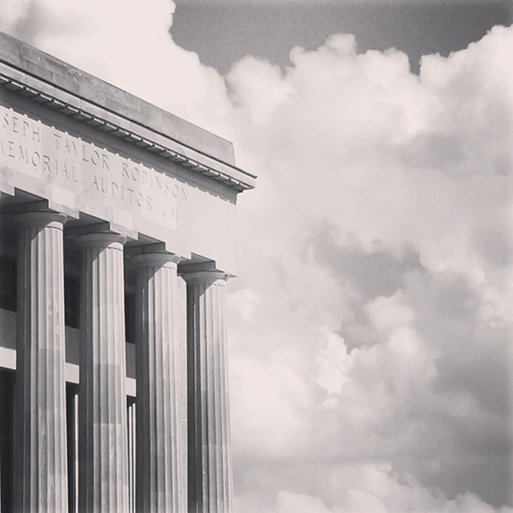
10.+citylittlerock-2On January 25, 1940, the City of Little Rock officially took complete possession of the Joseph Taylor Robinson Memorial Auditorium. By assuming custody of the structure from the contractor and the PWA, the City accepted responsibility for any of the remaining work to be completed.  This event happened one day shy of the third anniversary of the election which approved plans to issue bonds for an auditorium.

E. E. Beaumont, the Auditorium Commission chairman, stated that an opening date could not be set until more work was completed. A major unfinished task was the laying of the front sidewalk which had been delayed due to cold weather.

The night before Little Rock took possession, Robinson Auditorium had been a topic of discussion at the Little Rock Chamber of Commerce annual meeting. The new Chamber president Reeves E. Ritchie (who as an Arkansas Power & Light executive had been engaged in the lengthy discussions about the installation of the steam line and transformers of the building) pledged that the Chamber would work to bring more and larger conventions to Little Rock at the Joseph Taylor Robinson Memorial Auditorium.

Today, the building is once again a construction site as it is being renovated and repurposed to become a performing arts and event space for the 21st Century.

Little Rock Look Back: City Takes Possession of Robinson Auditorium

10.+citylittlerock-2On January 25, 1940, the City of Little Rock officially took complete possession of the Joseph Taylor Robinson Memorial Auditorium. By assuming custody of the structure from the contractor and the PWA, the City accepted responsibility for any of the remaining work to be completed.

E. E. Beaumont, the Auditorium Commission chairman stated that an opening date could not be set until more work was completed. A major unfinished task was the laying of the front sidewalk which had been delayed due to cold weather.

The night before Little Rock took possession, Robinson Auditorium had been a topic of discussion at the Little Rock Chamber of Commerce annual meeting. The new Chamber president Reeves E. Ritchie (who as an Arkansas Power & Light executive had been engaged in the lengthy discussions about the installation of the steam line and transformers of the building) pledged that the Chamber would work to bring more and larger conventions to Little Rock at the Joseph Taylor Robinson Memorial Auditorium.

May 28 Architeaser: AP&L Building

20130527-140356.jpg

The Arkansas Arts Center just opened an exhibit on Bauhaus architecture. Though Little Rock doesn’t have any strictly Bauhaus style buildings, there are a few buildings designed in the International Style which was related to Bauhaus.

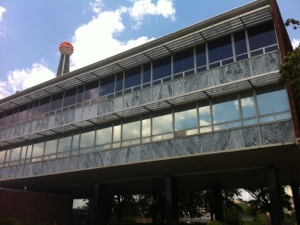
The Arkansas Power & Light Building on Louisiana and 9th Streets was announced in 1953 and completed in 1959. The design was by Fred Arnold of the Wittenberg Delony & Davidson firm. The reason for the delay was due to uncertainty regarding a rate case and labor contracts.

The four story building features a combination of glass, marble and brick. The second and third stories float over an open space as they extend eastward. In 2010, the marble panels on the second and third stories were replaced because of buckling. They were replaced with marble from the same quarry as the original marble.

The orb atop the building once bore the likeness of Reddy Kilowatt, a mascot used by AP&L as well as many other electric utilities in the post-World War II era. When AP&L changed its name to Entergy Arkansas (as part of the system-wide rebranding of various companies into Entergy), the orb was replaced with one which features a three-dimensional version of the Entergy logo.