Little Rock Look Back: Mayor Webb Hubbell

Mayor HubbellOn January 18, 1948, future Little Rock Mayor Webster “Webb” Hubbell was born. After playing football in high school, he played for the University of Arkansas Razorbacks.  He also received his law degree from the U of A.

At the age of 30, already a successful attorney, Hubbell was appointed to the Little Rock City Board of Directors to fill a vacancy in September 1978.  In 1980, he was elected to a four year term on the City Board.

In June 1979, there was a vacancy in the office of Mayor of Little Rock.  Hubbell was selected by his fellow City Directors to serve as Mayor until December 1980.  In January 1981, he was selected to serve another term as Mayor.  In June 1981, he stepped down as Mayor but continued to serve on the City Board of Directors.

In 1984, Hubbell was appointed to serve as Chief Justice of the Arkansas Supreme Court to finish out the term of Richard B. Adkisson.  Following his service on the court, he returned to the practice of law at the Rose Law Firm.  He later served as the Associate Attorney General in the Justice Department during the Clinton administration.

Hubbell resigned from the Justice Department due to an investigation related to Whitewater.  He has been an author and management consultant.  His novel, When Men Betray, was published by Beaufort Books in May 2014.  His next novel Ginger Snaps was released in May 2015.  A Game of Inches, another mystery novel, will be released in 2016.

PIGSKIN TURKEY DAY IN THE ROCK, Part 1 – The Beginning and the End

Turkey Day Header101 years ago, Little Rock High School (then located on Scott Street) kicked off a 69-year tradition of playing football on Thanksgiving Day.  (Though the date of Thanksgiving floats anywhere from the 22nd to the 28th, as with this year, Thanksgiving Day 1914 was on November 26.)

From 1914 until 1933, the Little Rock High School Tigers played a variety of different schools.  Then from 1934 until 1957, they played North Little Rock. From 1958 until 1982, the Little Rock Central Tigers took on the Warriors of Little Rock Hall.

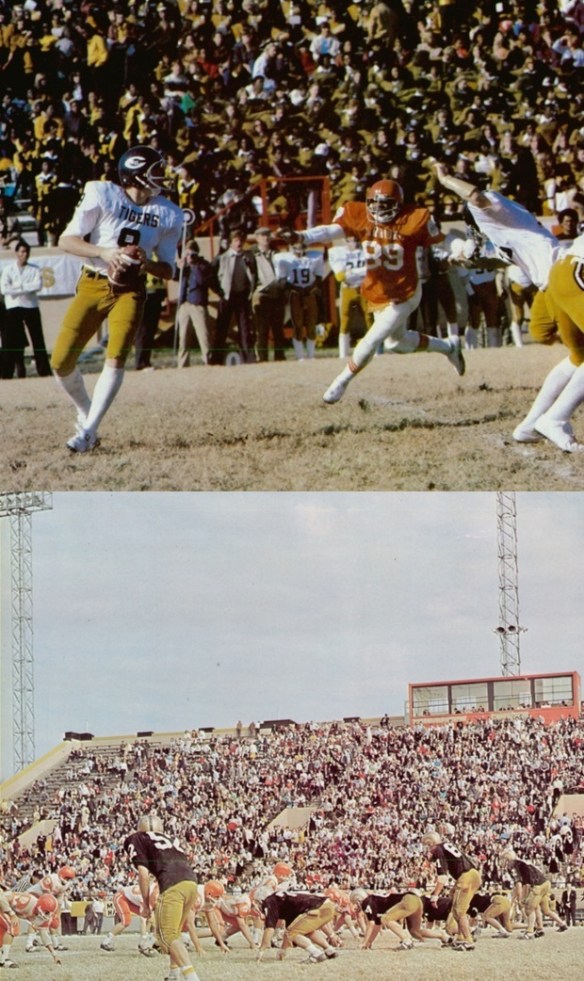
Thanksgiving Day football was a tradition not just for high schools in Little Rock but also all levels throughout the state and country.  The Friday after Thanksgiving, newspapers carried stories and scores for professional, college and high school football.  It was probably the only day of the year to see all three levels of football covered in the paper, and often high school games received the most ink.  This mix of football continued for decades.  In 1969, there were four football games played in Pulaski County on Thanksgiving Day: Little Rock Hall vs. Little Rock Central, Little Rock Catholic vs. North Little Rock, Horace Mann vs. Scipio Jones, and the Arkansas Razorbacks vs. Texas Tech.

By the 1970s, both high school and college football games on Thanksgiving were on the wane.  While college games on Turkey Day have regained some popularity, they are nowhere near approaching the level they once had.  High school football on Thanksgiving disappeared in Arkansas following the 1982 game between Hall and Central.  That rivalry had been the final series on Turkey Day to still be played.

While they lasted, Thanksgiving Day high school football games were civic focal points. They were about bragging rights.  For students who had grown up attending the games, the chance to play or cheer in a Turkey Day classic was a rite of passage.  Alumni home from college or visiting the family for Thanksgiving would descend on the stadium ensuring the largest attendance of the season.

High school football on Thanksgiving Day in Little Rock tells the tale of not just football; it reflects changes in the city and society.  What started out as two small high schools from neighboring cities changed as both schools grew. The addition of a second Little Rock high school reflected the city’s growth.  (Indeed the 1954 Little Rock High School yearbook, in discussing the school’s new designation as Central High, mentions vaguely that the second high school would be built at some yet to be determined location in “west” Little Rock.)

The presence of segregated high schools in separate but unequal football rivalries (lasting nearly two decades after the Supreme Court’s Brown v. Board decision) is an indictment of an unjust parallel education system.  As Little Rock continued to grow and diversify, the two high schools playing on Thanksgiving were no longer always the predominant schools in football – or other activities.  With state championships once again on the line, the last few years of the Hall and Central Thanksgiving rivalry were, in a way, a return to the halcyon days of the early faceoffs (though this time, thankfully, with fully integrated teams). In addition to trading the top spots in football, the two schools were piling accolades. In fact, all three Little Rock public high schools had achieved a stasis that inadvertently rotated areas of excellence academically, athletically and artistically fairly equally among the three.

There were undercurrents at work that hinted at future instabilities to come.  Indeed by 1982, the same year of the final game, Little Rock had filed suit against the North Little Rock and the Pulaski County Special School Districts claiming the schools in those neighboring districts were siphoning off white students from the Little Rock schools. The ensuing realignment of schools and districts would probably have brought an end to Central vs. Hall games even if athletic reclassification had not.

Central is now over twice the size of Hall, Parkview is a magnet school, two formerly county high schools (and several elementary schools and junior highs) were brought into the LR school district in the late 1980s.  Where once the Little Rock high schools were roughly equal in enrollment, they now are so varied they play in three different classifications.

It is up to the alternative historians to envision what continued Turkey Day classics would have looked like after 1982. Little Rock has grown and diversified. There are five public high schools and five private high schools playing football within the Little Rock city limits each season. With all these competing interests it is unlikely to envision the same citywide level of interest in one football game.

But back in the day…

Little Rock Look Back: There She Is – Miss America at a LR Razorback Game

miss america axumTonight a new Miss America will be crowned.  This ceremony marks the 52nd anniversary since Miss America 1964, Arkansan Donna Axum, was crowned.

A native of El Dorado and a student at the University of Arkansas, during her reign as Miss America Miss Axum (or simply Donna as the newspaper headlines referred to her) made four public visits to Little Rock.  As the first Miss Arkansas to become Miss America, the state’s Capitol City was very interested in giving her a warm welcome.

After being crowned on September 7, 1963, her first visit to Arkansas was November 1 through 3.  In addition to stops in Hot Springs and El Dorado, she appeared in Little Rock to attend events including an Arkansas Razorback football game at War Memorial Stadium.  Her entourage included the top four runners up from the Miss America pageant.

In February 1964, she made a brief appearance in Little Rock which included a press conference.

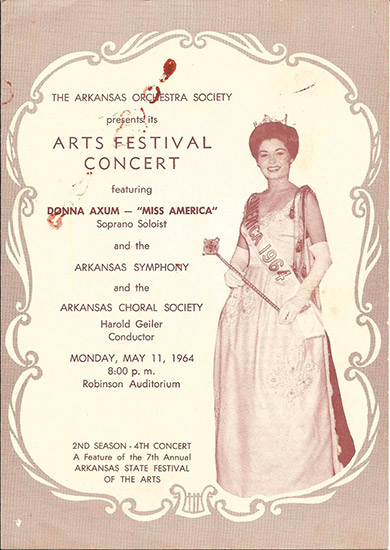
Donna Axum spent nearly two weeks in Arkansas in May 1964 attending several pageants as well as spending time with family.  During that visit she appeared in Little Rock twice.  The second time she headlined a concert with the Arkansas Symphony (not related to the current Arkansas Symphony Orchestra) and the Arkansas Choral Society. It took place at Robinson Auditorium.

LR Look Back: Webb Hubbell, Little Rock 64th Mayor

Mayor HubbellOn January 18, 1948, future Little Rock Mayor Webster “Webb” Hubbell was born. After playing football in high school, he played for the University of Arkansas Razorbacks.  He also received his law degree from the U of A.

At the age of 30, already a successful attorney, Hubbell was appointed to the Little Rock City Board of Directors to fill a vacancy in September 1978.  In 1980, he was elected to a four year term on the City Board.

In June 1979, there was a vacancy in the office of Mayor of Little Rock.  Hubbell was selected by his fellow City Directors to serve as Mayor until December 1980.  In January 1981, he was selected to serve another term as Mayor.  In June 1981, he stepped down as Mayor but continued to serve on the City Board of Directors.

In 1984, Hubbell was appointed to serve as Chief Justice of the Arkansas Supreme Court to finish out the term of Richard B. Adkisson.  Following his service on the court, he returned to the practice of law at the Rose Law Firm.  He later served as the Associate Attorney General in the Justice Department during the Clinton administration.

Hubbell resigned from the Justice Department due to an investigation related to Whitewater.  Following conviction and serving time in prison, he has been an author and management consultant.  His novel, When Men Betray, was published by Beaufort Books in May 2014.  This coming May, his next novel Ginger Snaps will be released.

Little Rock Look Back: Miss America 1964 comes to Little Rock

Photo from Encyclopedia of Arkansas, courtesy of Mike Polston

Photo from Encyclopedia of Arkansas, courtesy of Mike Polston

Tonight a new Miss America will be crowned.  This ceremony marks the 50th anniversary since Miss America 1964, Arkansan Donna Axum, ended her reign.

A native of El Dorado and a student at the University of Arkansas, during her reign as Miss America Miss Axum (or simply Donna as the newspaper headlines referred to her) made four public visits to Little Rock.  As the first Miss Arkansas to become Miss America, the state’s Capitol City was very interested in giving her a warm welcome.

After being crowned on September 7, 1963, her first visit to Arkansas was November 1 through 3.  In addition to stops in Hot Springs and El Dorado, she appeared in Little Rock to attend events including an Arkansas Razorback football game at War Memorial Stadium.  Her entourage included the top four runners up from the Miss America pageant.

In February 1964, she made a brief appearance in Little Rock which included a press conference.

Donna Axum spent nearly two weeks in Arkansas in May 1964 attending several pageants as well as spending time with family.  During that visit she appeared in Little Rock twice.  The second time she headlined a concert with the Arkansas Symphony (not related to the current Arkansas Symphony Orchestra) and the Arkansas Choral Society. It took place at Robinson Auditorium.

Little Rock Look Back: Webb Hubbell, Little Rock’s 64th Mayor

https://i0.wp.com/www.webbhubbell.com/wp-content/uploads/2009/12/Webb_0951-240x155.jpgOn January 18, 1948, future Little Rock Mayor Webster “Webb” Hubbell was born. After playing football in high school, he played for the University of Arkansas Razorbacks.  He also received his law degree from the U of A.
At the age of 30, already a successful attorney, Hubbell was appointed to the Little Rock City Board of Directors to fill a vacancy in September 1978.  In 1980, he was elected to a four year term on the City Board.

In June 1979, there was a vacancy in the office of Mayor of Little Rock.  Hubbell was selected by his fellow City Directors to serve as Mayor until December 1980.  In January 1981, he was selected to serve another term as Mayor.  In June 1981, he stepped down as Mayor but continued to serve on the City Board of Directors.

In 1984, Hubbell was appointed to serve as Chief Justice of the Arkansas Supreme Court to finish out the term of Richard B. Adkisson.  Following his service on the court, he returned to the practice of law at the Rose Law Firm.  He later served as the Associate Attorney General in the Justice Department during the Clinton administration.

Hubbell resigned from the Justice Department due to an investigation of his billing practices at the Rose Law Firm, which stemmed from the Whitewater investigation.  Following conviction, he served time in prison.  Since his release he has been an author and management consultant.  His novel, When Men Betray, will be published by Beaufort Books in May 2014.

Tailgate Party to celebrate VOICES OF THE RAZORBACKS book on Sept 5

bc-purvisFans aren’t the only ones who call the Hogs. Voices of the Razorbacks, which has just been released by Butler Center Books, traces the history of the Razorback broadcasters who many fans grew up hearing. Celebrate the launch of this book at a free book signing and tailgate party in the Main Library’s garden and Darragh Center, 100 Rock Street, at 5:30 p.m. on Thursday, September 5. Author Hoyt Purvis will speak and sign books, which will be available for purchase at the event. This event is free and open to the public. RSVP to kchagnon@cals.org or 918-3033.

Established more than sixty years ago, the Razorback broadcasting network was a pioneering effort in collegiate sports. With announcers such as Bud Campbell and Paul Eells at the microphone, it has become an enduring feature of life in Arkansas. The Razorback network, from its modest beginning to its growth into a major force in sports broadcasting, is the basis of Voices of the Razorbacks.

The Razorback broadcasting network helped build interest in the Razorbacks and a loyal following for them as well as forged strong links among Razorback fans and the broadcasters who became “voices” of the Razorbacks. A sense of kinship developed within the audience, and the broadcasts of Razorback sports became an essential part of the state’s culture.

Although an announcer today may say, This is the Razorback Sports Network from IMG College,” the Arkansas broadcast network is a direct descendant of the Razorback network Bob Cheyne assembled in the early 1950s at the direction of Athletic Director John Barnhill. There had been earlier broadcasts of Razorback sports, including games announced by Bob Fulton in the 1940s, but the Razorback network Cheyne developed help turn broadcasters into cultural icons.

Voices of the Razorbacks traces the history of the broadcasters and the memorable events and highlights over the decades, and it features interviews with many of the key figures in that history. It is hard to find anyone in Arkansas, or Razorback fans anywhere, without special memories of listening to or watching broadcasts of Razorback games. Voices of the Razorbacks brings all those memories back.

Co-author Hoyt Purvis has taught journalism, international relations, and political science at the University of Arkansas (UA) since 1982. He established the first sports journalism course at UA and taught it for twenty-five years. Co-author Stanley Sharp of Booneville, Arkansas, has followed Razorback sports all his life and has a master’s degree in journalism from UA.

Voices of the Razorbacks is available from River Market Books & Gifts, 120 River Market Ave., and from the University of Arkansas Press, Butler Center Books’ distributor. Butler Center Books is a division of the Butler Center for Arkansas Studies, a department of the Central Arkansas Library System (CALS). The Butler Center’s research collections, art galleries, and offices are located in the Arkansas Studies Institute building at 401 President Clinton Ave. on the campus of the CALS Main Library. For more information, contact Rod Lorenzen at (501) 320-5716 or rlorenzen@cals.org.