
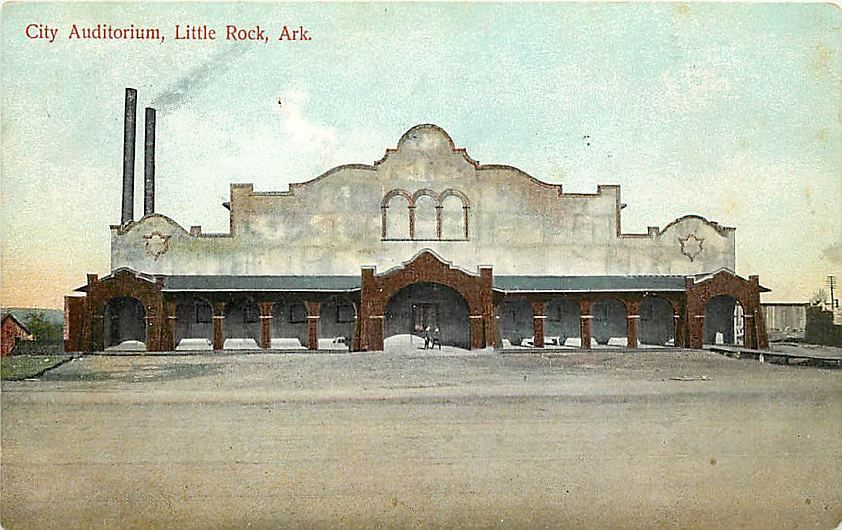
 On August 20, 1906, the Little Rock City Council approved plans for the City’s first municipal auditorium.
A week earlier, businessman A. C. Read petitioned the City for the right to construct a skating rink. The matter was referred to the Street & Fire Committee, the Superintendent of Public Works and Aldermen Louis Volmer and Benjamin S. Thalheimer, who represented the Sixth Ward, in which the structure would be located.
Neither the Gazette nor the Democrat carried a mention of this petition in their coverage of that meeting. By the next Council meeting a week later, the committee had reported back with a recommendation for approval. Resolution 288 was adopted giving Mr. Read the right to build the skating rink. Interestingly, the resolution did not contain the words “skating rink” though the original petition had. Instead it permitted Mr. Read to construct a building “suitable for purposes as defined” by the City. The resolution also stated that within three years the building would become property of the City.
Based on photos and postcards, the exterior of the building appears to have been covered in stucco. It was said to be modeled after San Antonio’s Alamo, but what that really meant was that it was in the Spanish Revival style. It was shorter and had more entrances than the Texas building did. The Markham Street façade featured faux windows and a front portico which extended the length of the building only interrupted by three entrance archways. The center one was taller and wider than the eastern and western entrances. All three, which projected southward from the building, mimicked the outline of the auditorium building.
The building was located on the western half of the City Hall property (and was constructed before City Hall). In 1912, the new Little Rock Central Fire Station (now the City Hall West Wing) was built between the auditorium and Markham Street. The auditorium stood until 1920. During that time it was used as a roller rink, opera house, rifle range, National Guard armory, convention hall, and gymnasium.
 Little Rock Culture Vulture