
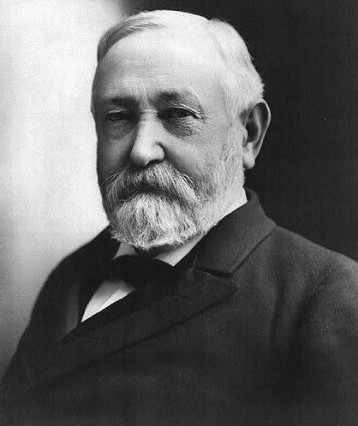
Little Rock Look Back: President Benjamin Harrison becomes first sitting president to visit LR

Benjamin-Harrison-by-Joseph-Gray-Kitchell-1897-358x426On April 17, 1891, Benjamin Harrison became the first sitting president to visit Arkansas.  He was on a cross-country railroad trip having left DC on April 13.

The morning of the 17th he spoke in Memphis and then took the train to Little Rock.  Accompanying him from Memphis to Little Rock were a delegation which included Governor and Mrs. James P. Eagle, Mayor H. L. Fletcher and Col. Logan H. Roots.  Also in the party was Mrs. W. G. Whipple, a former first lady of Little Rock.

They arrived in Little Rock in the afternoon.  A parade took them from the train station to the State House (now the Old State House Museum) where the Governor formally welcomed the President and his party.

In his brief remarks, President Harrison spoke of the hospitality and the natural resources available in Arkansas.  He also touched on the Civil War, which at the time was less than 30 years in the past. He noted “The commonwealth rests upon the free suffrage of its citizens and their devotion to the Constitution and the flag is the bulwark of its life.  We have agreed, I am sure, that we will do no more fighting among ourselves.” These remarks were met enthusiastically by the crowd assembled.

The President concluded is brief remarks thanking the State officials and the citizenry.  He then took the train to Texarkana where he made his third remarks of the day.

Benjamin Harrison was on the Presidential ticket two times. The first time he lost the popular vote but won the Electoral College defeating incumbent Grover Cleveland. The second time he lost both the popular and electoral votes to Cleveland.  He did not carry Arkansas in either election. Though he was the first sitting president to visit Little Rock, there is nothing here named for him.  Since there was already a Harrison Street named after his grandfather, he is skipped between Cleveland and McKinley in the presidential streets.

Little Rock Look Back: President William Henry Harrison

A campaign ribbon from an 1840 Harrison and Tyler rally in Little Rock.

A campaign ribbon from an 1840 Harrison and Tyler rally in Little Rock.

On February 9, 1773, future US President William Henry Harrison was born in Virginia. Though he would later be viewed as a frontiersman (which he was), his early years were spent on a family estate as part of one of the FFV’s (First Families of Virginia).

At the age of 18, he was commissioned in the US Army and began an illustrious military career which spanned the Northwest Indian War and the War of 1812. This career took him into the wilderness areas of the US, which at the time were Indiana and Ohio.

Harrison launched his political career in 1798 when he was appointed treasurer of the Northwest Territory. The next year, he was elected to represent the territory in Congress. In 1801, he was named Governor of the Indiana Territory.  In 1811, while still Governor of Indiana, he led troops to defend against a Shawnee attack in the Battle of Tippecanoe.  The following year, with the outbreak of the War of 1812, he continued to command armies in the northwest areas of the US.  In 1813, he scored a major victory at the Battle of the Thames in Canada.  This solidified him as a war hero with the public.

In 1814, he was appointed by President Monroe to oversee negotiations with Indians. In 1816, he was elected to Congress from Ohio and served until 1819. In 1824, he was elected as a US Senator from Ohio and served until 1828. He was sent as minister to Columbia in 1828 and served until the Presidency of Andrew Jackson in 1829.

220px-William_Henry_Harrison_daguerreotype_editReturning to private life, he ran for President as a Whig in 1836. At the time, the Whigs ran several candidates hoping to split the vote and send the election to Congress. Harrison narrowly lost Pennsylvania and its 30 electoral votes. (Though since the Democrats retained Congress in the election, it was expected that Van Buren still would have won.)  Four years later the Whigs coalesced behind Harrison.

Though his opponents tried to paint him as old, out of touch, and backwoods, he and running mate John Tyler (also a landed gentry from Virginia) embraced the depiction. They felt it helped them relate to the average voters and, in turn, painted Van Buren as out of touch and elitist.  Though Arkansas’ electoral votes went to Van Buren, Harrison ran fairly strong in the state. He narrowly captured Pulaski County and ran strong in the southeast portion of the state.

Harrison served in office only one month.  While at the time it was believed to be related to the weather at his inaugural (and his record-long inaugural address), subsequent analysis has shown it to be due to entric fever, the result of a bacterial infection.

Harrison Street in Little Rock is named for him. His grandson, Benjamin, the only grandson of a President to serve also serve as President, is skipped in the row of Presidential streets.

Little Rock Look Back: TR in LR

TheodoreRooseveltOn October 25, 1905, President Teddy Roosevelt, recently elected to a four year term in his own right, made an appearance in Little Rock.

He was greeted at the train station by Governor Jeff Davis and was the guest of honor in a parade up Main Street to City Park (now MacArthur Park) in where a public meeting was held featuring remarks by the President.  During this remarks, speaking to a largely Democratic crowd, the Republican Roosevelt noted: “The candidate is the candidate of a party; but if the president is worth his salt he is the president of the whole people.”

According to media reports at the time, Main Street from Markham to Tenth was a solid mass of cheering spectators for the parade.  This was the first time a sitting President had spent time in Little Rock away from a train station. The only other incumbent President to visit had been Benjamin Harrison.

He would make three more visits to Arkansas.  In 1910, he spoke at the Arkansas State Fair in Hot Springs.  In April and September 1912, he made several campaign stops in the state as he was running to reclaim the presidency, this time heading the Progressive (or Bull Moose) ticket.  Though Roosevelt’s successor, William Howard Taft, would visit briefly once in office and once after leaving office, it would not be until Roosevelt’s cousin Franklin Delano Roosevelt visited in 1936 that another sitting President spent much time in the state after TR’s 1905 visit.