
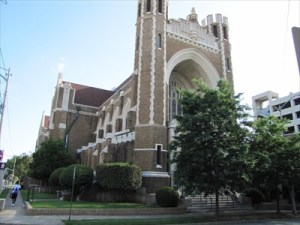
 This weekend, Little Rock’s First Presbyterian Church will celebrate 190 years.
The Sunday service will feature a Scottish Bagpiper, special music, and historical readings to recognize the church’s history. The message will be delivered by Reverend Stewart Smith, General Presbyter of the Presbytery of Arkansas.
The church was organized in July 1828. It is the oldest continuously serving Presbyterian church west of the Mississippi River. Not only that, it appears to be the oldest, continuously serving church of any denomination in Little Rock. It predated the establishment of Catholic (1830), Methodist (1833) and Episcopal (1839) churches in the city.
Little Rock’s first Presbyterian congregation was organized in July 1828. Reverend James Wilson Moore had been commissioned by the Northumberland Presbytery of Pennsylvania as a Presbyterian Missionary to the Territory of Arkansas.
Prior to the formal establishment of the church, Rev. Moore preached his first sermon in Little Rock on January 28, 1828. It took place in Jesse Brown’s schoolhouse (Little Rock’s first school) which was at the foot of Rock Street.
When the church was established, it had seven members: two men and five women. From 1828 until 1833, it met in a variety of temporary locations.
The congregation’s first permanent structure was at the southeast corner of Second and Main (where the Main Street Parking Deck is sited). In 1853, it moved to land on Markham between Cumberland and Rock. Following an 1866 fire which destroyed the church and several other buildings, the church made plans to move. In 1869, the congregation moved to three lots at the northwest corner of Capitol Avenue and Scott Streets. This brick sanctuary with a steeple was the first church built in Little Rock after the Civil War.
By 1909, the church was outgrowing the building. There was discussion as to whether the building should be expanded or a new building built elsewhere. Due to the increase in the property value in the existing site, the decision was made to move. In 1913, property at the southwest corner of 8th and Scott Streets was purchased. Construction began first on an education building (with a temporary auditorium). That building opened in 1914.
In May 1920, ground was broken for a new sanctuary building; the cornerstone was laid on November 7, 1920. The first worship service in the sanctuary took place on October 2, 1921.
A disastrous four-alarm fire gutted the sanctuary in May 1958, causing thousands of dollars damage of the chancel and the organ. The sanctuary was restored for worship services within nine months.
A Sesquicentennial Anniversary celebration marking the 150 years of First Presbyterian Church history was held in the summer of 1978. Governor David Pryor (Governor of Arkansas and shortly U. S. Senator-elect) was principal speaker at worship services.
The building was listed on the National Register of Historic Places in 1986.


 Little Rock Culture Vulture