
Little Rock Look Back: Arkansas Territory Established

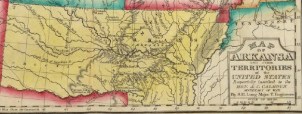
Arkansas TerritoryOn March 2, 1819, the Arkansas Territory was authorized by an act of Congress, to take effect  on July 4, 1819.

The Arkansas Territory was created from the portion of the Missouri Territory. It originally encompassed all of what is now Arkansas and much of what is now Oklahoma. The westernmost portion of the territory was removed on November 15, 1824, a second westernmost portion was removed on May 6, 1828, reducing the territory to the extent of the present state of Arkansas.

The Territorial capital was Arkansas Post from July 1819 until June 1821. At that point in time it was moved to Little Rock. In 1819, there was no permanent settlement in Little Rock. It would not be until early February 1820 that a permanent settlement would be established.  On 1818, the Quapaw Treaty had anticipated a future settlement in Little Rock.

Little Rock Look Back: Creation of the Arkansas Territory

Arkansas TerritoryOn March 2, 1819, the Arkansas Territory was authorized by an act of Congress, to take effect  on July 4, 1819.

The Arkansas Territory was created from the portion of the Missouri Territory. It originally encompassed all of what is now Arkansas and much of what is now Oklahoma. The westernmost portion of the territory was removed on November 15, 1824, a second westernmost portion was removed on May 6, 1828, reducing the territory to the extent of the present state of Arkansas.

The Territorial capital was Arkansas Post from July 1819 until June 1821. At that point in time it was moved to Little Rock. In 1819, there was no permanent settlement in Little Rock. It would my be until early 1820 that a permanent settlement would be established.  On 1818, the Quapaw Treaty had anticipated a future settlement in Little Rock.

“The Partisan Divide: Congress in Crisis” with Reps. Martin Frost & Tom Davis today at the Clinton School at noon


Today at noon at the Clinton School, former Congressmen Martin Frost and Tom Davis will discuss their book The Partisan Divide: Congress on Crisis.

While the authors, Martin Frost and Tom Davis, share many common viewpoints, they come from opposite sides of the political spectrum. 

Tom Davis served in Congress from 1994 to 2008 representing Virginia’s 11th district. During that time, he chaired the National Republican Congressional Committee for two cycles (2000 and 2002), and was chairman of the House Committee on Government Reform and Oversight before retiring, as he likes to say, “undefeated and unindicted” in 2008. 

Martin Frost represented the Dallas–Ft. Worth area of North Texas in Congress for 26 years, serving four years as chairman of the Democratic Congressional Campaign Committee and four years as chair of the House Democratic Caucus. 

According to Frost and Davis, Congress is incapable of reforming itself without a good kick in the seat from the American public. They dissect the causes of legislative gridlock and offer a common sense, bipartisan plan for making our Congress function again. 

The preface by Pulitzer Prize finalist David Eisenhower, grandson of President Dwight D. Eisenhower, sets the stage for this powerful behind-the-scenes narrative that uncovers the road to the present political gridlock and then offers thought-provoking insights and possibilities for the way out.

Former Congressman discusses state of Congress tonight at Clinton School

220px-Tom_Allen_110th_Congressional_portraitWith government shutdown, debt ceiling limit, continuing resolutions and other congressional contentions becoming hot topics for the general public, the Clinton School is featuring a speaker tonight at 6pm who has been in the halls of Congress.  This evening Congressman Tom Allen speaks about his book Dangerous Convictions: What’s Really Wrong with the U.S. Congress.

In his book “Dangerous Convictions,” former Congressman Tom Allen argues that what’s really wrong with the U.S. Congress is the widening, hardening gap in world-views that leaves the two parties unable to understand how the other thinks about what people should do on their own and what they are able to do together.

Allen represented Maine’s 1st congressional district from 1997 to 2009.  He was first elected by defeating incumbent James Longley Jr.  In 2008, he challenged incumbent Senator Susan Collins and was defeated.  Since then he has served as president and CEO of the Association of American Publishers.

Prior to serving in congress he had been a member of the Portland City Council, served as Mayor of Portland and ran for Governor of Maine.

The program will take place at Sturgis Hall.

*Reserve your seats for both programs by emailing publicprograms@clintonschool.uasys.edu or calling 501-683-5239.