
Heritage Month – Fones House

FonesThe Fones House, located at 902 West Second, has two areas of significance.  Architecturally, the house is a leading example of the Victorian Italianate style, which is rare in Little Rock.  Secondly, the builder, Daniel G. Fones, was a leading Little Rock businessman.

The two and one-half storey Fones House is constructed of red brick.  The exterior features a bracketed frieze topped by a steep gabled roof with wrought iron cresting, decorative window heads in several different styles and ornately railed balconies.

Daniel Gilbert Fones was born in Decatur, Georgia, on August 19, 1837, the eldest son of Alvan T. and Adelia A. Cone Fones.  Though raised in relatively luxurious surroundings, after his father’s death he was apprenticed as a tinsmith at the age of 15.  In 1855, he came to Pine Bluff, and in 1859, moved to Little Rock.  That year, he formed the Fones Brothers’ partnership which would eventually became known as Fones Brothers’ Hardware and existed until 1987.

At the outbreak of the Civil War, Fones enlisted in the Confederate Army; after the war he returned to Little Rock.  He remained a civic leader throughout the rest of his life.  The Fones House was constructed in 1878 for Fones and his wife.

Fones was president of the Fones Brothers’ Hardware Company, President of the Arkansas Building and Loan Association, Vice President of the Equitable Building and Loan Association, President of the German National Bank and was associated with many other financial enterprises.  He served as an alderman in Little Rock and in 1916 was elected to the Little Rock School Board.

Fones married Texanna Dustan Reaves on May 30, 1867, who died in 1893.  In 1899 he was married to Mrs. James Hennegan Tucker.  Fones, who had no descendants, died May 28, 1916.

The Fones House was added to the National Register of Historic Places on August 19, 1975.
Sculpture Vulture: Mount Holly Cameos

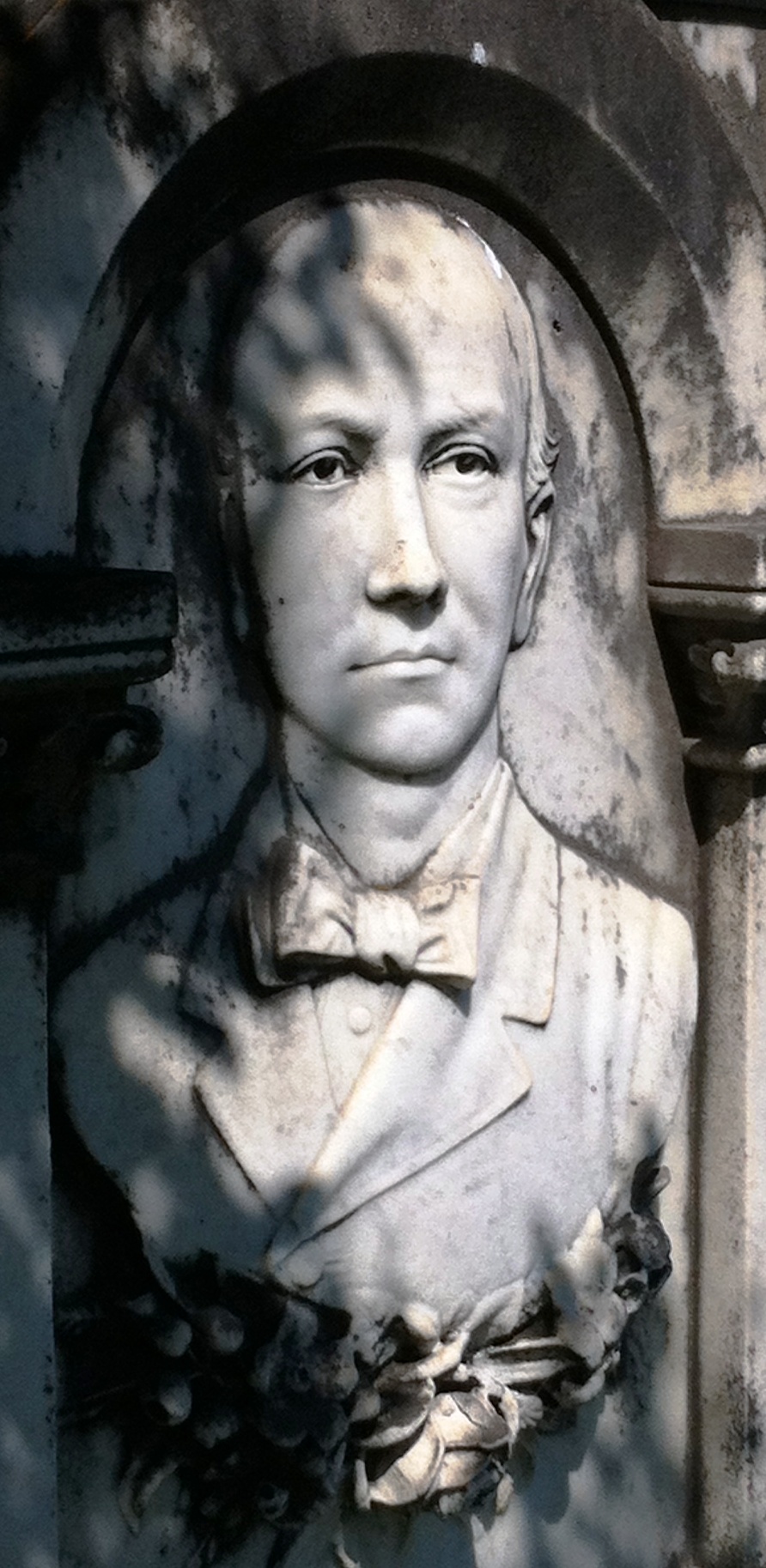
Today’s Sculpture Vulture returns to Mt. Holly Cemetery.  There are quite a few sculptures of angels and religious figures throughout the cemetery.   There are a few very unique sculptural ornamentations in the cemetery. These are carvings to represent the faces of the deceased which are mounted on grave markers.  Though this does not purport to be an exhaustive list of the carvings, it does showcase the ones the Culture Vulture noticed on a recent visit to Mt. Holly.

Hornibrook

James H. Hornibrook was born on July 8, 1840 and died on May 24, 1890.  He came to Little Rock from Toronto following the Civil War and ran a very successful saloon business.  He died of an “apoplectic stroke” just shy of his 50th birthday.  His house is now the Empress of Little Rock Bed & Breakfast located near the Governor’s Mansion.   He had feared his death and had commissioned a death mask to be made.

Johnson

Sydney J. Johnson was born February 12, 1866 and died on March 17, 1899.  He was a banker, Little Rock City Treasurer, and Pulaski County Deputy Circuit Clerk. He died from complications of a broken leg, an injury sustained while sledding.

Fones

Daniel Gilbert Fones was born on August 19, 1837 and died on May 28, 1912.  He was a hardware merchant who served as president of the German National Bank, the Arkansas Building & Loan Association, and the Equitable Building & Loan Association.  He served on the Little Rock School Board from 1883 to 1893.  Together with his brother James, he founded the Fones Brothers Hardware Company.  The final location of their warehouse, 100 Rock Street, opened in 1921. In 1997, after extensive renovation and repurposing the building reopened as the main branch of the Central Arkansas Library System.

LeFevre

Leon LeFevre was a farmer who owned a great deal of land north of the Arkansas River. He was born on April 19, 1808 and died on February 26, 1892. The house that he built in 1842 existed in what later became North Little Rock until 1966.  He was born on his family’s property prior to the establishment of Little Rock over a decade later. As Little Rock became formalized and grew to include both sides of the Arkansas River, he became a civic leader.

Peyton

Dr. Craven Peyton was born on November 30, 1823 and died on November 7, 1872.  He was a physician in Little Rock.  During the Civil War, he held the rank of Colonel and was commander of the 13th Regiment, Arkansas Militia.  He was Kentucky native who moved to Little Rock after graduating from Medical School. During the Mexican War he was commissioned as a surgeon in the Arkansas Regiment of Volunteers. He was one of the founders of Arkansas’s Medical School.