
Rock the Oscars 2019: TRUE GRIT (both versions)

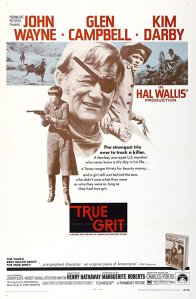
In 1969, Arkansan Charles Portis’ novel True Grit was made into a movie starring John Wayne and Arkansan Glen Campbell.  Kim Darby, Robert Duvall, Dennis Hopper, Jeff Corey and Strother Martin are also in the cast.

The movie was directed by Henry Hathaway, produced by Hal B. Wallis, and written by Marguerite Roberts.  Wilford Brimley and Jay Silverheels are uncredited actors in the movie.

Though set in Arkansas and Oklahoma, the movie was filmed in Colorado.  Elvis Presley was the first choice for the part Campbell would play. But when his manager demanded top billing (over Wayne), he was bypassed and the part went to Campbell.

The movie was nominated for two Oscars: Wayne for Best Actor and composer Elmer Bernstein and lyricist Don Black for the song “True Grit.”  The latter had been sung by Campbell in the movie.

Wayne won the Oscar that night, his only win.  He would reprise the character of Rooster Cogburn in the eponymously named sequel in 1975. This film, in which he co-starred with Katharine Hepburn, was his penultimate film.

In 1970, Campbell teamed up with Kim Darby again in a film written by Roberts based on a Portis book. This time it was Norwood.  It also starred Joe Namath, Carol Lynley, Meredith MacRae, and Dom DeLuise.  It did not repeat the success of the earlier Portis based movie.

In 2010, the Coen Brothers released a new version of Charles Portis’ True Grit.  Co-written and co-directed by Ethan and Joel Coen, it starred Jeff Bridges, Matt Damon, Hailee Steinfeld, Josh Brolin, Barry Pepper, Domhnall Gleeson and Elizabeth Marvel.  Unlike the original film, which was filmed in Colorado, this film was actually filmed partially in Arkansas, where  several scenes takes place.  Filming also took place in Texas.  Many Arkansas actors appeared in the film, but at the risk of omitting some, there will not be an attempt to name them.

The film received ten Oscar nominations: Best Picture, Adapted Screenplay, Directing, Leading Actor (Bridges), Supporting Actress (Steinfeld), Cinematography, Costume Design, Sound Mixing, Sound Editing, and Art Direction.  Sadly, the film went home empty handed.
Rock the Oscars, TRUE GRIT – Part 1

Fifty years ago, former Arkansas Gazette reporter Charles Portis wrote a novel entitled True Grit.  It is more than a work of literature, it is a work of art.  In April 2018, the Oxford American will be celebrating the 50th anniversary of the publication of the novel with a series of events.

In 1969, the movie was made into a movie starring John Wayne and Arkansan Glen Campbell.  Kim Darby, Robert Duvall, Dennis Hopper, Jeff Corey and Strother Martin are also in the cast.  The movie was directed by Henry Hathaway, produced by Hal B. Wallis, and written by Marguerite Roberts.  Wilford Brimley and Jay Silverheels are uncredited actors in the movie.

Though set in Arkansas and Oklahoma, the movie was filmed in Colorado.  Elvis Presley was the first choice for the part Campbell would play. But when his manager demanded top billing (over Wayne), he was bypassed and the part went to Campbell.

The movie was nominated for two Oscars: Wayne for Best Actor and composer Elmer Bernstein and lyricist Don Black for the song “True Grit.”  The latter had been sung by Campbell in the movie.

Wayne won the Oscar that night, his only win.  He would reprise the character of Rooster Cogburn in the eponymously named sequel in 1975. This film, in which he co-starred with Katharine Hepburn, was his penultimate film.

In 1970, Campbell teamed up with Kim Darby again in a film written by Roberts based on a Portis book. This time it was Norwood.  It also starred Joe Namath, Carol Lynley, Meredith MacRae, and Dom DeLuise.  It did not repeat the success of the earlier Portis based movie.

Back to School Cinema: TO SIR, WITH LOVE

tosirwithlove1967’s To Sir, With Love is a bit formulaic.  Following in the footsteps of Goodbye, Mr. Chips; The Corn Is Green; and Blackboard Jungle, it tells the tale of a teacher who seeks to educate “problem” students and show them a brighter future.

There are several reasons this movie succeeds.  One is Sidney Poitier. He is polished and understated exuding a genuine humanity without being beatifically noble.  The obvious wrinkle this movie presents to the formula is that the teacher is black, while the students are not mainly white.  While that is an added layer to the challenges “Sir” faces in teaching the students, neither the screenplay nor Poitier’s performance seek to make this a message movie.

The students also keep this movie from slipping into cliche.  They are a motley crew.  Filmed in the East End of London in 1966, these actors embody the time and era. These are not pristine, scrubbed faces – they are ruddy, with stringy hair. While they may be a bit older than their characters, it works in this movie.  These characters face hard lives and have had to grow up too quickly.  But, as Poitier’s character uncovers – they really are like schoolchildren who just want someone to care about them.

Several veteran mid-level British actors fill out the other adult roles.  Patricia Routledge makes her movie debut as one of Poitier’s colleagues.  For those who have only seen her as Hyacinth Bucket, her performance is a revelation here.

The cinematography, direction and music also aid the movie.  It has a dark, grimy look, more akin to a documentary. Director James Clavell working with cinematographer Paul Beeson and editor Peter Thornton, makes use of the realistic look while throwing in occasional quick cuts and varied angles. The iconic trip to the British Museum is accomplished by using only still photos over the score.  This was borne out of necessity because the museum would only allow still photos not filming.  But it is more powerful, and the photos are stunning.

The film was largely overlooked at awards time.  It was released the same year as Poitier’s In the Heat of the Night and Guess Who’s Coming to Dinner.  He received no nomination that year at the Oscars — his three films probably all cancelled each other out.

The title song, which was sung by Lulu in the movie, was nominated for a Grammy.  Written by Mark London and Don Black, it has been covered by everyone from Al Green to Soul Asylum to 10,000 Maniacs with Michael Stipe.  Lulu’s version spent five weeks at Number 1 on the Billboard chart.