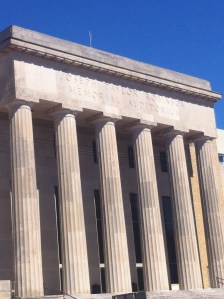
Black History Month – The Biggest Show of 1951 at Robinson Auditorium (with Duke Ellington, Nat King Cole and Sarah Vaughan)

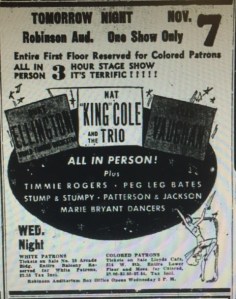
big-show-1951On November 7, 1951, Duke Ellington and His Orchestra, Nat King Cole and His Trio, and Sarah Vaughan headlined a three hour stage show which was billed nationally as “The Biggest Show of 1951.”

The tour launched in September 1951 and continued through December.  Also part of the show were Marie Bryant leading the dancers, vaudevillian Peg Leg Bates, comedian Timmie Rogers, comedians Stump and Stumpy and comedians Patterson and Jackson.  The tour played New England, parts of Canada, and the South.  At some venues in the South, the white musicians in Ellington’s orchestra were not allowed to play on stage with the African American musicians.  Sometimes he referred to his drummer as a light-skinned Haitian.

This was not the first visit for Cole or Ellington.  The former had been there in 1943 and 1944.  The latter had played there in 1949.

At the concert in Little Rock, there is no reference to problems with the musicians appearing on stage together. In a role reversal, white audience members were restricted to the balcony, while the orchestra and mezzanine levels were reserved for African American audience members.  (Many Southern venues would not even allow African Americans to attend events there at all, or to be in the same audience as whites.)  There were separate box offices.  White patron tickets were available at the Arcade Building. Tickets were $2.55 with tax included.  African Americans could purchase tickets at Lloyds Cafe on West 9th Street. Tickets ranged from $5.66 down to $2.44 with tax included.  The Robinson Box Office would be open a couple of hours before the concert began.

The advertisements did not provide instructions as to which doors were to be used to enter the building, so it was likely that the patrons headed to the balcony were able to enter through the three main front doors, while the orchestra and mezzanine level patrons had to enter in the one segregated door to the east of the main doors.
Black History Month – Ella Fitzgerald and Robinson Auditorium

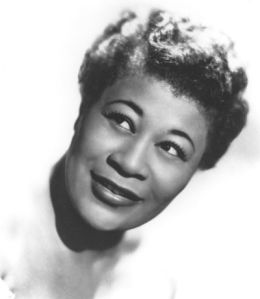
ellaElla Fitzgerald appeared at Robinson Auditorium in the 1940s.  She made the stops as she crisscrossed the US performing her hit songs.

Born in Virginia in 1917, she was raised in Yonkers. At 17 she won a contest at the Apollo Theatre which launched her career.  Saxophonist Benny Carter and bandleader Chick Webb were both instrumental in helping her establish her career.  She would tour with Webb until his death, and then took over as bandleader.

In 1938, at the age of 21, Ella recorded a playful version of the nursery rhyme, “A-Tisket, A-Tasket.” The album sold 1 million copies, hit number one, and stayed on the pop charts for 17 weeks.

She later toured with Dizzy Gillespie’s band and there met Ray Brown. The two would marry and adopt a son, Ray Jr.  Though they divorced in 1952, they remained friends.

In the late 1940s through the 1960s, Ella joined the Philharmonic tour, worked with Louis Armstrong on several albums and began producing her songbook series. From 1956-1964, she recorded covers of other musicians’ albums, including those by Cole Porter, Duke Ellington, the Gershwins, Johnny Mercer, Irving Berlin, and Rodgers and Hart.

As she moved into the 1970s, Ella kept performing. She also started receiving honors and honorary degrees.  She was a recipient of the Kennedy Center Honors in 1979.  In 1987, President Reagan bestowed upon her the National Medal of the Arts.  Her final concert was in 1991 at Carnegie Hall.  She died in June 1996 in California.

RobinsoNovember: Duke Ellington

On September 1, 1961, Duke Ellington announced he was cancelling his upcoming appearance at Robinson Auditorium. Ellington, who had previously appeared at Robinson at least once prior (on November 7, 1951), had been announced for a concert in late August.

In those days, Robinson did not have a formal box office.  Tickets were sold at various businesses, usually record stores.  When some African Americans called to inquire about tickets and were told they were only available in the segregated seating section of the balcony, they protested to the NAACP.  The local chapter then announced that it would encourage Ellington to cancel his concert.  The NAACP had a policy that they would boycott performers who ever played at segregated houses.  Since Robinson was still segregated, future Ellington appearances would have been met with boycotts.

The local presenters for the Ellington concert tried to negotiate a deal with the Auditorium Commission.  They were not successful.  One misguided commissioner stated, “Integration may be the law of the land, but it is not the law of Robinson Auditorium.”  When they commission refused to back down, Ellington cancelled.

This was only the latest in a string of issues surrounding the desegregation of Robinson.  The theatrical and opera producer organizations had both indicated that their touring shows would no longer play at segregated houses.  More and more entertainers were declining to play at segregated houses.

The Auditorium Commission was trying to balance their fear of lost revenue from cancelled bookings with their fears of poor attendance by audiences that did not want integration.  In a decade of rapid change, the commissioners tended to be older less likely to embrace change.

In 1962, a lawsuit was filed to integrate Robinson, city parks, and other public facilities.  It was settled in 1963 when the federal judge ruled against the City.  The Duke Ellington incident was often mentioned in media stories around the lawsuit.

Black History Month Spotlight – Joseph Taylor Robinson Auditorium

IMG_7690The new Arkansas Civil Rights History Audio Tour was launched in November 2015. Produced by the City of Little Rock and the University of Arkansas at Little Rock allows the many places and stories of the City’s Civil Rights history to come to life an interactive tour.  This month, during Black History Month, the Culture Vulture looks at some of the stops on this tour which focus on African American history.
In March 1974, Little Rock hosted the second National Black Political Convention at the Joseph T. Robinson Auditorium and Camelot Hotel (now a Doubletree Hotel). The first convention was held in Gary, Indiana, in 1972, and garnered much publicity, producing a National Black Political Agenda that included demands for the election of a proportionate number of black representatives to Congress, community control of schools, and national health insurance. The Little Rock convention was co-convened by Congressman Charles Diggs of Detroit, Michigan; Mayor Richard Hatcher of Gary, Indiana; and poet Amiri Baraka. Plenary speakers included Atlanta Mayor Maynard Jackson and comedian and activist Dick Gregory. Jesse Jackson was also in town for the convention. The convention featured a moving testimonial and tribute to local civil rights leader Daisy Bates at Central High School.

For many years, the lower Exhibition Hall of Robinson Auditorium hosted many concerts, dances and sporting events, popular with black audiences. However, because the large concert hall upstairs had segregated seating, Duke Ellington declined to play there in 1961. Louis Armstrong played to the first integrated audience in 1966 after the 1964 Civil Rights Act ended segregation in public facilities and accommodations.

The app, funded by a generous grant from the Arkansas Humanities Council, was a collaboration among UALR’s Institute on Race and Ethnicity, the City of Little Rock, the Mayor’s Tourism Commission, and KUAR, UALR’s public radio station, with assistance from the Little Rock Convention and Visitors Bureau.

Black History Month Spotlight – Taborian Hall and Dreamland Ballroom

The new Arkansas Civil Rights History Audio Tour was launched in November 2015. Produced by the City of Little Rock and the University of Arkansas at Little Rock allows the many places and stories of the City’s Civil Rights history to come to life an interactive tour.  This month, during Black History Month, the Culture Vulture looks at some of the stops on this tour which focus on African American history.

Completed in 1918, Taborian Hall stands as one of the last reminders of the once-prosperous West Ninth Street African-American business and cultural district. West Ninth Street buildings included offices for black professionals, businesses, hotels, and entertainment venues. In 1916, the Knights and Daughters of Tabor, a fraternal insurance organization, hired local black contractor Simeon Johnson to enlarge an existing building to accommodate their activities, other offices and a ballroom.

During World War I, black soldiers from Camp Pike came to the Negro Soldiers Service Center here. In World War II, Taborian Hall was home to the Ninth Street USO, catering to black soldiers from Camp Robinson. By 1936, Dreamland Ballroom hosted basketball games, boxing matches, concerts and dances.

A regular stop for popular black entertainers on the “Chitlin’ Circuit,” Dreamland hosted Cab Callaway, Count Basie, Duke Ellington, Ella Fitzgerald, Louis Armstrong, B.B. King, Earl “Fatha” Hines and Ray Charles. Arkansas’s own Louis Jordan also performed here. Between the 1960s and 1980s, West Ninth Street declined, and many buildings were demolished. In 1991, Taborian Hall was renovated to house Arkansas Flag and Banner. Once again, Dreamland Ballroom hosts concerts and social events.

The app, funded by a generous grant from the Arkansas Humanities Council, was a collaboration among UALR’s Institute on Race and Ethnicity, the City of Little Rock, the Mayor’s Tourism Commission, and KUAR, UALR’s public radio station, with assistance from the Little Rock Convention and Visitors Bureau.

ASO celebrates American Songbook

20121020-054530.jpgThis weekend the Arkansas Symphony Orchestra features a celebration of works from some of America’s greatest songwriters.

Vocalists Chauncey Packer and Rachel E. Copeland join Philip Mann and the ASO to perform tunes from George Gershwin’s “Porgy and Bess” and Hoagy Carmichael’s “Stardust” to Strayhorn’s “Lush Life” and Nat King Cole’s “Unforgettable.”

American tenor Chauncey Packer is an exciting talent on the stages of opera houses in Europe and the United States. In recent years, Mr. Packer has performed the roles of Steuermann DER FLIEGENDE HÖLLANDER with New Orleans Opera, Amon AKHNATEN with Atlanta Opera, Alfredo LA TRAVIATA with Pensacola Opera, and Rodolfo LA BOHÈME with Soo Theatre and Mobile Opera. This young tenor is highly in-demand for his captivating portrayal of Sportin’ Life PORGY AND BESS.

Lyric Coloratura Rachel E. Copeland continues to receive acclaim as a thriving young artist combining her crystalline voice with her compelling and energetic stage presence.  As Ms. Copeland’s career and reputation continue to grow, the 2012-2013 season sees her with repeat engagements with Opera North Carolina and Opera Per Tutti.

The selections for the concerts will include:

GERSHWIN – Cuban Overture
GERSHWIN – There’s A Boat That’s Leavin’ Soon for New York from Porgy and Bess
GERSHWIN/Holcombe – Gershwin Medley
CARMICHAEL – Stardust
STRAYHORN/Holcombe – Lush Life
COLE/Holcombe – Unforgettable
ELLINGTON/Holcombe – Duke Ellington Medley
HOLCOMBE – Songs of the South
GERSHWIN – Summertime from Porgy and Bess
ELLINGTON – Grand Slam Jam
RODGERS/HAMMERSTIEN/Walker – Soliloquy from Carousel
BERLIN/Ades – Irving Berlin – A Symphonic Portrait

The concerts take place at 8pm on Saturday, March 16 and 3pm on Sunday, March 17 at Robinson Center Music Hall.