
Heritage Month – Oakland-Fraternal Cemetery

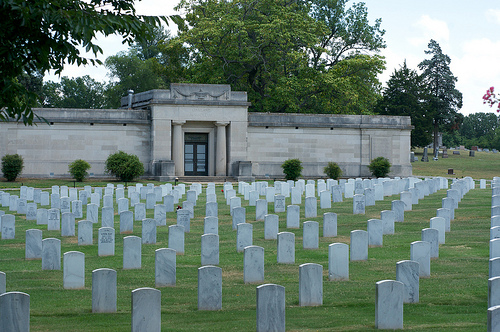
LR National Cemetery portion of Oakland Fraternal Cemetery

LR National Cemetery portion of Oakland Fraternal Cemetery

Since the focus of Memorial Day is to honor those who paid the ultimate sacrifice in service to their country, today’s feature is the Oakland & Fraternal Historic Cemetery Park. It was established in 1862 when the City of  Little Rock purchased a 160-acre estate in order to accommodate the Civil War dead. Through the years, this 160-acre estate has been carved into seven distinct cemeteries: Oakland, National, an eleven-acre Confederate, a one-acre Confederate, Fraternal, Jewish Oakland, and Agudath Achim. Today, 108 acres of the original 160 remain as burial grounds. The cemeteries have seen more than 62,000 burials since the first in 1863.

Oakland-Fraternal now includes over 10,000 monuments and sculptures on its 92 acres. As the public cemetery for over one hundred years, the cemetery is representative of Little Rock’s social fabric. United States Senators and Congressmen, Governors, Mayors, merchants, doctors, and educators are all interred in Oakland-Fraternal.  The cemetery is actually comprised of seven different cemeteries which are collectively known by the name “Oakland-Fraternal.”

The National Cemetery was listed on the National Register of Historic Places in 1996. The remaining cemeteries were listed on the National Register in 2010.
Today at noon at Legacies & Lunch: Oakland-Fraternal Cemetery

OakFratFor over 150 years, the Oakland-Fraternal Cemetery has been a final resting place for Little Rock citizens. This City of Little Rock cemetery is the focus on the August “Legacies and Lunch” program today at noon at the Bulter Center.  Jan Davenport, historian of the Oakland-Fraternal Cemetery will be the speaker.

The 160 acres on which Oakland-Fraternal was located was purchased from Mary Starbuck, the widow of Paul R. Starbuck, by the City of Little Rock in March 1863. This became the city’s largest cemetery. Gradually, the total acreage declined as unneeded property was sold. Oakland-Fraternal now includes over 10,000 monuments and sculptures on its 92 acres. As the public cemetery for over one hundred years, the cemetery is representative of Little Rock’s social fabric. United States Senators and Congressmen, Governors, Mayors, merchants, doctors, and educators are all interred in Oakland-Fraternal.  The cemetery is actually comprised of seven different cemeteries which are collectively known by the name “Oakland-Fraternal.”

Legacies & Lunch, a free program offered by the Butler Center for Arkansas Studies on the first Wednesday of each month, will feature Jan Davenport, historian of the Oakland-Fraternal Cemetery, on Wednesday, August 7, noon – 1 p.m. in the Main Library’s Darragh Center, 100 Rock Street.

After years of resting quietly, history is being uncovered at the Oakland-Fraternal Cemetery, as caretakers restore and research aged headstones. The cemetery is Little Rock’s best-kept historical secret and the final resting place for people ranging from working-class families to an assassinated judge. In her talk, “Gone but Not Forgotten: 150 Years at the Oakland-Fraternal Cemetery,” Davenport will discuss her efforts to raise awareness of the cemetery and the stories of the people resting there.

The Butler Center for Arkansas Studies is a department of CALS. It was founded in 1997 to promote the study and appreciation of Arkansas history and culture. The Butler Center’s research collections, art galleries, and offices are located in the Arkansas Studies Institute building at 401 President Clinton Ave. on the campus of the CALS Main Library.

For more information, call 918-3086.