
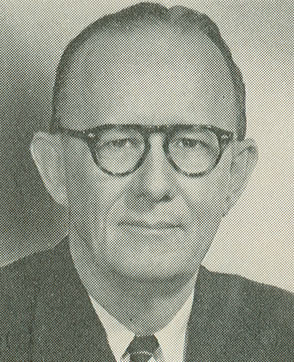
 For many years on a Sunday morning, the Brooks Hays Sunday School Class met at Second Baptist Church in downtown Little Rock. Named for its longtime leader, the class continued for decades after he had retired to the Washington D.C. area. Since today is a Sunday, and his birthday, this entry looks back at the life, career and legacy of Brooks Hays.
Lawrence Brooks Hays was born on August 9, 1898, in the Pope County town of London. He grew up in Russellville and attended the University of Arkansas. After military service in World War I and law school at George Washington University, he returned to Arkansas and practiced law with his father. In 1925, he was named an Assistant Attorney General and moved to Little Rock. A lifelong Southern Baptist, he joined Second Baptist Church.
His first entries into political races were not met with success. He failed to attain the Democratic nomination for governor in 1928 and 1930. In 1933, he narrowly lost a race for Congress to David D. Terry. Following that loss, he was appointed General Counsel to the U.S. Department of Agriculture by President Roosevelt.
In 1942, he was elected to Congress to succeed Terry. Throughout the 1940s and 1950s, he was focused on foreign affairs. He was a leading proponent of religion as a way to fight Communism. His emphasis on faith was also evident when he became elected the President of the Southern Baptist Convention in 1957. He was only the second lay person, and last one to date, to have been selected to this post.
In Congress, Hays had been a proponent of seeking a middle road on issues of segregation. He was not an integrationist, but he did believe that some rights should be afforded to African Americans. These efforts were met with disdain by both sides. Hays denounced the Brown v. Board decision in 1954, but three years later was caught up in it.
With Governor Orval Faubus openly defying federal law, there was pressure on President Dwight Eisenhower to uphold the law. Hays brokered a meeting with Faubus and Eisenhower, which did nothing to break the stalemate. However, because he had worked to uphold the law, he was a target when he was on the ballot in 1958. After defeating a segregationist candidate in the Democratic primary, Hays was surprised by a write-in candidate a week before the general election. Dr. Dale Alford, a member of the Little Rock School Board, pulled an upset and defeated Hays.
Presidents John F. Kennedy and Lyndon B. Johnson appointed Hays to a series of positions following that election. In 1966, he ran unsuccessfully for the Democratic gubernatorial nomination. He moved to North Carolina in 1968 to take a position with Wake Forest University. While in that state, he ran unsuccessfully for Congress in 1972. Shortly thereafter he moved to Chevy Chase, Maryland, which would be his base until his death in 1981. He is buried in Oakland Cemetery in Russellville.
Among the books he authored were Politics is My Parish, A Hotbed of Tranquility: My Life in Five Worlds, and A Southern Moderate Speaks.
His son, Steele Hays (named for the Congressman’s father) served on the Arkansas Supreme Court from 1981 to 1994. He had previously served on the Court of Appeals and as a Pulaski County Circuit Judge.

 Little Rock Culture Vulture