
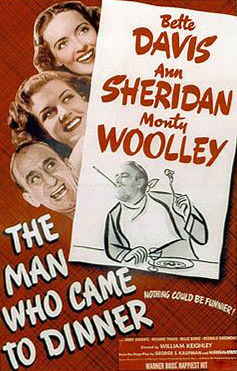
12 Days of Christmas movies: THE MAN WHO CAME TO DINNER

The_Man_Who_Came_to_DinnerWhat if you had a horrible house guest, and they would never leave?  That was the premise which launched Moss Hart and George S. Kaufman to write The Man Who Came to Dinner.  This rip-roaring stage play was made into a 1942 movie starring Monty Woolley, Bette Davis (cast against type as a frump) and Ann Sheridan.  In it Woolley plays a high-maintenance famous personality who is stuck as a guest in a house in small town Ohio due to an injury.

Others in the cast include Jimmy Durante, Billie Burke, Mary Wickes, Richard Travis, Grant Mitchell, and Reginald Gardner.  This is definitely a period piece rife with references to people and events in the 1930s and early 1940s.  But it is a lot of fun.  Woolley gleefully skewers everyone and everything in sight as he plots and plans ploys.

Most Kaufman and Hart plays and movies have underlying social themes or pertinent messages. This one does not.  Its only aim is to have fun.  Brothers Julius J. Epstein and Philip G. Epstein, do a good job of condensing the Kaufman & Hart play into a 90 minute movie without losing the bite or the wit.

Why is it a Christmas movie?  It takes place at Christmastime. A Christmas Eve radio broadcast is a plot point that provides a great deal of upheaval for the characters. In addition, a unique Christmas present serves as one half of a deus ex machina that helps wrap up the plotlines nicely.

Orson Welles, Don Knotts, Lee Remick, Joan Collins and Marty Feldman starred in a 1972 remake. A 2000 Broadway revival was filmed and aired on PBS with Nathan Lane, Jean Smart and Harriet Harris.

12 Days of Christmas Movies: HOLIDAY INN & WHITE CHRISTMAS

Holiday WhiteToday’s Christmas movie(s) are combined because they share a star, a composer and a song.  The latter is often erroneously referred to as a remake of the former.

Irving Berlin’s 1924 black & white Holiday Inn tells the tale of a crooner (Bing Crosby) who retires from show business to start an inn which would only be open on holidays.  Fred Astaire plays his former song and dance partner who has a knack for stealing all of Bing’s girlfriends. The rest of the cast is largely forgettable, indeed most did not have extensive careers before or after this movie.  One exception is the underused Louise Beavers stuck in the role of Crosby’s domestic at the Inn.  She had leading roles in several movies, but due to her race and the time, would still find herself playing maids and cooks with little onscreen time too much of her career.

The real gem here is the score. Though there are some forgettable (“I Can’t Tell a Lie”) and embarrassing (“Abraham”) but this also features “Happy Holidays,” “Be Careful It’s My Heart,” and “Easter Parade” (which Berlin had written for a musical revue in the 1930s).  The knock-it-out-of-the-ballpark breakaway hit was “White Christmas,” which went on to win the Oscar for Best Song.

(As a side note, this movie was the inspiration for the name of the hotel chain when it started in the 1950s.)

Twelve years later, Crosby, Berlin and “White Christmas” reunited for the film White Christmas.  By now color movies were more common, and the powers that be wanted Crosby singing the song in a color movie.  This time Crosby is joined by Danny Kaye, Rosemary Clooney and Vera-Ellen.  Oscar winner Dean Jagger and character actress Mary Wickes round out the leading roles.

For this film, Berlin supplied a new score, only repeating “White Christmas.” Though several of the songs were already popular in the Berlin songbook.  The main joy in this movie is to see Crosby, Clooney, Kaye and Vera-Ellen at the peak of their careers.

Though most of the songs work in this movie, there is one which doesn’t seem to fit. “Choreography” is a spoof of modern dance. It falls flat and drags the movie down. Though if you look at the chorus, you can see future Oscar winner George Chakiris of West Side Story fame.

It may be surprising that Michael Curtiz directed this film. He is often remembered today as the Oscar winning director of Casablanca (and justifiably so). But in his career he often bounded between light fare (Yankee Doodle Dandy, Life with Father) and heavier (Mildred Pierce, Angels with Dirty Faces) with some adventure films (The Adventures of Robin Hood, Captain Blood) thrown in.

Separately or together, Holiday Inn and White Christmas are fun Christmas movies.  White Christmas is the stronger of the two, partly because all of the characters are likeable.