Heritage Month – Villa Marre

villamarreThe Villa Marre is located at 1321 Scott Street. The Second Empire-style Villa Marre was built in 1881 by Italian immigrant and Little Rock saloonkeeper Angelo Marre, who also served on the Little Rock City Council.

The distinctive home features a mansard roof covered in patterned slate, a central tower topped by wrought-iron cresting, and hood molding above the doors and windows. Marre died in 1889, and his widow, Jennie, remained in the house until about 1900. Arkansas Governor Jeff Davis rented the house for a few years, and in 1905, the home was purchased by E. B. Kinsworthy, former state senator and attorney general of Arkansas.

It is probably most famous today for being the outdoor exterior of Sugarbakers design firm in the CBS sitcom “Designing Women.”  For several years, it was the home of the Quapaw Quarter Association. It later returned to a private residence.  Currently it is a venue for weddings and other events.

It was added to the National Register of Historic Places on June 15, 1970.

Heritage Month – Van Frank Cottages

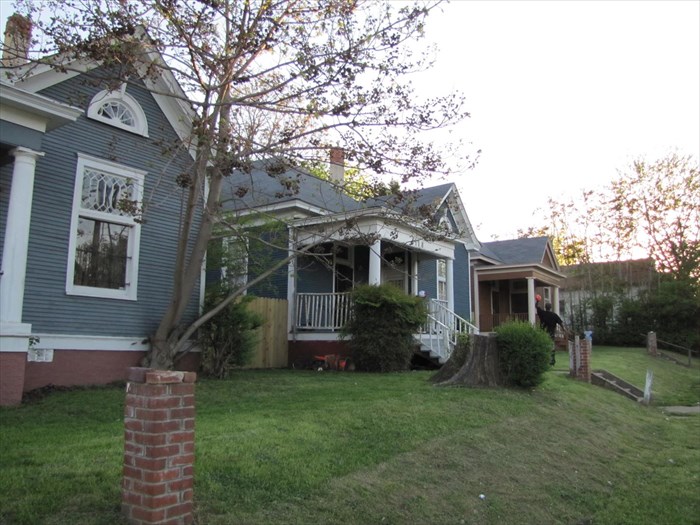
Van FrankToday’s historic property is actually four separate structures that are linked by the design and builder.  The Van Frank cottages are significant architecturally. Located between the MacArthur Park Historic District, to the immediate north, and the Marshall Square Historic District, a few blocks to the southeast, the Van Frank cottages represent a transition between the two.

While typical of the scale and speculative nature that characterizes the Marshall Square Historic District, the Van Frank cottages are reflective of the MacArthur Park Historic District in stylistic detail and in the ancestry and occupations of their owners and occupants.

Built in 1908, the cottages were the rental property of Philip R. Van Frank. They are the only existing historic houses associated with this civil engineer, who was instrumental in the improvement of Arkansas’ rivers.

Each of the four cottages is simply,  yet finely crafted with Colonial Revival details. In their unaltered state they are typical examples of the period. The cottages have been the residences of many individuals of diverse backgrounds.

The four cottages were added to the National Register of Historic Places in October 1985.

Heritage Month – Mount Holly Cemetery

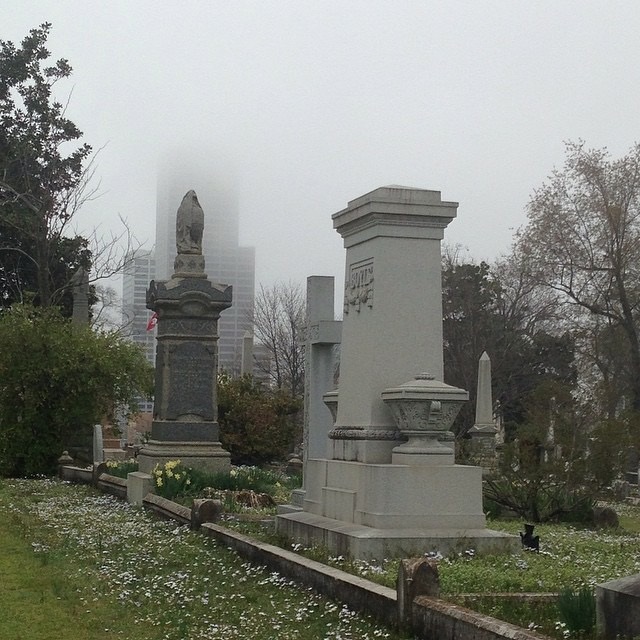
Mount Holly greyMount Holly Cemetery is an area equal to four city blocks of the City of Little Rock.  The main entrance on Broadway is marked by an imposing structure of stone and iron, and the four block square area is enclosed in a stone and iron fence which dates from 1881.

The cemetery has a park-like appearance, generously shaded with tall and stately trees. Many of these trees are so old as to have trunk diameters in excess of 33 inches.  Mount Holly is quaint, imposing, and inspiring. It provides examples of over 170 years of funerary sculptures which range from the simple, traditional, chiseled stones of the middle 19th century to the ornate and grandiose monuments of the 1880-1890 period.  While Mount Holly may be notable for the many dignitaries who reside there, over the years persons of all economic backgrounds and races have been buried there.

After planning for a larger cemetery started in 1839, the first burial took place in 1843.  The land for the cemetery was donated by Chester Ashley and Roswell Beebe, both of whom are buried there.  Veterans of all U.S. wars dating from the War of 1812 are buried in Mount Holly Cemetery.

While today there are no more plots available for burial, there are spots available in the columbarium. A City cemetery, it has been governed by the Mount Holly Cemetery Association since 1915. Later this summer, that organization will celebrate its 100th birthday.

On March 5, 1970, Mount Holly Cemetery was added to the National Register of Historic Places.

Heritage Month – Oakland-Fraternal Cemetery

LR National Cemetery portion of Oakland Fraternal Cemetery

LR National Cemetery portion of Oakland Fraternal Cemetery

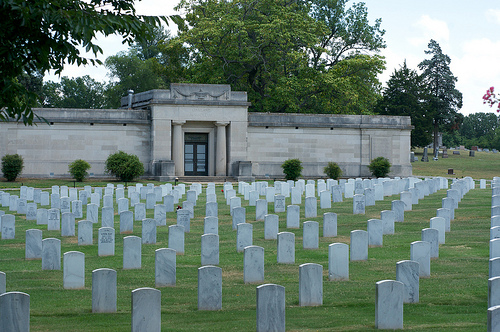
Since the focus of Memorial Day is to honor those who paid the ultimate sacrifice in service to their country, today’s feature is the Oakland & Fraternal Historic Cemetery Park. It was established in 1862 when the City of  Little Rock purchased a 160-acre estate in order to accommodate the Civil War dead. Through the years, this 160-acre estate has been carved into seven distinct cemeteries: Oakland, National, an eleven-acre Confederate, a one-acre Confederate, Fraternal, Jewish Oakland, and Agudath Achim. Today, 108 acres of the original 160 remain as burial grounds. The cemeteries have seen more than 62,000 burials since the first in 1863.

Oakland-Fraternal now includes over 10,000 monuments and sculptures on its 92 acres. As the public cemetery for over one hundred years, the cemetery is representative of Little Rock’s social fabric. United States Senators and Congressmen, Governors, Mayors, merchants, doctors, and educators are all interred in Oakland-Fraternal.  The cemetery is actually comprised of seven different cemeteries which are collectively known by the name “Oakland-Fraternal.”

The National Cemetery was listed on the National Register of Historic Places in 1996. The remaining cemeteries were listed on the National Register in 2010.

Heritage Month – Lincoln Viaduct

ahpp_nom_lincolnaveviaduct_largeToday kicks off the start of the Memorial Day weekend.  Since Memorial Day grew out of the Civil War-based Decoration Day, today’s property is named for a Civil War leader: Abraham Lincoln. The Lincoln Avenue Viaduct is traversed by thousands of cars each day, with most having no idea the name of the structure.  The Lincoln Avenue Viaduct is the arched bridge connecting LaHarpe with Cantrell Road which (literally) bridges downtown with the west along Highway 10.

The Lincoln Avenue Viaduct is a reinforced concrete rainbow arch bridge. It was opened at 2:05 p.m. on Friday, December 28, 1928, and, despite later alterations, it remains particularly well-preserved. The Missouri Pacific Railroad Company, considered the most important railroad company in the state, constructed the bridge amid a series of improvements in Little Rock made necessary by the damage wrought by the infamous spring floods of 1927.

Though the bride was constructed by the railroad, the City had to give authorization to do so, this was accomplished by the passing of Ordinance 4,335, at the May 28, 1928, City Council meeting.

Lincoln Avenue was one of several names for stretches of Highway 10 in Little Rock. By the 1960s, the areas west of the Lincoln Avenue viaduct were all renamed Cantrell in honor of the man who had developed much of the area west of the Heights. The longest stretch of the road already carried that name. There had been an effort to rename Highway 10 (including sections named Lincoln, Q, and Cantrell) in Little Rock for Senator Joseph Taylor Robinson in 1930. He declined the offer because he did not want to diminish the contributions of Mr. Cantrell.  Over time the entire stretch bore the name Cantrell.

The stretches east of the viaduct which involved a couple of names were renamed La Harpe Boulevard in honor of the French explorer who first saw the Little Rock.

Though the street has been renamed, the bridge still carries the name of the 16th President of the United States.

The Lincoln Avenue Viaduct was added to the National Register of Historic Places on April 9, 1990.

Heritage Month – La Petite Roche

IMG_4805Today’s Heritage Month “property” is the oldest in Little Rock.  It is, in fact, THE Little Rock.

On April 9, 1722, French explorer Jean-Baptiste Bénard de La Harpe rounded the bend of the Arkansas River and saw La Petite Roche and Le Rocher Français.

Though La Harpe and his expedition are the first Europeans documented to have seen La Petite Roche, the outcropping of rocks was well-known to the Quapaw Indians in the area.  The outcropping jutted out in the Arkansas River and created a natural harbor which provided a perfect place for boats to land.

The rock outcropping is the first one visible along the banks of the Arkansas River.  It marks the place where the Mississippi Delta meets the Ouachita Mountains.  Geologists now believe that the Little Rock is not the same type of rock as the Ouachita Mountains and more closely matches the composition and age of mountains in the western US.

In 1813, William Lewis became the first European settler to live near La Petite Roche but only stayed a few months.  Speculators and trappers continued to visit the area throughout the 1810s. During that time, the outcropping became known informally as the Little Rock.

La Petite Roche had become a well-known crossing when the Arkansas Territory was established in 1819. The permanent settlement of ‘The Rock’ began in the spring of 1820, and the first building has been described as a cabin, or shanty, and was built on the bank of the river near the ‘Rock.’ In March 1820, a Post Office was established at the ‘Rock’ with the name “Little Rock.”

Over the years, La Petite Roche was altered.  In 1872, Congress authorized the building of a railroad bridge. A pier for the bridge was built at the location of the La Petite Roche which caused the removal of several tons of rock.  The bridge was never built.  When the Junction Bridge was built in 1899, even more rock was removed in the process of erecting part of the bridge on top of the rock.  It was not viewed as being disrespectful of the City’s namesake at the time.  Indeed, it was viewed as a testament to the sturdiness of the rock.

In 2010, La Petite Roche plaza opened in Riverfront Park.  It celebrates the history of La Petite Roche and explores its importance to various aspects of Little Rock’s history and geography.

The Little Rock was added to the National Register of Historic Places in October 1970.

Heritage Month – Ten Mile House

Ten_Mile_fDeriving its common name from its distance from Little Rock at the time, the Federal-style Ten Mile House,  is a rare example of a largely intact rural home of the early nineteenth century.  In addition to the house, there are four nineteenth-century outbuildings surrounded by a large parcel of wooded property.

It was built by Archibald McHenry, and is sometimes known as the McHenry House or Stagecoach House (due to its presence on the Southwest Trail stagecoach line).  During the Civil War it served as a military outpost for Union troops.  David O. Dodd was held a prisoner in the smokehouse prior to his trial and execution.

Ten Mile House exhibits Early Georgian or Federal influence through the use of bridging between paired chimneys situated at each end of the house. Traits of the Federal style include simple, symmetrical proportions and large multi-paned windows. Ornamentation is minimal and is usually found around entries, windows, and cornice lines. A brick smokehouse, dairy house, well house, and kitchen house—all dating from the nineteenth century—remain on the property.

The Ten Mile House was listed on the National Register in June of 1970. Several families have owned the home since its early nineteenth century construction. It has served as a combination tea room/antiques store, a venue for public dinner parties and weddings, and a residence.