
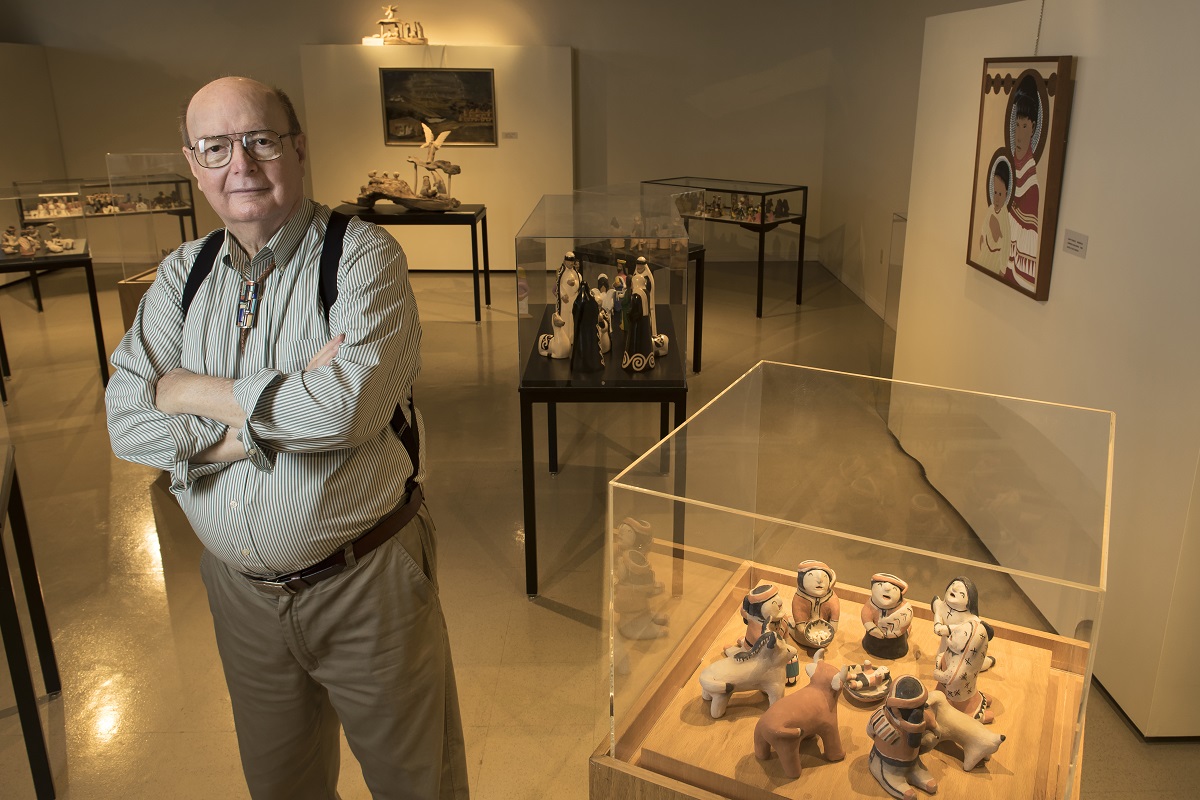
Dr. Bill Wiggins at UALR’s Sequoyah National Research Center on Wednesday, August 5, 2015.
Christmas is four months from today – yet you can see a variety of Nativity scenes at UALR.
Dr. J.W. “Bill” Wiggins took a different route with his Nativity scene collection. Essentially, if he ran across something native-arts related that he liked during his travels, he bought it.
“As I started to collect Nativities, it quickly became a folk art collection,” Wiggins said.
Figures and paintings Wiggins accumulated during the past four decades found a home in his “Nativities from the Americas” exhibit, available for viewing 8 a.m. to 5 p.m. weekdays through Oct. 9 at the University of Arkansas at Little Rock Sequoyah National Research Center.
The exhibit features about 45 Nativity scenes, mainly crafted by Native American, Mexican and South American artists, although there also are some from other parts of the world.
Wiggins is fascinated with how different cultures view Christianity and the story of the birth of Jesus Christ. Most of the artists represented in his collection incorporate their culture into the imagery.
That means, for example, visitors might see a buffalo or an eagle among the Nativity animals in some displays, and they’ll have a chance to view the figures presented in different mediums — from wood to clay, to even mud.
Wiggins said the Nativity collection is one of his most popular and most-requested exhibits. It was last on display in 2011, and Wiggins’ collection has grown since then.
One of the reasons for the exhibit’s popularity is that so many families decorate with Nativity sets of their own, Wiggins said, and the exhibit lets people see different interpretations of that venerated tradition.
Visitors to Wiggins’ exhibit shouldn’t expect to find Nativity scenes similar to those that annually line department store shelves. His collection features unique artistic perspectives such as a display that uses characters from other American holidays to symbolically represent the birth in Bethlehem.
Wiggins enjoys meeting the artists as he adds to his collection, and he tries not to miss an opportunity to discuss the displays with guests.
“I’m always interested in people’s reaction,” Wiggins said. “And what they see and what they don’t see is interesting.”
The Sequoyah National Research Center is home to one of the largest collections of Native American expression in the world. Its mission is to acquire and preserve the written and visual ideas of Native North Americans.
For more information, visit its website: http://ualr.edu/sequoyah/

 Little Rock Culture Vulture