Rock the Oscars: Hal Holbrook

(Photo by Joseph Harris for the AP)

Oscar nominated actor Hal Holbrook’s visits to Little Rock have been fairly regular over the decades.  In the 1980s and 1990s, he came several times in conjunction with the TV shows “Designing Women” and “Evening Shade.”  He also made an appearance at Wildwood in his one man play Mark Twain Tonight.

His first visit to Little Rock was in the mid-1950s.  He was just out of college and on a national tour of schools and small towns performing scenes from Shakespeare opposite his then-wife.  In a lengthy essay reflecting on his early career, Holbrook speaks fondly of his visit to Little Rock and of the grandiose stage and auditorium at Little Rock Central High School.

Rock the Oscars: Robinson Center Music Hall

Over the years, Robinson Center Music Hall has played host to numerous Oscar winners and Oscar nominees.
Stage actors Alfred Lunt and Lynn Fontanne made only one movie, but each were Oscar nominated for their performances in The Guardsman.  Over the years, they made several appearances in Little Rock in plays.  Their first visits were to the Little Rock High School auditorium. Once Robinson opened, they appeared on that stage.

Two time Oscar winner Helen Hayes appeared on stage at Robinson.  At the time, she was only a single Oscar winner (Best Actress for The Sin of Madelon Claudet).  Later she would pick up her second statuette for Supporting Actress in Airport.

Four time winner Katharine Hepburn graced the stage of Robinson in the 1940s.  Her first Oscar was for Morning Glory.  By the time she appeared at Robinson she had that award.  Later she would pick up Oscars for The Lion in Winter, Guess Who’s Coming to Dinner and On Golden Pond.

Charles Boyer never won an Oscar in a competitive category (though he was nominated).  He did however win an Honorary Oscar in the 1940s for his promotiono of French culture during World War II.  He appeared on stage at Robinson in the early 1950s as part of the tour of Don Juan in Hell (written by Oscar winner George Bernard Shaw — yes Shaw won an Oscar for the screenplay of Pygmalion.)

Multiple Oscar nominee, and special Oscar recipient, Mickey Rooney appeared on stage at Robinson in 1986 in the national tour of Sugar Babies.

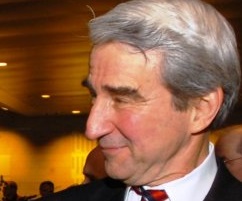
Rock the Oscars: Sam Waterston

On February 15, 2008, Oscar nominated actor Sam Waterston appeared at the Clinton Presidential Center in a Kumpuris Distinguished Lecture Series program sponsored by the Clinton School for Public Service and the Clinton Foundation.

Waterston was joined by the nation’s leading authority on Abraham Lincoln, Harold Holzer in presenting “Lincoln Seen and Heard,” featuring excerpts from Lincoln’s speeches, photographs of the late president and historical commentary.

He received a Best Actor Oscar nomination for 1984’s The Killing Fields.  He has also appeared in the Oscar winning The Great Gatsby and the Oscar nominated Heaven’s Gate, Interiors, Crimes & Misdemeanors, and Nixon.  On stage, Waterston was nominated for a Tony Award and received the Drama League Award for his performance in a revival of Abe Lincoln in Illinois.


Rock the Oscars: Roy Reed

It is possible that journalist extraordinaire Roy Reed appears in archival footage of the Oscar winning documentary “Nine from Little Rock” (Documentary, Short-1964) and Oscar nominated Eyes on the Prize: Bridge to Freedom 1965 (Documentary, Feature-1988).  First for the Arkansas Gazette and then for The New York Times, Reed was an eyewitness to history being made.  What is not in doubt is that he is a character in the Oscar winning film Selma.  In that movie, he was played by actor John Lavelle.
Roy Reed was born on February 14, 1930, in Hot Springs and grew up in Garland County. After attending Ouachita Baptist College and the University of Missouri (from which he would receive a Bachelor’s and a Master’s in Journalism), Reed worked for a newspaper in Joplin and served in the US Army.  In 1956, he returned to Arkansas to work for the Arkansas Gazette.

While he did not specifically cover the integration of Little Rock Central High in 1957, he was part of the paper’s coverage of civil rights. He later was assigned to cover the Faubus administration.  In 1965, he was hired by The New York Times and covered the South. He covered the historic Freedom March to the state Capitol in Montgomery in March 1965.  After spending 1965 and 1966 in the South, he was assigned to the Times’ Washington DC bureau.  In 1969, he moved to New Orleans to open a Southern bureau for the paper.  He remained in the Crescent City until 1976, when he was transferred to the London bureau.

After retiring in 1978, he moved to Northwest Arkansas and taught journalism at the University of Arkansas until 1995.  Reed continued to write essays and books including Faubus: The Life and Times of an American Prodigal (1997),  Looking Back at the Arkansas Gazette: An Oral History (2009) and Beware of Limbo Dancers: A Correspondent’s Adventures with the New York Times (2012).  Reed died in December 2017.

Rock the Oscars: A SOLDIER’S STORY

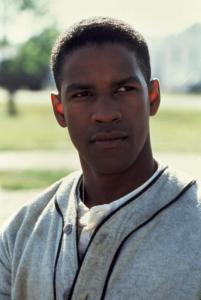
A SOLDIER’S STORY, Denzel Washington, 1984

In September and October of 1983, Norman Jewison and the cast of A Soldier’s Story filmed the movie at various locations in Arkansas.  Little Rock’s Lamar Porter Field was the site for the baseball scenes.  Adolph Caesar would receive an Oscar nomination for his performance in this movie.  Howard Rollins had recently been an Oscar nominee for his performance in Ragtime.  Future Oscar winner Denzel Washington was also featured in the cast.

Based on Charles Fuller’s Pulitzer Prize winning A Soldier’s Play, the movie was directed by Jewison from a script adapted by Fuller.  The film was nominated for three Oscars: Best Picture, Caesar in the Best Supporting Actor category and Fuller in the Best Adapted Screenplay category.

While the movie was filming in Arkansas, Governor Bill Clinton visited the set.  He had also been instrumental in making the Arkansas National Guard and some of the military facilities in the state available.  In addition to filming at Lamar Porter, scenes were shot in Fort Smith and at Fort Chaffee.

Rock the Oscars: James Earl Jones

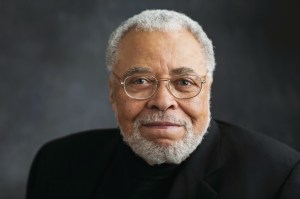
Actor James Earl Jones has made several appearances in Central Arkansas over the years.  He has appeared at Robinson Center with the Arkansas Symphony Orchestra.  On February 12, 1999, he narrated Aaron Copland’s “Lincoln Portrait” and Alexander Miller’s “Let Freedom Ring” with the Symphony in a concert at Robinson Center.  (It was the 190th birthday for Lincoln.)

Born in Mississippi, he spent most of his childhood in Michigan.  After service in the Army during the Korean War, he moved to New York to study theatre.  In the late 1950s he started alternating between Broadway (where he often played a servant) and Off Broadway (where he played leading roles).  His first film appearance was in Dr. Strangelove….  From the 1960s onward he has alternated between stage, film and TV.  In the 1980s, he added voice work to his repertoire.

In 1969 and in 1987, he won Tony Awards for Actor in a Play (The Great White Hope and Fences, respectively).  His other Tony nominations have been for revivals of On Golden Pond and The Best Man.  He was nominated for an Oscar in 1970 for reprising The Great White Hope on film.  He received two Emmy Awards in 1991 – the only actor to ever win two in the same year.

In 2008, he won the Screen Actors Guild Lifetime Achievement Award, and in 2011 he was given an Honorary Oscar.  In 2002, he was a Kennedy Center Honors recipient.

He is probably best loved for his work as the voice of Darth Vader in many of the Star Wars films as well as his voicework in The Lion King.

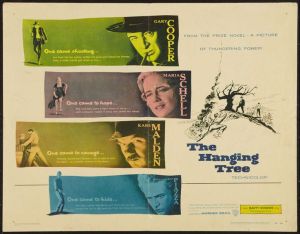
Rock the Oscars: THE HANGING TREE

On February 11, 1959, THE HANGING TREE was released.  This film was the first Hollywood movie in with Little Rock native Ben Piazza appeared.  For the film, Piazza received a coveted “and introducing Ben Piazza” credit.

The movie starred Oscar winners Gary Cooper and Karl Malden, along with Maria Schell.  Future Oscar winner George C. Scott, was fifth billed for his scenery chewing role of a religious zealot.

The title song, “The Hanging Tree,” written by Jerry Livingston and Mack David, was sung by Marty Robbins in the film.  It was nominated for the Oscar for Best Song.

Filming began in June 1958 in Washington state.  Shooting took place from June through August 1958 mainly near Yakima, Washington.  The film was directed by Delmer Daves, who was probably best known as screenwriter of Love Affair and director of 3:10 to Yuma.  In conjunction with filming The Hanging Tree, Piazza appeared in a TV special on western movies.  Most of the others appearing in the special were well-established Hollywood western personalities including Little Rock natives Bronco Billy Anderson and Gail Davis.

The Hanging Tree had a budget of $1.35 million ($11.5 million today—about half of the typical modest film budget).  A good portion of this expense was the construction of a mining town.  Once production began, Daves became ill and had to be hospitalized for ulcers. Co-star Karl Malden was approached to complete the film.  He had recently finished his first directing assignment.  He had reservations, but agreed to direct because of support of Cooper. (There are discrepancies as to the length of time Daves was out of commission.)

Ben received positive notices.  One reviewer referred to him as being a “laconic, doe-eyed rebel.” Another said he was a “handsome and mean-looking boy…with curls like a golden poodle.”     Several reviewers referenced James Dean when discussing Piazza in a positive light.

The film was released to respectful notices in February 1959.  It earned around $2.2 million, which meant it turned a profit.
