 Following the success of meetings at Forest Park Elementary and the Little Rock Chamber of Commerce, as well as other school, PTA, and civic meetings, the effort was underway to recall the three segregationist members of the Little Rock School Board.
On May 7, 1959, at Brier’s Restaurant, a group of young civic leaders gathered as they often did. This time, their conversation focused on how to capitalize on the momentum mounting in the desire to recall the three segregationist School Board members. Attorneys Edward Lester, Robert Shults, and Maurice Mitchell were present as well as Gene Fretz, a Gazette editor. It was he who came up with the acronym STOP – Stop This Outrageous Purge.
That afternoon, the group reconvened at the Grady Manning Hotel. This time joined by esteemed attorney Will Mitchell. Among the other men who were instrumental in getting STOP started were attorney Henry Woods, attorney W. P. Hamilton Jr., and banker B. Finley Vinson. As chair of the Chamber of Commerce, Grainger Williams had been a vocal supporter of the efforts to reopen the school. His leadership was, no doubt, instrumental in the Chamber’s quick and vocal support for the fired LRSD personnel.
Dr. Drew Agar was chosen to be the chair of STOP. The father of three children at Forest Park Elementary School, he was vice president of the Forest Park PTA. It was he who had presided over the successful Forest Park PTA meeting which saw several hundred parents oppose the firing and endorse the recall of the three segregationist members. (Dr. Agar had to use some fancy footing to get the items added to the agenda at the last minute, but with creative parliamentary maneuvering, he succeeded.)
On May 8, 1959, STOP was publicly announced. The event took place at Union National Bank. Approximately 179 men were in attendance. Those present were asked to contribute or solicit $100. (In time, approximately $36,000 would be raised.)
In addition to Dr. Agar serving as chair, Maurice Mitchell served as finance chair, Will Mitchell and Henry Woods were political strategists behind the campaign. Many other men stepped up. Dr. Agar announced at the May 8 meeting that a STOP office would open in room 1010 of the Pyramid Life building on May 9. It was to be open between 9am and 5pm to accept donations and to to collect recall petitions.
At the meeting standing ovations were given to R. A. Lile, a former member of the Little Rock School Board, and Everett Tucker, Ted Lamb and Russell Matson, current members. (Remember, this was back in the day when standing ovations were few and far between.)
Because most of the STOP members were younger, and second-tier business executives, the leadership of Will Mitchell and the chamber’s leadership by Grainger Williams was crucial in giving not only sage advice, but adding gravitas.
In the coming weeks, STOP would work closely with the Women’s Emergency Committee. The WEC had studied voter registration lists. They would put this skill to use as potential voters were identified as “Saints,” “Sinners,” or “Savables.” The two groups, working hand in hand behind the scenes, had their work cut out for them.
When the issue about reopening the schools had been put to the voters the previous autumn, Little Rock voters had overwhelmingly approved keeping the schools closed. There were many factors which had led to it – confusing ballot title, short campaign time, belief that the schools would reopen soon, etc. But even though there were some key factors in favor of STOP and the WEC this time, nothing could be taken for granted.

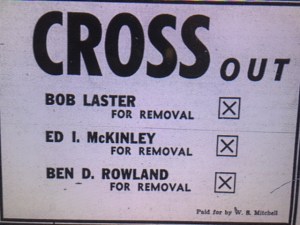 May 23, 1959, was a Saturday. It was also two days before the School Board recall election. With it being a Saturday, it was the last full day for door knocking as supporters for all sides were busy trying to get out the vote.
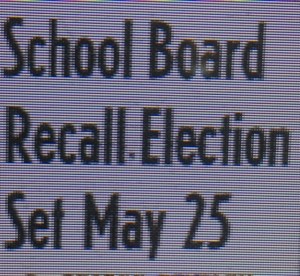 On May 15, 1959, the Pulaski County Election Commission met to discuss the competing efforts to recall members of the Little Rock School Board.
 Little Rock Culture Vulture