
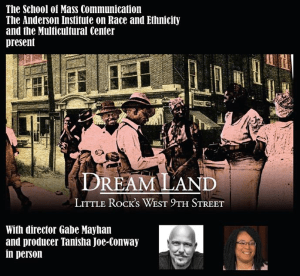
 Tonight at 6pm at the Stella Boyle Smith Concert Hall the UA Little Rock School of Mass Communication, Anderson Institute on Race and Ethnicity, and Multicultural Center present the 2017 documentary DREAM LAND.
Little Rock’s West 9th Street was once a vibrant, African-American business and entertainment district. Taborian Hall is the only remaining historic structure on West 9th Street and stands as a living witness of the street’s former glory days. Throughout the 1920s and 1930s, Taborian Hall housed varied and important black businesses, including professional offices, a USO, the Gem Pharmacy and the Dreamland Ballroom. By the 1930s, Dreamland was firmly established as a stop on the “Chitlin Circuit,” which showcased regional and national African-American bands and stage shows. It was also host to local musicians, dances, socials, concerts and sporting events.
This documentary seeks to recognize, memorialize and share this history. The spirit and hard work of the people and the implications of federal programs such as Urban Renewal, school desegregation, the Housing Act of 1949 and the Eisenhower Interstate Program are explored. West 9th Street and the Dreamland Ballroom have patiently waited for their story to unfold so new audiences can connect to their historical past and unknown future.
Following the screening, director Gabe Mayan and producer Tanisha Joe-Conway will participate in a discussion.
 The new Arkansas Civil Rights History Audio Tour was launched in November 2015. Produced by the City of Little Rock and the University of Arkansas at Little Rock allows the many places and stories of the City’s Civil Rights history to come to life an interactive tour. This month, during Black History Month, the Culture Vulture looks at some of the stops on this tour which focus on African American history.
 Little Rock Culture Vulture