Little Rock Look Back: US Supreme Court decision in BATES V. LITTLE ROCK

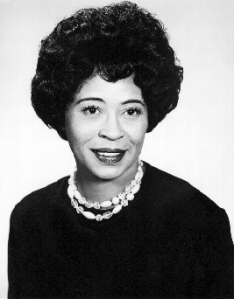
bates daisyOn February 23, 1960, the U. S. Supreme Court handed down a decision in the case of Daisy BATES et al., Petitioners, v. CITY OF LITTLE ROCK et al.  This case had been argued before the Court in November 1959.

Daisy Bates of Little Rock and Birdie Williams of North Little Rock were the petitioners.  Each had been convicted of violating an identical ordinance of an Arkansas municipality by refusing a demand to furnish city officials with a list of the names of the members of a local branch of the National Association for the Advancement of Colored People. The question for decision was whether these convictions can stand under the Due Process Clause of the Fourteenth Amendment to the United States Constitution.

The Little Rock ordinance (10,638) was passed on October 14, 1957. It charged that certain non-profits were actually functioning as businesses and using non-profit status to skirt the law. Therefore it required the non-profits to disclose their members and sources of dues.  North Little Rock passed an identical ordinance.

(Mayor Woodrow Mann was not present at the meeting of the LR Council when the ordinance was passed. But he signed all of the resolutions and ordinances approved that night.  Ordinance 10,638 was the only legislation that night which had also been signed by Acting Mayor Franklin Loy.  Mayor Mann crossed through Loy’s name and signed his own.)

Mrs. Bates and Mrs. Williams as keepers of the records for their respective chapters of the NAACP refused to comply with the law.  While they provided most of the information requested, they contended they did not have to provide the membership rosters and dues paid.

After refusing upon further demand to submit the names of the members of her organization, each was tried, convicted, and fined for a violation of the ordinance of her respective municipality. At the Bates trial evidence was offered to show that many former members of the local organization had declined to renew their membership because of the existence of the ordinance in question. Similar evidence was received in the Williams trial, as well as evidence that those who had been publicly identified in the community as members of the National Association for the Advancement of Colored People had been subjected to harassment and threats of bodily harm.

Each woman was convicted in the court of Pulaski Circuit Court, First Division, William J. KirbyJudge. They were fined $25 a person.  On appeal the cases were consolidated in the Supreme Court of Arkansas in 1958. The convictions were upheld by five justices with George Rose Smith and J. Seaborn Holt dissenting.

Mrs. Bates and Mrs. Williams then appealed to the U. S. Supreme Court.  The pair’s legal team included Robert L. Carter and George Howard, Jr. (who would later become a federal judge).  Little Rock City Attorney Joseph Kemp argued the case for the City.  The arguments before the U. S. Supreme Court were heard on November 18, 1959.

The SCOTUS decision was written by Associate Justice Potter Stewart.  He was joined by Chief Justice Earl Warren and Associate Justices Felix Frankfurter, Tom C. Clark, John M. Harlan II, William J. Brennan and Charles E. Whittaker.  Justices Hugo Black and William O. Douglas wrote a concurring opinion.

The U. S. Supreme Court reversed the lower courts.

In sum, there is a complete failure in this record to show (1) that the organizations were engaged in any occupation for which a license would be required, even if the occupation were conducted for a profit; (2) that the cities have ever asserted a claim against the organizations for payment of an occupation license tax; (3) that the organizations have ever asserted exemption from a tax imposed by the municipalities, either because of their alleged nonprofit character or for any other reason.

We conclude that the municipalities have failed to demonstrate a controlling justification for the deterrence of free association which compulsory disclosure of the membership lists would cause. The petitioners cannot be punished for refusing to produce information which the municipalities could not constitutionally require. The judgments cannot stand.

In their concurring opinion, Justices Black and Douglas wrote that they felt the facts not only violated freedom of speech and assembly from the First Amendment, but also aspects of the Fourteenth Amendment. They wrote that the freedom of assembly (including freedom of association) was a principle to be applied “to all people under our Constitution irrespective of their race, color, politics, or religion. That is, for us, the essence of the present opinion of the Court.”

Neither the Gazette or Democrat carried any reaction from City leaders. There was a City Board meeting the evening of the decision. If it was mentioned, the minutes from the meeting do not reflect it.

Arkansas Attorney General Bruce Bennett, on the other hand, was very vocal in his outrage. The city laws were known as Bennett Laws because they had been drafted by him as ways to intimidate African Americans and others he viewed as agitators.

In 1960 Bennett was challenging Governor Orval Faubus for the Democratic gubernatorial nomination.  In reaction to the to the Supreme Court he vowed that, if elected Governor, he would “de-integrate” (a term he proudly took credit for coining) the state.

For his part, and not to be outdone by the AG, Faubus fretted that the Court’s decision meant that Communists would be able to give money to the NAACP.

Black History Month – Andre Watts at Robinson Center

andre-wattsClassical pianist Andre Watts has performed at Robinson Center with the Arkansas Symphony Orchestra.

In 1963, 16 year old Andre Watts won a piano competition to play in the New York Philharmonic’s Young People’s Concert at Lincoln Center, conducted by Leonard Bernstein.  Within weeks of the contest the renowned conductor tapped Watts to substitute for the eminent but ailing pianist Glenn Gould, for a regular performance with the New York Philharmonic Orchestra. The performance was televised nationally, with Watts playing Liszt’s E-flat Concerto, and his career was launched.

Born in Germany to an American soldier and a Hungarian mother, he grew up on military bases.  At age 8, his family moved to Philadelphia. Following his 1963 performance, he won a Grammy in 1964 (at age 17) for Best New Classical Artist.

Since the 1960s, he has maintained a busy concert schedule. Along the way, he played for President Nixon’s first inaugural concert, graduated from college, been featured on PBS Live from Lincoln Center, toured Japan and Europe and the US.  At age 26, he received an honorary doctorate from Yale.  In 2004, he was appointed to the music faculty at the University of Indiana.  At age 70, he still performs concerts.  In 2011, he received the National Medal of the Arts.

Black History Month – Natalie Cole at Robinson Center

natalie-coleOn April 3, 2005, Natalie Cole performed at Robinson Center with the Arkansas Symphony Orchestra.  She also performed a retro-duet with her late-father, Nat King Cole.  As noted previously on this blog, he had graced the Robinson stage himself in the 1940s and 1950s.  Helaine Freeman from the Arkansas Democrat-Gazette noted that “Cole took her listeners through music genres that included a bit of jazz, a dash of blues and a fistful of R&B/pop.”

Cole was born in 1950 the daughter of the crooner and of singer Maria Hawkins Cole.  At age 6 she sang on her father’s Christmas album and started performing publicly at age 11.  After attending private schools, she attended both the University of Massachusetts and University of Southern California.  After college, she was signed with Capitol Records, her father’s label.  Her first album was released in 1975, which garnered her a Grammy Award for Female R&B Vocal Performance.

Throughout the 1970s, she had a series of successful albums. She became the first female singer to have two platinum albums in one year.  In the 1980s, her recording career slowed down, but by the late part of the decade, she had a resurgence.

In 1991, she recorded the album Unforgettable…with Love in which she sang songs her father had made famous.  The best known track was the title song, “Unforgettable” in which she dueted with him.  It won Album of the Year, Record of the Year, and Traditional Pop Vocal Performance of the Year at the Grammy Awards.

In the 2000s, she continued to sing and record switching between R&B and jazz genres.  She also started performing with symphony orchestras.

She cancelled several concerts in December 2015 and died on December 31, 2015.

Polk Stanley Wilcox joins Studio Gang Architects in planning for reimagined Arkansas Arts Center

arkartsThe Arkansas Arts Center announced the selection of Polk Stanley Wilcox Architects as associate architect for its upcoming building project. Polk Stanley Wilcox will work in partnership with Studio Gang Architects on a reimagined Arkansas Arts Center. Studio Gang was selected as design architect for the expansion and renovation in December.

Polk Stanley Wilcox Architects is a programming, architectural, planning and interior design firm with offices in Little Rock and Fayetteville. The firm has experience working with clients in a variety of industries, including healthcare, nonprofit, cultural, education, corporate and worship. Polk Stanley Wilcox also focuses on sustainability and creating buildings that operate on minimal energy usage.

“We are thrilled to partner with the Arkansas Arts Center and Studio Gang on this transformative project,” Polk Stanley Wilcox Principal David Porter said. “AAC has cast an exciting vision to rethink not only how the Center upgrades the interior and exterior spaces, but how the AAC connects to and enriches the broad arts and cultural tapestry of Little Rock. Studio Gang is a uniquely talented firm to lead the design effort. PSW is honored to bring our extensive experience from years of important projects in downtown Little Rock to come alongside them and the AAC to help create this next critical milestone for the city, state and region.”

Polk Stanley Wilcox has previously worked on a number of local projects, including the William J. Clinton Presidential Library, Heifer International Headquarters, the Arkansas Studies Institute and the recently opened Robinson Center expansion and renovation.

“We look forward to working with the team at Polk Stanley Wilcox,” said Studio Gang Founding Principal Jeanne Gang. “We hope to build on their strong history of collaborations in the area and believe that their knowledge of Little Rock will be a huge asset as we expand the impact of the Arkansas Arts Center in Little Rock, and in the region.”

Polk Stanley Wilcox Architects was selected from among three finalists to work in partnership with Studio Gang. Ten local firms responded to the RFQ issued last month. Allison and Partners and Cromwell Architects were also finalists.

The three finalist firms presented to the selection committee on February 16. The selection committee for the associate architect included AAC Executive Director Todd Herman, three representatives from Studio Gang, and international museum consultant Deborah Frieden, and AAC Board member Sara Hendricks Batcheller.

“Each of the finalists are strong, well-respected firms,” Arts Center Executive Director Todd Herman said. “Ultimately, Polk, Stanley, Wilcox was the best complement to Studio Gang in terms of experience and strengths. Their work at Robinson auditorium – similar in both scope and complexity – will be an asset as we move through the project. We are very pleased to have PSW on board for this important project that will create wonderful new spaces for the people of Little Rock and Arkansas to enjoy the arts. Having our architectural team in place is a major milestone. We are very excited to move the project forward.”

Black History Month – Daisy Bates and Robinson Center

bates daisyToday is the Daisy Bates Holiday in the State of Arkansas.  So it is an appropriate day to pay tribute to Mrs. Bates, who played a leading role in the Little Rock Integration Crisis of 1957.

Daisy Lee Gatson Bates and her husband were important figures in the African American community in the capital city of Little Rock.  Realizing her intense involvement and dedication to education and school integration, Daisy was the chosen agent after nine black students were selected to attend and integrate a Little Rock High School.  Bates guided and advised the nine students, known as the Little Rock Nine, when they enrolled in 1957 at Little Rock Central High School. President Clinton presented the Little Rock Nine with the Congressional Gold Medal and spoke at the 40th anniversary of the desegregation while he was in office.

When Mrs. Bates died, a memorial service was held at Robinson Center on April 27, 2000.  Among the speakers were President Bill Clinton, Secretary of Transportation Rodney Slater, and Rev. Rufus K. Young, pastor of the Bethel AME Church.  Others in attendance included Lt. Gov. Winthrop Paul Rockefeller, Mayor Jim Dailey, Presidential diarist Janis Kearney, former senator and governor David Pryor, and five members of the Little Rock Nine:  Carlotta Walls Lanier, Ernest Green, Minnijean Brown Trickey, Jefferson Thomas, and Elizabeth Eckford.

It was during his remarks at the service that President Clinton announced he had asked that Bates’ south-central Little Rock home be designated as a national historic landmark.

Little Rock Look Back: The first Elvis performance in Little Rock

Photo by Wayne Cranford

Photo by Wayne Cranford

Sixty-two years ago today, on February 20, 1955, Elvis Presley made his first appearance on stage in Little Rock. He performed at Joseph Taylor Robinson Memorial Auditorium.

He was billed as “an added attraction” to a Grand Ole Opry Show headlined by the Duke of Paducah.  Others on the bill included Mother Maybelle and the Carter Sisters, Jimmie Rodgers Snow, Charlie Stewart, the Singing Hardens, Sammy Barnhart, Bob Neal, Uncle Dudley and Smilin’ Mac Cyclone. (It is interesting to note that at least some of the advance tickets billed it as The Elvis Presley Show, though the newspaper ads billed the Duke of Paducah as the headliner.)

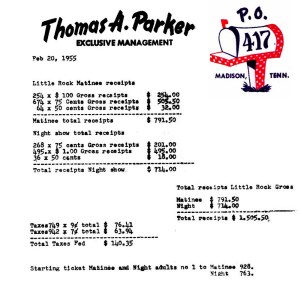
eap receits 05-little.rock_.feb_.55This concert was part of a weeklong tour of Arkansas and Louisiana.  There were two shows that day – one at 3p.m. and the other at 8:15p.m.  Tickets on the day of the concert were $1.00 for adults and fifty cents for children.  Advanced tickets had sold for 75 cents at Walgreens.
The night before, Elvis played the Louisiana Hayride in Shreveport.  Following his Little Rock appearance (for which he and his band were paid $350 instead of their usual $200), they played in Camden, Hope, and Pine Bluff.

It is believed that Elvis’ parents attended this concert in Little Rock. Gladys Presley was a big fan of the Duke of Paducah. Elvis apparently also wanted his parents to meet with Colonel Tom Parker, who would become inexorably linked with Elvis’ career.

Black History Month – Wiley Branton and Robinson Auditorium

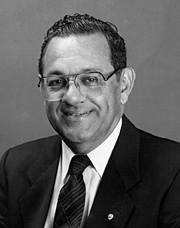
brantonMost of the people who are being featured this month have played at Robinson Center.  But today’s entry, Wiley A. Branton, Sr. worked to integrate Robinson Center.

In 1962, he filed a suit on behalf of several African American residents of Little Rock to integrate the City’s public facilities including Robinson Auditorium.  (The City Board and the Auditorium Commission were named in the lawsuit.)  In 1963, the decision came down and the facilities had to integrate.

This lawsuit was just one of many in which Branton paved the way for equal opportunities for all.  He helped desegregate the University of Arkansas School of Law and later filed suit against the Little Rock School Board in a case that went to the U.S. Supreme Court as Cooper v. Aaron.

A native of Pine Bluff, he graduated from what is now UAPB. After first being refused admission, he later became the fifth African American to attend the UA Law School and the third to graduate.  From 1953 to 1962, he had a law practice in Pine Bluff.  Between 1962 and 1965, Branton worked with representatives of the major African-American civil rights organizations to register almost 700,000 new black voters in eleven Southern states. Following that, he became executive director of the President’s Council on Equal Opportunity and help coordinate implementation of the Civil Rights Act of 1964. He spent 1965 to 1967 at the Justice Department, before becoming executive director of the United Planning Organization (UPO).  After working with a couple of other organizations, he returned to private practice in 1971.  In December 1977 it was announced that Branton would be the new dean of Howard University School of Law. After five years, he joined the law firm of Sidley and Austin in its Washington DC office.

Branton died of a heart attack in December 1988.  Eleven hundred mourners gathered at a memorial service at the Washington National Cathedral in Washington, D.C. Among those present was Supreme Court Justice Thurgood Marshall. The eulogy was delivered by Vernon E. Jordan, Jr..  Then-Gov. Bill Clinton spoke at the Pine Bluff memorial service for Branton.