Rock the Oscars 2019: Geena Davis

On February 7, 2012, Academy Award-winning actor Geena Davis spoke in Little Rock.  She was hosted by the University of Arkansas Clinton School for Public Service and the William J. Clinton Foundation.
Davis founded the Geena Davis Institute on Gender in Media in 2004. The institute is the only research-based organization working within the media and entertainment industry to engage, educate and influence the need for gender balance, reducing stereotyping and creating a wide variety of female characters in entertainment. Davis won the Academy Award for Best Supporting Actress for her role in “The Accidental Tourist” in 1988.

She was again nominated for an Academy Award and Golden Globe for her performance as Thelma in Ridley Scott’s “Thelma and Louise,” in which she co-starred with Susan Sarandon.  She received a Golden Globe nomination for Best Actress for her portrayal of baseball phenomenon Dottie Hinson in “A League of Their Own.”

Geena Davis is the founder of the non-profit Geena Davis Institute on Gender in Media and its programming arm See Jane, which engages film and television creators to dramatically increase the percentages of female characters — and reduce gender stereotyping — in media made for children 11 and under.  In 2015, she founded the Bentonville Film Festival.

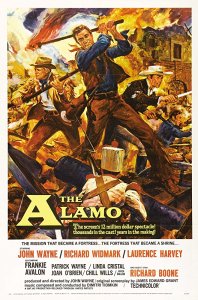
Rock the Oscars 2019: THE ALAMO

One of the early settlers in Little Rock was a man from Tennessee named Davy Crockett.  He did not stay in Little Rock very long. He and several others ventured to the Republic of Texas.  His final days are depicted (with more liberties than the original Texans had under Mexican control), in the film The Alamo.

(While Stephen F. Austin does not appear in the movie, he was actually one of Little Rock’s founding fathers before becoming a founder of Texas.)

The very fictionalized, grandiose, and jingoistic movie starred John Wayne as Crockett, Richard Widmark as Col Jim Bowie (another Arkansas traveler who left his impact on the state), Laurence Harvey as Col. William Travis, along with Frankie Avalon, Patrick Wayne, Chill Wills, Ken Curtis, and Denver Pyle.

Though one of the top grossing films of the year, it was still a financial flop due to its excessive cost.  However, when Oscar time came around, the film received seven nominations. They were Best Picture, Supporting Actor (Wills), Cinematography-Color, Film Editing, Sound, Song, and Scoring of a Dramatic or Comedy Picture.

Wills took out an ad claiming that his fellow Alamo actors were praying for him to win even harder than the original Alamo soldier had prayed for victory.  There was much backlash.  It was felt that this may have affected award chances in all categories.  It only won the Award for Best Sound – which went to Gordon Sawyer and Fred Hynes.

The remake/new version of The Alamo received no Oscar nominations.

Rock the Oscars 2019: Nine from Little Rock

On April 5, 1965, the Academy Award for Best Documentary, Short Subject went to the film “Nine from Little Rock.”

Narrated by Jefferson Thomas, Charles Guggenheim’s documentary looks at the nine African-American students who enrolled in Little Rock Central High School in 1957. Thomas, one of the students reflects on the state of race relations in the seven years that had elapsed (up to 1964).  The film also focuses on Ernest Green, Elizabeth Eckford and Thelma Mothershed.

Guggenheim both directed and co-wrote the film. The latter credit was shared with Shelby Storck, who also produced the film.   The film had been commissioned by George Stevens, Jr., for the United State Information Agency.

The Oscar that night was Guggenheim’s first of four.  His others would be for: 1968’s “Robert Kennedy Remembered” (Live Action Short), 1989’s “The Johnstown Flood” (Documentary Short) and 1994’s “A Time for Justice” (Documentary Short).  His son Davis Guggenheim won the Oscar for Documentary, Feature for An Inconvenient Truth.

The film was digitally restored by the Motion Picture Preservation Lab for the 50th anniversary of its win for Best Short Documentary at the 1965 Academy Awards.  It is available for purchase on DVD and can also be viewed in its entirety on YouTube

Rock the Oscars: Marvin Hamlisch

Composer-conductor-arranger-pianist Marvin Hamlisch was a multi-hyphenate.  He also was an early EGOT winner (back when it was more difficult to accomplish this feat because there were fewer categories in all four awards).
Hamlisch visited Little Rock numerous times throughout his careers.  In 1996, he performed at Wildwood Park during the first season of the Lucy Lockett Cabe Festival Theatre.  He soloed with the Arkansas Symphony Orchestra in January 2000 performing many of his works for film and a few for stage.

In 2006, he returned to the ASO to perform with Robert Klein and Lucie Arnaz and the latter duo recreated their roles from the Hamlisch-Neil Simon-Carole Bayer Sager musical They’re Playing Our Song.  His final visit to Little Rock was in 2011. He was performing in Conway but shopped in Little Rock for clothes when his luggage stayed in Chicago.

Over his career, Hamlisch was nominated for twelve Oscars.  He won three at the 1974 ceremony. They were Best Song for “The Way We Were” from the film of the same name (shared with Alan and Marilyn Bergman), Best Score for The Way We Were and Best Adaptation Score for The Sting.  The latter heavily featured music by former Little Rock resident Scott Joplin.

Rock the Oscars 2019: Richard Linklater

Image may contain: 2 people, people smiling, people standing

Arkansas Cinema Society’s Jeff Nichols (left) with 5 time Oscar nominee Richard Linklater at ACS’s 2018 FILMLAND opening night. (Photo from ACS)

The 2018 Arkansas Cinema Society FILMLAND kicked off with a screening of Richard Linklater’s THE NEWTON BOYS. 

Linklater, a multiple Oscar nominee, founded the Austin Film Society, which was one of the models for the creation of the Arkansas Cinema Society.  Following the screening of his film, he engaged in a conversation with filmmaker Jeff Nichols, who is a founder of the ACS.

Linklater is mostly known for his realistic and natural humanist films which revolve mainly around suburban culture and the effects of the passage of time. Some notable films of his include the observational comedy film Slacker, the coming-of-age comedy Dazed and Confused,” the romantic drama film trilogy Before SunriseBefore Sunset, & Before Midnight and the music-themed comedy School of Rock, as well as the rotoscope animated films Waking Life and A Scanner Darkly.

In 2002, he began filming “Boyhood,” a passion project which took over twelve years to complete. The film was released in 2014 to widespread critical acclaim. Linklater won the Golden Globes, Critics’ Choice Movie Awards, and BAFTAs for Best Director and Best Picture.

Linklater was nominated for Best Adapted Screenplay for 2004’s Before Sunset, 2013’s Before Midnight, and 2014’s Boyhood. He also picked up a Best Director and Best Picture nomination for the latter.


Rock the Oscars 2019: Lisa Blount

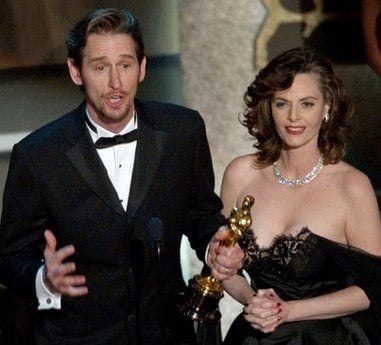
Image result for lisa blount ray mckinnonOn March 24, 2002, Lisa Blount and and her husband Ray McKinnon picked up the Oscar for Best Live Action Short for their film “The Accountant.”  Directed by McKinnon (and starring him) it was produced by Blount.

Married since 1998, the couple were strong promoters of the Arkansas film scene, especially from the early 2000s, onward. They were active in supporting the Little Rock Film Festival as well as film projects located in Arkansas.

In 2004, they moved to Little Rock, which was a return for Blount to the Central Arkansas in which she had grown up.  Born in Fayetteville, her family had moved to Jacksonville. After graduating from Jacksonville High School, she attended the University of Central Arkansas. It was there she got her big break appearing in the film September 30, 1955.

A month before her October 2010 death, Blount was inducted into the Arkansas Entertainers Hall of Fame.

Little Rock Look Back: Movie Ball sends LR Film Fans into Frenzy

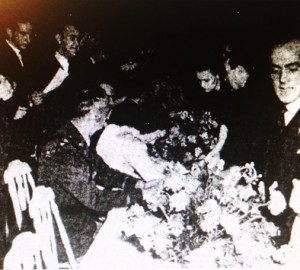
Autograph seekers crowd around the actors at the Movie Ball (photo from Arkansas Gazette)

As final preparations were being made for the opening of the Joseph Taylor Robinson Municipal Auditorium in early 1940, a glamorous evening took place in Robinson’s lower level convention hall on February 1.

In conjunction with a meeting of film executives and movie theatre owners sponsored by Robb and Rowley Theaters (which later became the United Artists theatre chain), several Hollywood actors were in Little Rock and headlined a Movie Ball. While in Little Rock, Maureen O’Hara, Phyllis Brooks, Arleen Whelan, Tim Holt and Gene Autry had also made a variety of public appearances.

Mr. Autrey had to miss the ball because he had to return to Hollywood early to attend to business matters. Actress Ilona Massey had also been scheduled to attend the events but was unable due to illness.

The quartet who did appear at the Movie Ball caused quite a scene. Upon their entrance, so many of the attendees crowded around for autographs that the evening’s grand march could not take place (a newspaper headline in the Democrat innocently used the word “orgy” to describe the crowd). After two attempts, Little Rock Mayor J. V. Satterfield (who was escorting Miss O’Hara) and the other members of the Little Rock host delegation led the Hollywood foursome to their reserved table. For quite a while that evening, the table was besieged by autograph seekers.

Though it is unknown as to whether he sought an autograph, photos from the evening showed a very satisfied Mayor Satterfield with Miss O’Hara on his arm. Satterfield family lore joked that Mrs. Satterfield (who had stayed home that night to tend to a sick son) was not a fan of Miss O’Hara’s films after that evening.

The Movie Ball showed Little Rock citizens the value of Robinson Auditorium even before it had been officially dedicated. The film industry meetings had taken place at the Albert Pike Hotel which did not feature a ballroom large enough to host the ball. Without the auditorium’s availability for the gala, organizers might not have chosen Little Rock for the meeting.

With the auditorium’s convention hall not attached to any hotel, it opened up the chance for Little Rock to host more events. This had been one of the key arguments for an auditorium since Mayor W. E. Lenon’s first proposal back in 1904. Having a glamorous event this early in the auditorium’s life validated that contention. After having endured the challenges to open the building, it was a nice lagniappe for the auditorium’s proponents who were present.

The actor Tim Holt would again be connected to Little Rock. In September 1951, he tried to obtain a divorce in Arkansas and stated that he had been a resident of the state for at least six weeks. He also had someone else testify to that fact. In October 1951, the divorce was granted. Later Mr. Holt was charged with perjury and fined $200 for falsely representing his length of residence in Arkansas. Judicial sanctions for his legal team, which included a State Senator, were eventually reviewed by the Arkansas Supreme Court.
