12 Days of Christmas Movies: HOLIDAY INN & WHITE CHRISTMAS

Holiday WhiteToday’s Christmas movie(s) are combined because they share a star, a composer and a song.  The latter is often erroneously referred to as a remake of the former.

Irving Berlin’s 1924 black & white Holiday Inn tells the tale of a crooner (Bing Crosby) who retires from show business to start an inn which would only be open on holidays.  Fred Astaire plays his former song and dance partner who has a knack for stealing all of Bing’s girlfriends. The rest of the cast is largely forgettable, indeed most did not have extensive careers before or after this movie.  One exception is the underused Louise Beavers stuck in the role of Crosby’s domestic at the Inn.  She had leading roles in several movies, but due to her race and the time, would still find herself playing maids and cooks with little onscreen time too much of her career.

The real gem here is the score. Though there are some forgettable (“I Can’t Tell a Lie”) and embarrassing (“Abraham”) but this also features “Happy Holidays,” “Be Careful It’s My Heart,” and “Easter Parade” (which Berlin had written for a musical revue in the 1930s).  The knock-it-out-of-the-ballpark breakaway hit was “White Christmas,” which went on to win the Oscar for Best Song.

(As a side note, this movie was the inspiration for the name of the hotel chain when it started in the 1950s.)

Twelve years later, Crosby, Berlin and “White Christmas” reunited for the film White Christmas.  By now color movies were more common, and the powers that be wanted Crosby singing the song in a color movie.  This time Crosby is joined by Danny Kaye, Rosemary Clooney and Vera-Ellen.  Oscar winner Dean Jagger and character actress Mary Wickes round out the leading roles.

For this film, Berlin supplied a new score, only repeating “White Christmas.” Though several of the songs were already popular in the Berlin songbook.  The main joy in this movie is to see Crosby, Clooney, Kaye and Vera-Ellen at the peak of their careers.

Though most of the songs work in this movie, there is one which doesn’t seem to fit. “Choreography” is a spoof of modern dance. It falls flat and drags the movie down. Though if you look at the chorus, you can see future Oscar winner George Chakiris of West Side Story fame.

It may be surprising that Michael Curtiz directed this film. He is often remembered today as the Oscar winning director of Casablanca (and justifiably so). But in his career he often bounded between light fare (Yankee Doodle Dandy, Life with Father) and heavier (Mildred Pierce, Angels with Dirty Faces) with some adventure films (The Adventures of Robin Hood, Captain Blood) thrown in.

Separately or together, Holiday Inn and White Christmas are fun Christmas movies.  White Christmas is the stronger of the two, partly because all of the characters are likeable.

12 Days of Christmas Movies : DIE HARD and DIE HARD 2

Though not the typical holiday fare, both DIE HARD (1988) and DIE HARD 2 (1990) take place at Christmas time.

Christmas parties, Christmas travel and references to Santa Claus are present throughout these movies.

Bruce Willis’ John McClane is an Everyman hero in these movies. His performance combines macho bravura with humor, frustration, exhaustion, honor, compassion and rough edges.

Bonnie Bedelia, as his long-suffering but independent-minded wife turns what could have been a caricature into a fully-fleshed character.

Reginald VelJohnson adds humor and a sense of redemption to the first movie. He also makes a welcome cameo in the second.

One of the joys of the first movie is Alan Rickman’s deliciously slick villain. He relishes the role. Rickman’s portrait of a nemesis is so compelling the audience is almost sad to see him disappear at the end.

For the second movie, the villains are less interesting, but the plots twists and turns make up for that.

Veteran character actors William Atherton (in both), Paul Gleason (in the first), Fred Thompson, Dennis Franz, and Art Evans (in the second) flesh out the movies as skeptics and/or foils for Willis and Bedelia.

These two movies are definitely period pieces. The plot points would be much different now in this day of smartphones, social media, and truly 24 hour news cycles. It was also amusing to see 74 cent gas. IMG_5077-0.JPG

12 Days of Christmas Movies: CHRISTMAS IN CONNECTICUT

Before there was Martha Stewart, there was Gladys Taber of Family Circle magazine. A lifestyle columnist, Ms Taber lived on a farm in Connecticut.

In 1945, Warner Bros. released a comedy which wondered what would happen if a food writer for a magazine really couldn’t cook. Barbara Stanwyck played the domestically-challenged writer who must fake her way through a Christmastime while playing hostess to a WWII veteran as part of a publicity stunt.

Dennis Morgan plays the veteran and Sydney Greenstreet portrays Stanwyck’s editor. Neither visitor has any idea she is a single NYC woman who cannot cook, not the Connecticut housewife and mother her column depicts. As she tried to fake her way through the holidays, much merriment ensues, as does romance.

This light, smart comedy was released in summer 1945 just as the war was ending in Europe and winding down in Japan. It was a combination screwball comedy, wartime distraction, and romance. Stanwyck and Greenstreet were better known for dramas. Morgan had started in a series of war-set movies thoughout WWII. This comedy also gave the actors a chance to be a bit more carefree and represented the optimism Americans were feeling as the war was finally ending.

IMG_5080.JPG

12 Days of Christmas Movies: CHRISTMAS VACATION

Christmas-VacationChristmas Vacation is definitely a modern classic. This movie aptly captures all that the holidays can be about: spending too much money, spending too much time with relatives (not that I have ever felt that), spending too much effort on decorating.  This is the one “Vacation” movie in which Clark, Ellen, Rusty and Audrey are presented as the relatively sane ones surrounded by craziness.

It is hard to pick a favorite scene, there are so many wonderful ones.  From Aunt Bethany reciting the Pledge of Allegiance in lieu of saying grace, to the cat and the tree, to Clark’s efforts to decorate the house, to the obnoxious neighbors, to Cousin Eddie, to …. well the list goes on and on.

How the actors kept straight faces throughout the filming of this movie is beyond me. But they did, and the reward is a fun movie that never disappoints to delight.

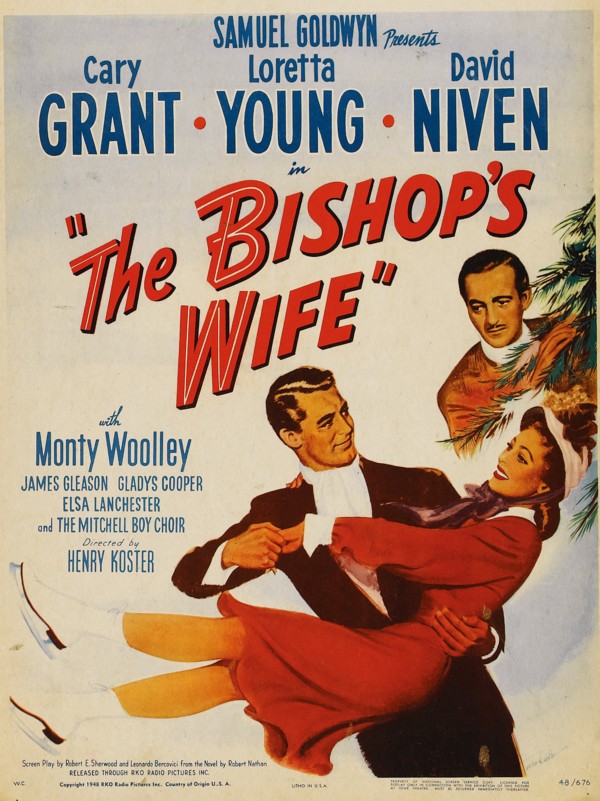
12 Days of Christmas Movies: THE BISHOP’S WIFE & THE PREACHER’S WIFE

the-bishops-wife-posterI will admit I have unique taste in movies veering from the ridiculous to the sublime.  This extends to my Christmas movie viewing.

It is not that I dislike It’s A Wonderful Life, A Christmas Story or Miracle on 34th Street, it is that they have become cliché. I long since tired of watching them.  Christmas movies should make me laugh, think, and/or feel.

In the final Twelve Days to Christmas, I’ll share my favorite Christmas movies. Some are designed to be Christmas movies, others simply take place at the Christmas season.  In a few instances, I feature two movies because they are linked to each other (doing so allowed me to include 5 more). They are largely in alphabetical order because I could not rank them.  The one exception is perhaps my favorite Christmas movie.

To get things started The Bishop’s Wife and The Preacher’s Wife.

I remember first seeing The Bishop’s Wife when I was a child visiting my grandparents at Christmas.  My uncle loved old movies so he would watch them a great deal.  Back then, there were only five cable stations and the 4 Arkansas broadcast stations (if you count AETN).  But there seemed to be more on TV worth watching then with fewer choices.  Anyway, I remember seeing this movie.

What’s not to love?  Cary Grant, David Niven, Loretta Young?  Any movie with two future Oscar winners and Cary Grant has to be good.  Perhaps it was this movie that planted the seeds of Episcopalianism in my then-Baptist head.  There is much humor and heart in this movie, but it does not hit you over the head with its message.

It was remade as The Preacher’s Wife with Tony winners Denzel Washington and Courtney B. Vance, Tony nominee Loretta Devine and the incomparable Whitney Huston.  Yes, it is inferior to the original, but it is still fun to watch.

Grants for Rep, ASO announced by National Endowment for the Arts

nea-logo-960Two Little Rock cultural institutions were among the nine Arkansas recipients of National Endowment for Arts grants recently announced.

These were Art Works and Challenge America grants. Art Works grants supports the creation of art that meets the highest standards of excellence, public engagement with diverse and excellent art, lifelong learning in the arts and the strengthening of communities through the arts. Challenge America grants offer support primarily to small and mid-sized organizations for projects that extend the reach of the arts to underserved populations whose opportunities to experience the arts are limited by geography, ethnicity, economics or disability.

The Arkansas Repertory Theatre received $10,000 to support the production of Matthew Lopez’s The Whipping Man. This play is set during Passover 1865.  As the annual celebration of freedom from bondage is being observed in Jewish homes, a wounded Confederate officer returns from the Civil War to find his family missing and only two former slaves remaining.

The Rep  will partner with the Mosaic Templars Cultural Center and the Jewish Federation of Arkansas to explore the play’s themes and the role of both the African-American and Jewish communities in Arkansas history.

The Arkansas Symphony Orchestra received $10,000 Little to support performances, workshops, and related outreach activities featuring violinist Randall Goosby. Goosby, the first-place winner of the 2010 Sphinx Competition, will be in residence in Central Arkansas conducting free workshops and music demonstrations for community members and student musicians drawn from economically disadvantaged schools.

In addition, TheatreSquared in Fayetteville received $10,000 for its Arkansas New Play Festival. This is presented in Fayetteville and Little Rock. The Little Rock performances are in conjunction with the Arkansas Rep.

Other Arkansas recipients were the Walton Arts Center, Fort Smith Symphony, Sonny Boy Blues Society (for the King Biscuit Blues Festival), Low Key Arts of Hot Springs, Ozarks Foothills Film Festival and John Brown University.

THE TOUGHEST JOB film on former Mississippi Governor shown tonight at Ron Robinson Theatre by Clinton School and LR Film Festival

Winter-Title-Page-240x135The Clinton School Speaker Series in partnership with the Little Rock Film Festival presents a new documentary tonight.  The Toughest Job focuses on the life and career of Mississippi’s 57th Governor William Winter and his fight to reform education in the state.  The movie addresses the mechanics of Mississippi state government, the political climate for education reform, and the decision-making of Governor Winter.

The film will be shown starting at 6pm at the CALS Ron Robinson Theater.

Here is more on the film:

The Toughest Job: William Winter’s Mississippi, a documentary directed by Matthew Graves for the University of Mississippi’s Southern Documentary Project (SouthDocs), chronicles the life and career of Mississippi’s 57th Governor William Winter and his fight to pass the 1982 Education Reform Bill.

The Toughest Job emphasizes William Winter’s role as a leader in education reform, economic development, and racial reconciliation. Utilizing materials from the Mississippi Department of Archives and History and interviews with Governor Winter, Elise Winter, Vernon Jordan, Dick Molpus, Myrlie Evers-Williams, Ray Mabus, Reuben V. Anderson, Charles Overby, President Bill Clinton, and others, the film examines the political life and policy accomplishments of one of Mississippi’s most progressive leaders.

The 1982 Education Reform Bill, which, among other things, established public kindergartens in the state, was a landmark legislative act in terms of both civil rights and economic development. William Winter “understood that education was essential for Mississippi to flourish in the future,” says Reuben V. Anderson in the film. President Bill Clinton, who was governor at Arkansas at the same time Winter served Mississippi, talks of Winter’s “personal strength and political openness” and courageous dedication to creating opportunity for the state’s children.

The film highlights the challenges of generating bipartisan change in a contentious political environment, a timely message for current political leaders. Executive producer and former gubernatorial advisor David Crews observed, “In an age of shrill, often gridlocked politics, we need more leaders with Winter’s courage, character, resolve and constructive leadership. This film portrays a rich, tumultuous period of history while documenting the accomplishments of a rare leader willing to tackle tough, vexing, important issues.”

Vernon Jordan notes the legacy of racial tensions in the state and Winter’s approach. “That kind of courage, that kind of willingness to speak out, to stand up, to take a position contrary to the consensus of white people was quite extraordinary.”  Winter played a key role in Clinton’s “One America” initiative to start a national conversation on race, bringing the only deep South public forum to the University of Mississippi. The legacy of this forum is the William Winter Institute for Racial Reconciliation at UM, which strives to end all difference-based discrimination through community building, youth engagement, and scholarship.

“It’s been a remarkable challenge attempting to condense a whole life’s worth of passion, bitter defeats, and momentous victories into an hour-long documentary but I feel very satisfied with what we’ve created,” said filmmaker Matthew Graves. “To me, it’s a thrilling story of perseverance and leadership and is truly a testament to what is possible in this state.”

For Southern Documentary Project director Andy Harper, this film fits perfectly into his mission of having Mississippians telling Mississippi stories. “I think it is vitally important that we document the stories of leaders like William Winter,” says Harper.

“Governor Winter felt a moral obligation to provide all Mississippians an adequate education and he worked tirelessly towards that end. It is our obligation to tell his story.”