
A Culture Vulture Christmas
Image

 The final movie in this list is Ernst Lubitsch’s 1940 film The Shop Around the Corner. Based on a 1937 Hungarian play, it tells the tale of warring co-workers who are actually conducting an anonymous love affair through lonelyhearts letters. (If this sounds familiar, Nora Ephron’s You’ve Got Mail is based on this movie.)
Jimmy Stewart and Margaret Sullavan play the dueling lovers with Frank Morgan as their boss. Others in the cast include Joseph Schildkraut as a cad, Inez Courtney as a bad girl with a heart of gold, Sara Haden, Felix Bressart, and William Tracy as other workers. There are mixups and confusions in the quiet, leisurely paced romantic comedy. Stewart plays a character who is not completely noble – he has fun teasing Sullavan when he realizes who she is, but knows she hasn’t a clue he is the correspondent. Sullavan is a delight too. The rest of the cast giddily inhabit their roles.
The movie ends with the characters all getting what they deserved. However there is a layer of poignancy. Given its setting of (an unnamed) Budapest in the late 1930s, the audience knows what they don’t – the Nazis will soon be marching through and destroying happiness. At the time the film was released, the US was not yet in World War II, and the outcome was far from certain.
The movie ends on Christmas Eve. It is during a gift exchange that the (probably temporary) happy endings unfold for the characters.
This film and the European play also inspired the MGM musical In the Good Old Summertime (set in a music store) and the Broadway musical She Loves Me. Of all the remakes, only She Loves Me keeps the setting in Budapest in the late 1930s, and thus the added layer of poignancy.
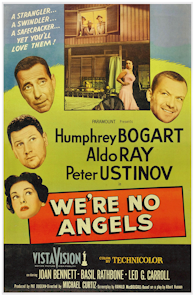 Humphrey Bogart and Michael Curtiz reunited 13 years after Casablanca for a Christmas-time comedy. Based on the stage play My Three Angels, the film We’re No Angels tells the tale of three escaped convicts who help a merchant and his family in a French coastal town at the Christmas season (or more aptly saison de noël).
Joining Bogart in wearing the stripes are Aldo Ray and Peter Ustinov. Leo G. Carroll and Joan Bennett play the merchant and his wife, while Basil Rathbone is his oiliest as an unscrupulous relative. This movie has it all: romance, intrigue, and humor.
Wisely, neither Curtiz nor screenwriter Ranald MacDougall tried to “open up” the play too much. The movie hews closely to the source material and is set largely in the merchant’s store. In this holiday-themed morality tale, the convicts are more moral than the “upstanding” citizens. The family and the convicts come to realize this. In its own way, it has a “happily ever after” ending, or at least an ending of just desserts.
Bogart was not known for his comedies. But he is wonderfully wry in this movie. Paired with Sabrina, this makes one wonder what his career might have been had he lived longer. He certainly could have slipped easily into character parts in both dramas and comedies.
 Today’s Christmas movies take a darkly comic turn with Billy Wilder’s Stalag 17 and The Apartment.
William Holden won an Oscar for his heroic-anti-hero Sefton in 1953’s Stalag 17. Set in a German POW camp during World War II, it tells the story of a group of Americans who share a barracks. Holden’s character is a black market profiteer who is disliked by most of his fellow prisoners. Otto Preminger plays the iron-fisted commandant of the stalag. Robert Strauss, Harvey Lembeck, Don Taylor, Richard Erdman, Neville Brand, Gil Stratton and Robert Shawley play other residents of the barracks.
Wilder’s movie was based on a play written by Donald Bevan and Edmund Trzcinski. The two playwrights had actually spent time in a Stalag during WWII. The latter also had a bit part in the movie. Once “Hogan’s Heroes” started airing on TV, the makers of Stalag 17 sued for plagiarism since they had pitched it as a TV series in the 1960s. The case was settled out of court.
Stalag 17 is a layered story with much humor in such a depressing setting. It is also a mystery as the barracks residents seek to determine who is sharing their secrets.
Wilder would return to Christmas Eve and a different type of hero in 1960’s The Apartment. Jack Lemmon plays a rising corporate executive who tries to succeed by letting his superiors use his apartment for their assignations. Complications arise when he falls in love with Shirley MacLaine, who is involved with his boss played by Fred MacMurray. Others in the cast include Hope Holiday as a barfly who meets Lemmon in a bar on Christmas Eve, Ray Walston, Edie Adams, Jack Kruschen and David Lewis. David White, better known as Larry Tate on “Bewitched,” plays a less honorable businessman in this movie.
This is definitely an adult comedy. It subtly shifts between comedy and drama. Like Stalag 17, Wilder chose to shoot this movie in black and white to add to its mood. These films serve as reminders that in the 1950s and early 1960s, the choice of filmstock really lent a tone to the movie.
The chemistry between Lemmon and MacLaine is palpable. They both play lovable losers that the audience wants to root for. MacMurray, who had starred in Wilder’s Double Indemnity, is unafraid to play an unlikable character. Interestingly he was just starting his run in “My Three Sons” when this film came out.
The Apartment won five Oscars: Best Picture, Best Director (Wilder), Best Original Screenplay (Wilder and I.A.L. Diamond), Black & White Art Direction and Film Editing. It was also nominated for five other Oscars including Lemmon (Actor), MacLaine (Actress) and Kruschen (Supporting Actor).
Billy Wilder was a genius of a filmmaker. These two films are testaments to that fact.
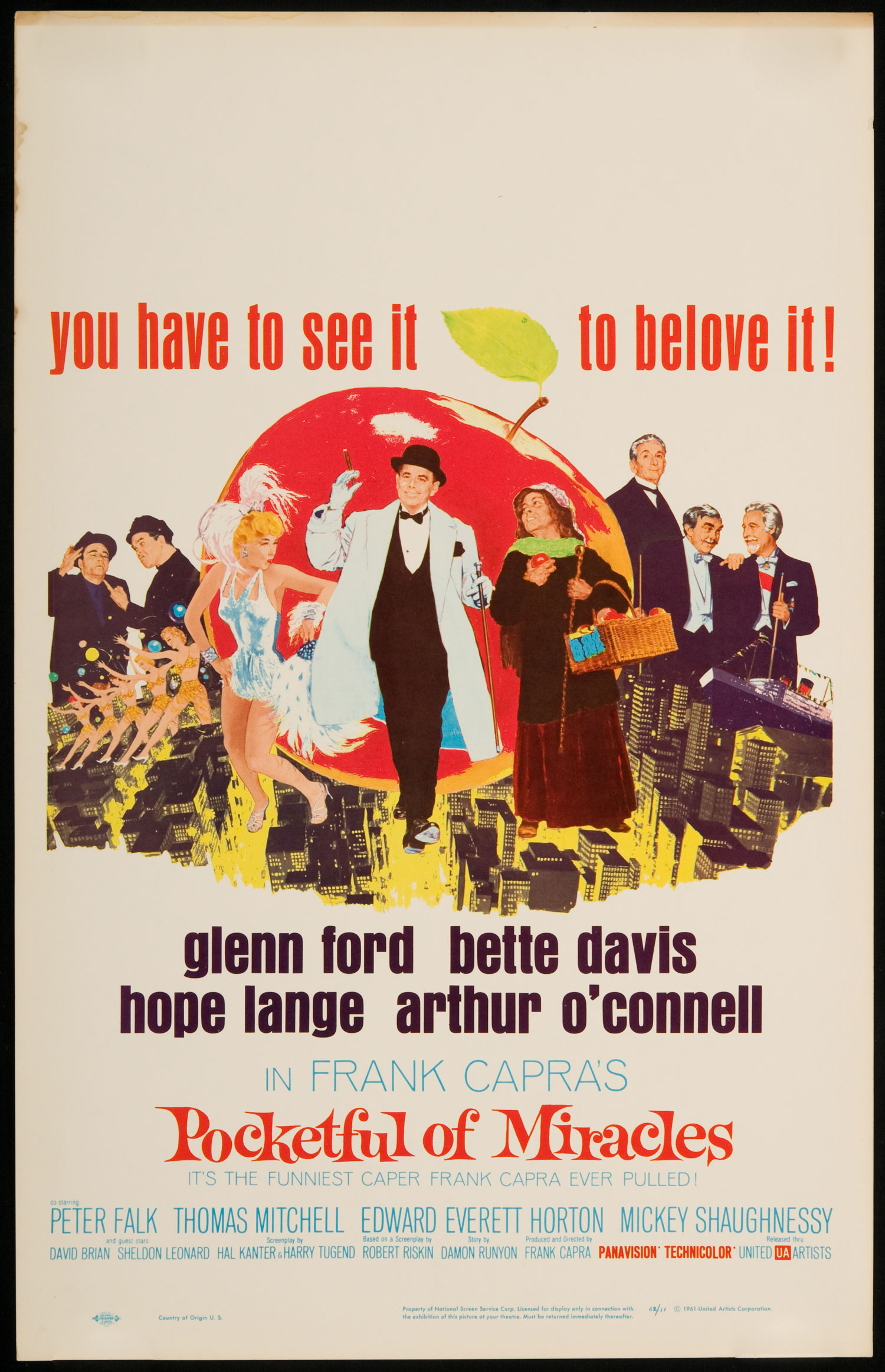 Yesterday’s movie featured Bette Davis cast against type as a frump. Today’s movie marks her transition into character parts. It is 1961’s Pocketful of Miracles which was Frank Capra’s final movie. Davis plays Apple Annie, a homeless woman who shakes down the other panhandlers in NYC.
In the complicated plot (based on a Damon Runyan story) Ann-Margret plays Davis’ daughter who has never met her because she has been away at boarding school in Switzerland (paid for with proceeds from Davis and her cohorts). Glenn Ford and Hope Lange play a friendly gangster and his moll. Thomas Mitchell, Peter Falk, Edward Everett Horton, Arthur O’Connell and Sheldon Leonard.
Ford, Lange and Mitchell help Davis pass herself off as a society matron during her daughter’s visit. But of course, mayhem ensues. It is a witty story filled with its share of Capraesque moments as people do the right thing for the right reasons.
Peter Falk nabbed an Oscar nomination for his wise-cracking portrayal of Joy Boy, one of Ford’s henchmen. The film was the last for Mitchell, who once again played a lovable Irish drunk as he had in Gone with the Wind, It’s a Wonderful Life, Stagecoach (winning and Oscar) and so many other films. Ann-Margret is, well, Ann-Margret. While Ford and Lange may simply walk through their parts, they are affable, relaxed performers who seem to be enjoying the company.
Davis would later become a caricature of herself. But in this movie there are still flashes of brilliance. She spends much of the movie looking unglamorous. But when she emerges as a regal society grand dame, it is clear that she still can command a room.
The climax of the movie takes place on Christmas Eve. Capra’s message of hope and redemption fits well within this setting.
 What is real?” the Velveteen Rabbit asks his strange new friend. “Real is something that happens to you when a child loves you for a long, long, time—not just to play with—but really loves you,” the old Skin Horse replies. From this moment on, the timid toy bunny longs for only one thing in the world—to become real.
But how can he become real when the boy doesn’t play with him or even notice him, let alone love him? Then one day, the Velveteen Rabbit is taken from the dark toy cupboard and finds himself in the warm arms of a sleeping child. And so he begins his journey down the long, long road to real.
This classic tale has been made “real” at the Arkansas Arts Center Children’s Theatre.
This is adapted by Keith Smith from the classic story by Margery Williams.
The final performance is at 2pm today.
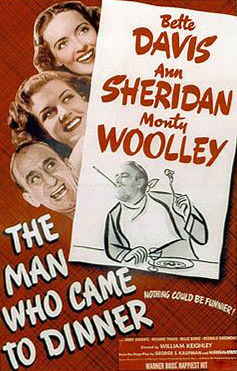 What if you had a horrible house guest, and they would never leave? That was the premise which launched Moss Hart and George S. Kaufman to write The Man Who Came to Dinner. This rip-roaring stage play was made into a 1942 movie starring Monty Woolley, Bette Davis (cast against type as a frump) and Ann Sheridan. In it Woolley plays a high-maintenance famous personality who is stuck as a guest in a house in small town Ohio due to an injury.
Others in the cast include Jimmy Durante, Billie Burke, Mary Wickes, Richard Travis, Grant Mitchell, and Reginald Gardner. This is definitely a period piece rife with references to people and events in the 1930s and early 1940s. But it is a lot of fun. Woolley gleefully skewers everyone and everything in sight as he plots and plans ploys.
Most Kaufman and Hart plays and movies have underlying social themes or pertinent messages. This one does not. Its only aim is to have fun. Brothers Julius J. Epstein and Philip G. Epstein, do a good job of condensing the Kaufman & Hart play into a 90 minute movie without losing the bite or the wit.
Why is it a Christmas movie? It takes place at Christmastime. A Christmas Eve radio broadcast is a plot point that provides a great deal of upheaval for the characters. In addition, a unique Christmas present serves as one half of a deus ex machina that helps wrap up the plotlines nicely.
Orson Welles, Don Knotts, Lee Remick, Joan Collins and Marty Feldman starred in a 1972 remake. A 2000 Broadway revival was filmed and aired on PBS with Nathan Lane, Jean Smart and Harriet Harris.
 Little Rock Culture Vulture