
Black History Month Spotlight – L.C. and Daisy Bates House

Bates HouseThe new Arkansas Civil Rights History Audio Tour was launched in November 2015. Produced by the City of Little Rock and the University of Arkansas at Little Rock allows the many places and stories of the City’s Civil Rights history to come to life an interactive tour.  This month, during Black History Month, the Culture Vulture looks at some of the stops on this tour which focus on African American history.

L.C. and Daisy Bates were civil rights activists and co-owners and publishers of the Arkansas State Press newspaper. During the 1957 school desegregation crisis of Central High School, their home functioned as headquarters for the “Little Rock Nine,” the first black students to attend the school. The Bateses’ home provided a safe-haven for “the Nine.” It was a refuge, a place to study and receive counseling to contend with frequent harassment by white students and other staunch segregationists who demonstrated outside the school.

“The Nine” also visited with the NAACP legal team of Thurgood Marshall and Wiley Branton, who worked on the school desegregation case of Aaron v. Cooper. Daisy Bates, a mentor to the Nine, was president of the Arkansas State Conference of the National Association for the Advancement of Colored People (NAACP.) For taking a stand against segregated schools, L.C. and Daisy Bates had numerous missiles hurled at their home during the school crisis and had several fiery crosses—an emblem of the white terror organization the Ku Klux Klan— burned on their lawn. Segregationists mounted a boycott of the Arkansas State Press newspaper, putting it out of business in 1959.

In 2001, it was declared a National Historic Landmark.  The house is now being restored and turned into a museum.

The app, funded by a generous grant from the Arkansas Humanities Council, was a collaboration among UALR’s Institute on Race and Ethnicity, the City of Little Rock, the Mayor’s Tourism Commission, and KUAR, UALR’s public radio station, with assistance from the Little Rock Convention and Visitors Bureau.
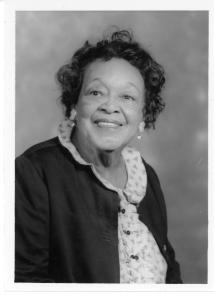
Black History Month Spotlight – Sue Cowan Williams Library

sue_cowan_williamsThe new Arkansas Civil Rights History Audio Tour was launched in November 2015. Produced by the City of Little Rock and the University of Arkansas at Little Rock allows the many places and stories of the City’s Civil Rights history to come to life an interactive tour.  This month, during Black History Month, the Culture Vulture looks at some of the stops on this tour which focus on African American history.

In 1945, Sue Cowan Williams successfully sued the Little Rock School District for equal pay for black and white teachers. The existing inequality in pay clearly did not meet the stipulation of “separate but equal” treatment of African Americans required by the law.

Williams was chair of the English Department at Dunbar High School. She had attended Spelman College in Atlanta, Talladega College in Alabama, and the University of Chicago. These impressive credentials made her an ideal standard bearer for the suit. Local lawyers, along with the NAACP’s Thurgood Marshall, successfully appealed Williams’ case to the Eighth Circuit Court of Appeals in St. Louis. In the meantime, however, Williams’ contract was not renewed at Dunbar.

After working several other jobs, she was eventually rehired in 1952. She remained at Dunbar until her retirement in 1974. Williams died in 1994. In 1997, the tenth library in the Central Arkansas Library System was dedicated as the Sue Cowan Williams Library in her honor.

The app, funded by a generous grant from the Arkansas Humanities Council, was a collaboration among UALR’s Institute on Race and Ethnicity, the City of Little Rock, the Mayor’s Tourism Commission, and KUAR, UALR’s public radio station, with assistance from the Little Rock Convention and Visitors Bureau.
Black History Month Spotlight – Horace Mann High School

Mann-SignThe new Arkansas Civil Rights History Audio Tour was launched in November 2015. Produced by the City of Little Rock and the University of Arkansas at Little Rock allows the many places and stories of the City’s Civil Rights history to come to life an interactive tour.  This month, during Black History Month, the Culture Vulture looks at some of the stops on this tour which focus on African American history.

Horace Mann Senior High School opened in 1956 as one of two new Little Rock public high schools, after the 1954 U. S. Supreme Court Brown v. Board of Education school desegregation decision. Mann was built in the predominantly black eastern part of Little Rock, while Hall High was in a predominantly affluent and white western area of residence. This plan ensured that, in practical terms, both schools would remain racially segregated. The assignment of an all-black teaching faculty to Mann and an all-white teaching faculty to Hall underscored this intent.

After Mann was built, the school board transferred black students from Dunbar High, the city’s existing segregated black high school, to Mann. Dunbar then became a junior high school. Teachers were divided and reassigned, new principals were named, and the school mascots respectively became the “Dunbar Bobcats” and the “Horace Mann Bearcats.” The schools are now Horace Mann Arts and Science Magnet Middle School and the Dunbar International Studies Magnet Middle School. In 2012, both alumni groups combined to form the National Dunbar Horace Mann Alumni Association.

The app, funded by a generous grant from the Arkansas Humanities Council, was a collaboration among UALR’s Institute on Race and Ethnicity, the City of Little Rock, the Mayor’s Tourism Commission, and KUAR, UALR’s public radio station, with assistance from the Little Rock Convention and Visitors Bureau.

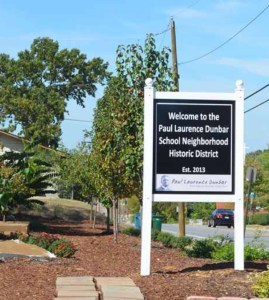
Black History Spotlight – Dunbar Historic Neighborhood

DunbarNeighborhoodThe new Arkansas Civil Rights History Audio Tour was launched in November 2015. Produced by the City of Little Rock and the University of Arkansas at Little Rock allows the many places and stories of the City’s Civil Rights history to come to life an interactive tour.  This month, during Black History Month, the Culture Vulture looks at some of the stops on this tour which focus on African American history.

The Paul Laurence Dunbar School Historic District played an important role as the center of Little Rock’s African American community from the mid-1800s to the mid-1900s.  Development began around Wesley Chapel, organized in 1853.

The neighborhood expanded after the Civil War to become home to many African Americans noted for their success in a number of fields, including business, politics, religion, education, law, music, and medicine. Among the historically black institutions that were founded in the neighborhood and remain there today are several churches, including Wesley Chapel United Methodist, Bethel A.M.E., Mount Pleasant Baptist, Mount Zion Baptist, and Union A.M.E.; and two colleges, Arkansas Baptist and Philander Smith.

The existing Dunbar School replaced an older high school that was named for Mifflin Gibbs, a prominent African American lawyer and political leader who lived in the neighborhood.  Today, Gibbs Elementary School continues the recognition of Gibbs.

The app, funded by a generous grant from the Arkansas Humanities Council, was a collaboration among UALR’s Institute on Race and Ethnicity, the City of Little Rock, the Mayor’s Tourism Commission, and KUAR, UALR’s public radio station, with assistance from the Little Rock Convention and Visitors Bureau.

Black History Month Spotlight – Dunbar High School

dunbarimage2The new Arkansas Civil Rights History Audio Tour was launched in November 2015. Produced by the City of Little Rock and the University of Arkansas at Little Rock allows the many places and stories of the City’s Civil Rights history to come to life an interactive tour.  This month, during Black History Month, the Culture Vulture looks at some of the stops on this tour which focus on African American history.
After Little Rock High School (now Central High School) was completed in 1927, the building of Paul Laurence Dunbar High School was completed in 1929.  Money came from the Rosenwald Fund, founded by Julius Rosenwald, president of Sears, Roebuck and Company, and from local black residents.  Local blacks insisted on adding college preparatory classes to the vocational-industrial ones that were offered in black schools at the time. The building, modeled after the white high school, housed grades seven through twelve plus a junior college.  Black students came from all over Arkansas to take advantage of its educational opportunities.

When Horace Mann High School opened as a segregated school in 1956, Dunbar became a junior high school. A Dunbar-Mann Alumni Association, whose members live throughout the country, still helps to support both schools.  In the 1930s, Charlotte Andrews Stephens, the first black public school teacher in Little Rock, was on the faculty at Dunbar, completing seventy years of teaching with the district.  In the 1940s, Sue Cowan Williams, English Department chair, lost her job when she sued the Little Rock School District for equal pay for black and white teachers.

The app, funded by a generous grant from the Arkansas Humanities Council, was a collaboration among UALR’s Institute on Race and Ethnicity, the City of Little Rock, the Mayor’s Tourism Commission, and KUAR, UALR’s public radio station, with assistance from the Little Rock Convention and Visitors Bureau.

Black History Month Spotlight – Arkansas Baptist College

The new Arkansas Civil Rights History Audio Tour was launched in November 2015. Produced by the City of Little Rock and the University of Arkansas at Little Rock allows the many places and stories of the City’s Civil Rights history to come to life an interactive tour.  This month, during Black History Month, the Culture Vulture looks at some of the stops on this tour which focus on African American history.


Arkansas Baptist College, established in 1884 by Rev. E. C. Morris and the National Baptist Convention, trained black students to become ministers and teachers. One of the earliest historically black colleges in the state, Arkansas Baptist College was first hosted by neighborhood churches, including Mt. Zion Baptist. In 1885, the College finally settled at what is now 16th and Dr. Martin Luther King, Jr., Drive.

Reverend Joseph A. Booker was appointed president of Arkansas Baptist College in 1887 and served for nearly forty years. Born into slavery, Booker was later educated at Nashville Institute in Tennessee. He not only scored early success for the college but also won acclaim as editor of Baptist Vanguard, a weekly publication produced on campus. Noted as a staunch opponent of Jim Crow segregation laws in Little Rock, Booker fought the Separate Coach Law of 1891.

In 2006, the College launched the African American Leadership Institute and in 2015 the Scott Ford Center for Entrepreneurship and Community Development. Dr. Fitzgerald Hill has directed the resurgence of Arkansas Baptist College, securing federal grants and recruiting more students.

The app, funded by a generous grant from the Arkansas Humanities Council, was a collaboration among UALR’s Institute on Race and Ethnicity, the City of Little Rock, the Mayor’s Tourism Commission, and KUAR, UALR’s public radio station, with assistance from the Little Rock Convention and Visitors Bureau

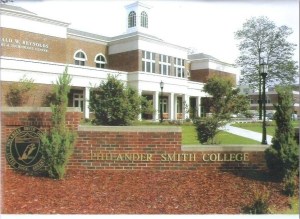
Black History Month Spotlight – Philander Smith College

reynoldslibraryphilandersmithThe new Arkansas Civil Rights History Audio Tour was launched in November 2015. Produced by the City of Little Rock and the University of Arkansas at Little Rock allows the many places and stories of the City’s Civil Rights history to come to life an interactive tour.  This month, during Black History Month, the Culture Vulture looks at some of the stops on this tour which focus on African American history.

Philander Smith College is Little Rock’s oldest historically black educational institution. It was established in 1877 as Walden Seminary, by the African Methodist Episcopal Church to educate ministers. Its name changed after an endowment in 1882 by the widow of Illinois philanthropist Philander Smith. Wesley Chapel has always been associated with the college’s activities. The enslaved William Wallace Andrews founded Wesley in 1854 on land donated by his owner, U.S. Senator Chester Ashley. In 1864, parishioners celebrated their freedom with a “Parade of Emancipation.”

Pastors at Wesley included Rev. J. C. Crenchaw, president of the Little Rock NAACP, and Rev. Negail Riley, leader of the Black United Fund. In the 1960’s, Philander Smith students participated in “sit-ins” at downtown lunch counters.

Noted alumni include Dr. Joycelyn Elders, former U.S. surgeon general; professional athletes Elijah Pitts of the Green Bay Packers; Hubert “Geese” Ausbie of the Harlem Globetrotters; and Milton Pitts Crenchaw, a Tuskeegee Airman; James Hal Cone, a pioneer of black liberation theology; Lottie Shackelford, former Mayor of Little Rock; Al Bell, founder of Stax Records and former president of Motown Records; and Stephanie Flowers, Arkansas State Senator.

The app, funded by a generous grant from the Arkansas Humanities Council, was a collaboration among UALR’s Institute on Race and Ethnicity, the City of Little Rock, the Mayor’s Tourism Commission, and KUAR, UALR’s public radio station, with assistance from the Little Rock Convention and Visitors Bureau