
Black History Month Spotlight – Little Rock Cemeteries

Mount Holly greyThe new Arkansas Civil Rights History Audio Tour was launched in November 2015. Produced by the City of Little Rock and the University of Arkansas at Little Rock allows the many places and stories of the City’s Civil Rights history to come to life an interactive tour.  This month, during Black History Month, the Culture Vulture looks at some of the stops on this tour which focus on African American history.

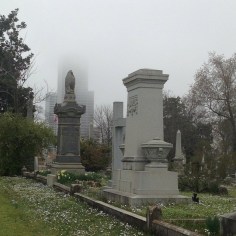
Mount Holly Cemetery: Broadway at Twelfth Street, est. 1843

Oakland and Fraternal Historic Cemetery Park: 2101 S. Barber, est. 1863

Haven of Rest Cemetery: 1702 Twelfth Street, est. 1903

National African Americans and important civil rights leaders are interred in several local cemeteries.

Mount Holly Cemetery is the final resting place of enslaved people, who were buried in their owner’s family plots, and the graves of several free blacks in the mid-1800s. One notable black leader buried here is Nathan Warren, founding pastor of Bethel AME Church. A marker is dedicated to Quatie Ross, wife of Cherokee Chief John Ross, who died along the Trail of Tears in 1839.

Oakland and Fraternal Historic Cemetery Park is composed of several cemeteries serving different communities: Oakland, Confederate, National, Jewish, and Fraternal, an historically black cemetery. Civil rights advocates buried in Fraternal include Mifflin Wistar Gibbs, John E. Bush, Charlotte Andrews Stephens, Dr. John Marshall Robinson, Isaac Gillam, Sr. and Jr., Asa l. Richmond, as well as members of the influential Pankey and Ish families.

Haven of Rest Cemetery is the largest cemetery for black people in Little Rock. Among the graves here are those of Daisy Gatson Bates, civil rights activist and mentor to the Little Rock Nine; attorney Scipio Africanus Jones; and Rev. Joseph Booker, president of Arkansas Baptist College.

The app, funded by a generous grant from the Arkansas Humanities Council, was a collaboration among UALR’s Institute on Race and Ethnicity, the City of Little Rock, the Mayor’s Tourism Commission, and KUAR, UALR’s public radio station, with assistance from the Little Rock Convention and Visitors Bureau

Black History Month Spotlight – Mt Zion Baptist Church

Mount Zion Baptist Church, Little Rock, AR.JPGThe new Arkansas Civil Rights History Audio Tour was launched in November 2015. Produced by the City of Little Rock and the University of Arkansas at Little Rock allows the many places and stories of the City’s Civil Rights history to come to life an interactive tour.  This month, during Black History Month, the Culture Vulture looks at some of the stops on this tour which focus on African American history.

Mt. Zion Baptist Church was organized in 1877 and is one of the earliest black congregations in Little Rock. The church was rebuilt in its current location in 1927 under the leadership of Rev. Fred T. Guy. From the late 1800s to the present, local church leaders, their congregants, grassroots groups, civic organizations, fraternal societies, and black business owners fought for equal rights.

A warrior in the community and tireless human rights advocate, Rev. Fred T. Guy, Mr. Zion’s pastor, challenged Superintendent of Schools Virgil Blossom and the Little Rock School Board to desegregate schools in 1957. “Next to the law of God, the Constitution of the United States means the most to me. When you start to tinker with the Constitution, it becomes awfully important to us,” said Rev. Guy.

The app, funded by a generous grant from the Arkansas Humanities Council, was a collaboration among UALR’s Institute on Race and Ethnicity, the City of Little Rock, the Mayor’s Tourism Commission, and KUAR, UALR’s public radio station, with assistance from the Little Rock Convention and Visitors Bureau

Black History Month Spotlight – Taborian Hall and Dreamland Ballroom

The new Arkansas Civil Rights History Audio Tour was launched in November 2015. Produced by the City of Little Rock and the University of Arkansas at Little Rock allows the many places and stories of the City’s Civil Rights history to come to life an interactive tour.  This month, during Black History Month, the Culture Vulture looks at some of the stops on this tour which focus on African American history.

Completed in 1918, Taborian Hall stands as one of the last reminders of the once-prosperous West Ninth Street African-American business and cultural district. West Ninth Street buildings included offices for black professionals, businesses, hotels, and entertainment venues. In 1916, the Knights and Daughters of Tabor, a fraternal insurance organization, hired local black contractor Simeon Johnson to enlarge an existing building to accommodate their activities, other offices and a ballroom.

During World War I, black soldiers from Camp Pike came to the Negro Soldiers Service Center here. In World War II, Taborian Hall was home to the Ninth Street USO, catering to black soldiers from Camp Robinson. By 1936, Dreamland Ballroom hosted basketball games, boxing matches, concerts and dances.

A regular stop for popular black entertainers on the “Chitlin’ Circuit,” Dreamland hosted Cab Callaway, Count Basie, Duke Ellington, Ella Fitzgerald, Louis Armstrong, B.B. King, Earl “Fatha” Hines and Ray Charles. Arkansas’s own Louis Jordan also performed here. Between the 1960s and 1980s, West Ninth Street declined, and many buildings were demolished. In 1991, Taborian Hall was renovated to house Arkansas Flag and Banner. Once again, Dreamland Ballroom hosts concerts and social events.

The app, funded by a generous grant from the Arkansas Humanities Council, was a collaboration among UALR’s Institute on Race and Ethnicity, the City of Little Rock, the Mayor’s Tourism Commission, and KUAR, UALR’s public radio station, with assistance from the Little Rock Convention and Visitors Bureau.

Black History Month Spotlight – First Missionary Baptist Church

The new Arkansas Civil Rights History Audio Tour was launched in November 2015. Produced by the City of Little Rock and the University of Arkansas at Little Rock allows the many places and stories of the City’s Civil Rights history to come to life an interactive tour.  This month, during Black History Month, the Culture Vulture looks at some of the stops on this tour which focus on African American history.

Established in 1845, First Missionary Baptist Church is one of the oldest black congregations in Arkansas. The first church building was completed by 1847, with the current Gothic Revival building constructed in 1882.

In 1891, more than 600 blacks gathered here to protest the state’s recently enacted Separate Coach Law that required racial separation in passenger cars and separate waiting rooms in train stations. They marched from the church to the then state capitol, now the Old State House., to dispute laws that denied black people their constitutional rights. Historians cite that black boycotts in Little Rock, Pine Bluff, and Hot Springs on May 27, 1903, the first day of the streetcar law, caused a 90 percent drop in black patrons on Little Rock streetcars.

In May 1958, Dr. Martin Luther King, Jr., traveled to Little Rock here to attend the graduation ceremony of Ernest Green, the first African American to graduate from Central High School. In 1963, four months before the famous “I Have a Dream” speech, Dr. King visited Little Rock to provide the First Missionary Baptist Church’s 118th anniversary sermon.

The app, funded by a generous grant from the Arkansas Humanities Council, was a collaboration among UALR’s Institute on Race and Ethnicity, the City of Little Rock, the Mayor’s Tourism Commission, and KUAR, UALR’s public radio station, with assistance from the Little Rock Convention and Visitors Bureau.

Black History Month Spotlight – Mosaic Templars Cultural Center

The new Arkansas Civil Rights History Audio Tour was launched in November 2015. Produced by the City of Little Rock and the University of Arkansas at Little Rock allows the many places and stories of the City’s Civil Rights history to come to life an interactive tour.  This month, during Black History Month, the Culture Vulture looks at some of the stops on this tour which focus on African American history.

The Mosaic Templars Cultural Center and Museum collects, preserves, interprets and celebrates Arkansas’s unique African American political, economic, and social achievement from 1865 to 1950. The Center resides in the footprint of the original Mosaic Templars of America National Headquarters and Annex Buildings.

The permanent museum exhibits depict historic West Ninth Street as a thriving commercial and social hub, focusing on the black entrepreneurship, Templars organization, and the legacy of black legislators. Between 1868 and 1893, eighty-five African Americans served in the Arkansas General Assembly. The majority served in the House, with nine in the Senate. Election laws passed in 1891, together with a poll tax in 1832, ended the election of African Americans to the legislature. No black person served again until the General Assembly in 1973.

In addition to community educational programs, the Center offers a genealogy research room, an art collection created by local talent, and a well-stocked store. The Center’s third floor features a replica of the original Headquarters Building auditorium and the Arkansas Black Hall of Fame galleries.

The Center is a museum of the Department of Arkansas Heritage and admission is free.

The app, funded by a generous grant from the Arkansas Humanities Council, was a collaboration among UALR’s Institute on Race and Ethnicity, the City of Little Rock, the Mayor’s Tourism Commission, and KUAR, UALR’s public radio station, with assistance from the Little Rock Convention and Visitors Bureau.

Black History Month Spotlight – Mosaic Templars of America

The new Arkansas Civil Rights History Audio Tour was launched in November 2015. Produced by the City of Little Rock and the University of Arkansas at Little Rock allows the many places and stories of the City’s Civil Rights history to come to life an interactive tour.  This month, during Black History Month, the Culture Vulture looks at some of the stops on this tour which focus on African American history.

The Mosaic Templars of America was formed as a business in the late 1870s by Arkansas freedmen John E. Bush and Chester W. Keatts to provide insurance and other services to black people, and was incorporated as a fraternal organization in 1882. The Mosaic Templars name was derived from the biblical Moses who led his people out of bondage and relates to black America’s journey out of slavery.

By the 1920s the Templars’ organization extended to 26 states and six Caribbean nations. At the time, as one of the largest black-owned business enterprises in the world, Templars’ holdings included the original insurance company, a building and loan association, a publishing company, a business college, a nursing school and a hospital. For more than 40 years, the Templars Headquarters Building and the adjoining Annex and State Temple buildings on Broadway anchored the city’s black business district on West Ninth Street. Like many businesses, black and white, the Templars did not survive the era of the Great Depression.

Though the original Headquarters building burned in 2005, the Mosaic Templars Cultural Center is modeled on the original design. Exhibits highlight black business and self-achievement from Reconstruction to the 1950s in Arkansas and the nation.

The app, funded by a generous grant from the Arkansas Humanities Council, was a collaboration among UALR’s Institute on Race and Ethnicity, the City of Little Rock, the Mayor’s Tourism Commission, and KUAR, UALR’s public radio station, with assistance from the Little Rock Convention and Visitors Bureau.


Black History Month Spotlight – West Ninth Street

BHM16 W9thThe new Arkansas Civil Rights History Audio Tour was launched in November 2015. Produced by the City of Little Rock and the University of Arkansas at Little Rock allows the many places and stories of the City’s Civil Rights history to come to life an interactive tour.  This month, during Black History Month, the Culture Vulture looks at some of the stops on this tour which focus on African American history.

As early as the 1840s and reaching 1880, the businesses of both black and white races existed in what is now known as Downtown Little Rock. In the last years of the 1800s, a prolific business broker and social center for African Americans dominated West Ninth Street.

In 1898, D. B. Gaines, a local black doctor who also served as pastor of the Mt. Pleasant Baptist Church, wrote a book called Racial Possibilities as Indicated by the Negroes of Arkansas. The last chapter, “Colored Business Directory of Little Rock,” documents the existence of a vibrant commercial center with almost twenty churches and hundreds of dealers of black people.

The black district was home to doctors, dentists, lawyers and entrepreneurs such as restaurant owners, newspaper editors, pharmacists, barbers, tailors, and merchants.

This city within a city, met the needs of the black community since the early 1880 to the 1950s. West Ninth Street saw its peak between 1870 and 1950. Since the 1960s, a number of factors including desegregation, urbanization, urban renewal and the construction of I-630 caused its decline.

The app, funded by a generous grant from the Arkansas Humanities Council, was a collaboration among UALR’s Institute on Race and Ethnicity, the City of Little Rock, the Mayor’s Tourism Commission, and KUAR, UALR’s public radio station, with assistance from the Little Rock Convention and Visitors Bureau.