
Remember the Fallen on Memorial Day at Mount Holly Cemetery

Today is Memorial Day – a time to pay tribute to the men and women in uniform who died in service to their country.

As a way to give this recognition, today would be a good day to visit a cemetery. One of Little Rock’s most storied cemeteries is Mount Holly Cemetery. There are numerous persons buried there who died while in service to their country.

One of them is 2Lt Carrick W. Heiskell, son of Arkansas Gazette editor J. N. Heiskell.  2Lt Heiskell died while flying for the Air Transport Command in the Himalayas during World War II.  He was posthumously the recipient of the Distinguished Unit Emblem, Purple Heart, and the Air Medal.

Founded in 1843, Mount Holly has been called “The Westminster Abbey of Arkansas.” Thousands of visitors come each year. Those interested in history come to see the resting places of the territorial citizens of the state, including governors, senators, generals, black artisans, and even a Cherokee princess. For others the cemetery is an open air museum of artistic eras: Classical, Victorian, Art Deco, Modern––expressed in gravestone styles from simple to elaborate. Some come to read the epitaphs that range from heartbreaking to humorous to mysterious.

Though a City of Little Rock facility, the cemetery is maintained by the Mount Holly Cemetery Association, a non-profit organization with a volunteer Board of Directors. The cemetery is located at 1200 South Broadway in Little Rock. Gates are open from 8 a.m. until 5 p.m. in the summer and from 8 a.m. until 4 p.m. in the winter.

Little Rock Look Back: Final Graduation of Dunbar High School

On May 27, 1955, on the stage of Robinson Auditorium, the Dunbar High School senior class graduated. This academic year marked not only the 25th anniversary of Dunbar’s opening, but it was the last year that the school building would offer junior high through junior college classes.
In the fall of 1955, the new Horace Mann High School would open. Dunbar would continue to be open, but only as a junior high.  (Though no reason was given, the junior college component ended in May 1955.)

The new Mann High School was constructed, in part, as a way to delay any integration plans for the Little Rock School District.  With a new second all-white high school in the works for Little Rock, it was thought that a new African American school would placate the African-American community by not only giving them a new building, but relieving the overcrowding at Dunbar.

But on May 27, 1955, and the days leading up to it, the focus was on celebrating the final graduation class and the 25th anniversary of Dunbar High School.  On May 25, teachers who had taught for 25 years at the school, and original teachers who retired from the school were honored.

The school’s original principal, Dr. John H. Lewis, was the commencement speaker.  The current principal, Dr. L. W. Christophe presided over the awarding of the diplomas and announcements of scholarships.  Among the higher education institutions to which they received scholarships were the University of Michigan, Wiley College, Tennessee State, Arkansas AM&N, Talladega College, and Philander Smith College.

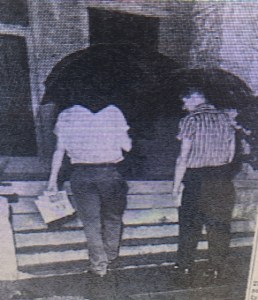
While the Arkansas Gazette and Arkansas Democrat  both DID run stories on the graduation, it was hardly equal to the coverage they gave Central High School.  In fact, on the day after Dunbar’s graduation, the Democrat ran a photo of two Central graduates huddled under an umbrella in the rain – three days after the ceremony took place.

In 1971, Mann ceased its status as a high school as well.  Today, both Mann and Dunbar serve as middle schools within the Little Rock School District.

Little Rock Look Back: Sermons, TV Shows Dominate Final Day of 1959 Recall Campaign

A rainy Sunday afternoon did not stop STOP canvassers on May 24, 1959.

Sunday, May 24, 1959, was election eve for the Recall Campaign.  As such, the election figured into some Sunday morning sermons.  Reverend M. L. Moser Jr. spoke from the pulpit of his church and described the issue of segregation as Biblical. As many had before him, and would after him, he used the story of Noah’s three sons as a way to justify segregation of the races.

(Supposedly one of the sons was the father of the white race, one the father of the African American race, and one the father of the Asian race.  In this narrative, no explanation is given for other variations such as Native Americans and other indigenous people or persons from the sub-continent of India.  Also excluded is the likely race of everyone in the story – those who live in the Middle East.)

At Trinity Episcopal Cathedral, Dean Charles A. Higgins prayed for the schools but did not tell his parishioners how to vote.  Rev. Aubrey G. Walton at First Methodist Church spoke about the schools needing to be free from politics and pressure groups.  (Though Rev. Walton did later appear that evening on a STOP sponsored TV show.)

Embattled School Board president Ed McKinley refused requests from the media and others to divulge his plans for the future of the Little Rock School District.  Earlier he had stated he had an idea on how the schools could be reopened and segregated, but still remain in compliance with the courts.  Across the river, segregationists were planning a rally in North Little Rock to head off any plans for future integration on the north side.  Congressman Alford had already agreed to speak at this rally.

In paid time on TV, Governor Faubus spoke at length in a criticism of the Arkansas Gazette. He called the fired teachers pawns in a larger game.  He noted in his remarks that he did not expect to sway any votes by this point.

Not to be outdone, STOP was on all three TV stations. Sometimes the program was aired on more than one station simultaneously.  In an appearance sponsored by STOP, William S. Mitchell noted that May 24 was coincidentally Children’s Day.  He noted that never before in Little Rock history had so many people volunteered for a cause as those who had worked on STOP and with STOP.  The Women’s Emergency Committee, PTA Council, labor unions, and numerous other organizations had come together to raise money, knock on doors, and otherwise get the word out.

Finally, it was all over but the voting.  Nineteen days of outrage, exasperation, and hyperbole was coming to an end.  When dawn broke, it would be election day.

Little Rock Look Back: End near for 1959 School Board Recall Election

May 23, 1959, was a Saturday. It was also two days before the School Board recall election.  With it being a Saturday, it was the last full day for door knocking as supporters for all sides were busy trying to get out the vote.

Both sides were confident of victory.  Before a crowd of 1,000 in MacArthur Park, segregationists Rep. Dale Alford and Mississippi congressman John Bell Williams berated Harry Ashmore and the Arkansas Gazette.

STOP chair Dr. Drew Agar and campaign chair William Mitchell predicted it would be the largest turnout in Little Rock school election history.  They also stated that Gov. Faubus’ TV appearance criticizing STOP had actually pushed people over to their side.

Echoing Agar and Mitchell, the Pulaski County Election Commission predicted 30,000 of the district’s 42,000 registered voters would cast ballots.  The previous record of 27,000 had been cast in September 1958 when voters decided to keep the high schools closed.  By contrast, 14,300 voted in the December 1958 election which had selected the six school board members now on the ballot for recall.  On May 22, the final day of absentee ballot voting, 205 absentee votes had been cast bringing it to a total of 455 absentee ballots.

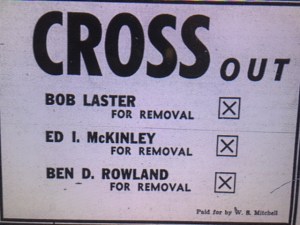
William S. Mitchell, who in addition to being a renowned attorney, apparently had a wicked sense of humor.  He used CROSS’s name against them in ads (placed throughout the newspaper) which urged voters to “Cross” out the names of the three candidates being backed by CROSS.

Little Rock Look Back: Dan T. Sprick

Future Little Rock Mayor Dan T. Sprick was born on May 19, 1902.  He served three terms on the Little Rock City Council (from 1935 to 1941).  In 1945, he was elected Mayor of Little Rock and served one term. During his tenure on the City Council, he was the sole vote against locating Robinson Auditorium at Markham and Broadway.  He had favored another location.

He was not alone, however, in being held in contempt of court and spending part of the day in jail.  On Monday, December 4, a dozen of Little Rock’s aldermen (which included Sprick) reported to the county jail to serve sentences for contempt of court. The previous Monday, the twelve council members had voted against an ordinance which had been ordered by the judge in an improvement district matter. The other aldermen had either voted in the affirmative or had been absent. Because the twelve had refused to change their votes since that meeting, the judge ordered them jailed.  After the aldermen changed their votes later in the day, they were freed.

His tenure as Mayor was relatively quiet. He took office the same month that World War II ended. While in office, the Sprick administration was marked by growth in the city budget and in city positions. As a part of that growth, there were many more new purchases taking place which had prompted extra scrutiny of the City’s purchasing procedures. A thorough investigation toward the end of his tenure found no malfeasance or misfeasance, it did note that the city needed to do a better job of anticipating cash flow. Much of the City’s focus during the Sprick tenure was on growth and keeping up infrastructure needs.

Sprick later served for ten years in the Arkansas State Senate (from 1961 to 1970).  During his tenure in the Senate, Sprick was closely aligned with Gov. Orval Faubus.  When the Little Rock high schools had been closed a year to ensure segregation, Sprick had served on the board of a private school set up by some of the leaders of the segregation movement.

His time in the Senate was also marked by controversy.  He was one of three Senators to opposed Muhammad Ali’s speaking at the University of Arkansas at Fayetteville.  After an Arkansas Gazette editorial lambasted him, Sprick sued the paper for libel. The Gazette settled with him out of court because his health was poor.

One of the landmark pieces of legislation he guided through the Arkansas General Assembly allowed cities to collect advertising and promotion taxes.  The 1972 and 1973 upgrades to Robinson Center were funded by this tax (as have some subsequent upgrades). So the building he voted against while on the LR City Council benefited from legislation he championed while in the General Assembly.

Sprick died in January 1972.

Little Rock Look Back: Gov. Baxter returns after end of Brooks-Baxter War

On the morning of May 19, 1874, Joseph Brooks cleaned out his belongings from the gubernatorial office in the 1842 Arkansas State Capitol (now the Old State House) and disappeared to points unknown.
The beginning of the end of his stint claiming to be Arkansas Governor came on May 15 when President US Grant accepted the recommendation of his Attorney General that found Elisha Baxter was the duly elected Governor of Arkansas.

Following Brooks’s departure, the grounds and building were in shambles.  A Gazette reporter noted that barricades had been built on the lawn of the building.  The front and back doors remained, but their facings had been removed to make it easier to roll big weapons and equipment in and out of the building.

Inside, furniture was in disarray and broken.  The bookcases in the state library had been turned on their sides to serve as tables.  The reporter described the smell as composed of “a mixed perfume of sour bacon and human beings.”

In preparation for the return of Gov. Baxter, crews were busy trying to restore order in the building. The Senate Chambers were nearly put back in order that day, but the House Chambers needed more attention.

As another illustration of the disarray in state government between April 15 and May 19, the state treasurer, Henry Page, told the newspaper that he had not cut a single check at the request of the Brooks administration.  He stated that he had not denied the request, he just delayed responding to it.

Finally that day, Governor Baxter arrived at the head of a ceremonial parade of carriages.  Among those who accompanied the governor was Arkansas Gazette founder William Woodruff.  In the next carriage, future US Senator and Attorney General Augustus Garland sat with reporters from the New York Times and Arkansas Gazette.

Upon arriving at the Capitol grounds, Baxter delivered a speech.  101 guns were fired in salute to him.  The cannon on the capitol grounds (nicknamed Old Lady Baxter) was shot off several times.  A retinue of Little Rock’s ladies pulled the lanyard to detonate the cannon.

As part of President Grant’s order to end the Brooks-Baxter War, the ground was laid for a new Arkansas Constitution, the end of Reconstruction, and the re-enfranchisement of Democratic voters.  In short order, the 1874 constitution, under which Arkansas still operates, was adopted.  Many of the Republicans and African American office holders soon found themselves out of power. And African Americans were completely disenfranchised.

It would be 92 years before Arkansas would again elect a Republican to be Governor.  The adoption of the new constitution took the term of governor and other constitutional officers from four years to two years.  In 1874, he retired to Batesville and lived there until his death in 1899.  Brooks remained in Little Rock until his death in 1877.

Little Rock Look Back: Brooks Robinson

On May 18, 1937, Brooks Calbert Robinson, Jr. was born in Little Rock.  His father worked for Colonial Bakery and later the Little Rock Fire Department.  His mother worked for Sears and later state government.

As a boy, Brooks was a paper boy for the ARKANSAS GAZETTE and sold concessions at Lamar Porter Field.  He also played baseball there in youth leagues.

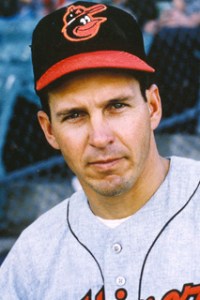
After graduating from Little Rock Central High School in 1955, he was drafted by the Baltimore Orioles.  He would spend his entire Major League Baseball career with the Orioles.   His primary position was Third Base for the team but also was a powerful batter.

When he retired at the end of the 1977 season, Robinson had amassed many honors including 2 World Series Championships, 1 World Series MVP, 1 American League MVP, 16 Golden Glove Awards, 18 times in the All-Star game.  At the end of his final season, his number 5 was retired by the Orioles.  In 1983, his first year of eligibility, he was selected to the Major League Baseball Hall of Fame.

He spent his career and since retirement engaged in a number of charitable endeavors. Robinson was beloved by teammates and fans, as well as respected by opponents and the media.  There is no telling how many babies in Baltimore were named Brooks or Robinson during and after his 23 season career.

Robinson has also leant his name and time to efforts to restore Lamar Porter Field here in Little Rock.