Little Rock Look Back: Founding Fathers of Little Rock

Fathers DayThere are several men who can be considered founding fathers of Little Rock: William Lewis, the first settler, who stayed for a few months in 1814; Roswell Beebe, who acquired most of the land and laid out streets as well as providing land for public buildings and a cemetery; Amos Wheeler, who was the first postmaster and later a land agent; Jesse Brown, who founded the first school and later served as mayor; and William Woodruff, the founder of the Arkansas Gazette.

There are three other men who were not only founding fathers, but also actual fathers to other leaders. They are: Dr. Matthew Cunningham, Major Nicholas Peay and Chester Ashley.

Dr. Cunningham was one of the first residents of Little Rock. He arrived in 1821 and was shortly joined by his family.  Dr. Cunningham would be Little Rock’s first physician. His son Chester was the first child born in Little Rock.  Dr. Cunningham later served as Little Rock’s first mayor from January 1832 to January 1833.  His stepson, Charles P. Bertrand, later served as Mayor of Little Rock from January 1855 to January 1857.  This is the closest Little Rock has ever had to a father and son both serving as Mayor.

Major Nicholas Peay arrived in Little Rock in 1825.  He quickly became engaged in civic affairs and served as a trustee of Little Rock (a precursor to a city council).  In the 1830s, Major Peay served on the Little Rock City Council. In that capacity, he also served as Acting Mayor of Little Rock.  His son, Gordon Neill Peay, would serve as Mayor of Little Rock from 1859 to 1861.  A grandson son, Ashley Peay, was a Little Rock alderman in the 1920s. A great-great-grandson, Joseph B. Hurst, served on the Little Rock City Board from 1967 to 1970.

Chester Ashley never served on the Little Rock council or as mayor.  He was, however, an early leader of Little Rock.  He actually arrived in 1820 and brought his new wife here in late 1821 (a few months after Mrs. Cunningham arrived).  One of Little Rock’s first attorneys, he was instrumental in the settlement of a competing land ownership disputes. In 1844, he was appointed to be one of Arkansas’ U.S. senators. He served in the Senate until his 1848 death.  His son William E. Ashley, served as Little Rock’s mayor from January 1857 to January 1859 and again from January 1861 until September 1863.

With Bertrand, Ashley, Peay and Ashley in the office of Mayor, from January 1855 until September 1863, Little Rock was governed by second generation leaders.

Descendants of the Cunningham and Peay families still reside in Little Rock today.
Mother’s Day Little Rock Look Back: Eliza Bertrand Cunningham, Founding Mother of Little Rock

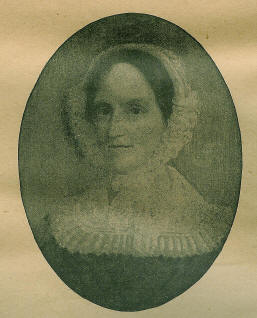
Eliza CunninghamEliza Wilson Bertrand Cunningham was the First Lady of Little Rock.  She literally was the first lady and the founding mother.

She became the first permanent female resident when she joined her husband Matthew Cunningham in Little Rock.  She gave birth to Chester Ashley Cunningham, the first baby born in Little Rock, as well as several other children with Cunningham.  When he became the first Mayor of Little Rock, she was the first First Lady of Little Rock. They hosted the first Little Rock Council meeting at their house on what is now the block downtown bounded by Third, Main, Fourth and Louisiana Streets.  Her son Charles P. Bertrand, from her first husband, later served as Mayor of Little Rock, making her the only woman to be married to a Mayor and be mother of a Mayor.

Born in Scotland in December 1788, she emigrated with her parents to the United States as a young girl.  In 1804 or 1805, she married a French businessman, Pierre Bertrand in New York City.  She lived in New York City, while he traveled to his various business ventures.  He never returned from a trip to his coffee plantation in Santo Domingo and was presumed to have died in 1808 or 1809.  She and Bertrand had three children, Charles Pierre, Arabella and Jane. (Jane may have died in childhood, because records and lore only indicated Charles and Arabella coming to Little Rock with their mother.)

Eliza married Dr. Matthew Cunningham in New York City.  He later moved to Saint Louis and settled in Little Rock in early 1820.  Eliza and her two children came to Little Rock in September 1820.  In 1822, she gave birth to Chester Ashley Cunningham, the first documented baby born in Little Rock.  (There are unsubstantiated reports that at least one slave child may have been born prior to Chester.)  She and Matthew also had Robert, Henrietta, Sarah and Matilda.  The latter married Peter Hanger, after whom the Hanger Hill neighborhood is named.

Dr. Cunningham died in June 1851.  Eliza died in September 1856. They and Chester (who died in December 1856) are buried in the Hanger family plot at Mount Holly Cemetery.

Poetry Month: Albert Pike and “Night on the Arkansa”

PikeAlbert_fAlbert Pike was a lawyer who played a major role in the development of the early courts of Arkansas and played an active role in the state’s politics during the middle 19th Century.  He was also a soldier, a national leader of masonry, and poet & writer.

Born in Boston in December 1809, he grew up in the greater Boston area.  Pike was admitted to Harvard, but could not afford it. He began teaching school.  In 1831, he left Massachusetts for Mexico. After spending some time in Santa Fe, he headed east and ended up in Fort Smith.  Based on some political writings, he was invited to Little Rock by Charles Bertrand (a future Little Rock mayor).

In Little Rock he flourished as a writer and attorney. He also became involved in military matters first with the Mexican War and then with Confederate army during the Civil War.  He also married and fathered several children.  At the end of the Civil War, Pike moved to New York City, then for a short time to Canada. After receiving an amnesty from President Andrew Johnson on August 30, 1865, he returned for a time to Arkansas and resumed the practice of law. He then moved to Memphis and later Washington DC.

After he ceased practicing law, Pike’s real interest was the Masonic Lodge. He had become a Mason in 1850.  He held several national posts in the Mason organization.  Pike died at the Scottish Rite Temple in Washington DC on April 2, 1891. He was buried in Oak Hill Cemetery there. His Masonic brothers erected a statute to him in 1901 in Washington DC, making him the only former Confederate general to have a monument there.

The house he built in Little Rock still stands, and is known as the Pike-Fletcher-Terry House.  It was the boyhood home of Pulitzer Prize winning poet John Gould Fletcher.  Though he is buried in Washington DC, there is a memorial to him erected in Mount Holly Cemetery.  It can be seen every day, but especially today during the Mount Holly Rest in Perpetuity fundraiser picnic.

Pike began to write poetry as a young man, which he continued to do for the rest of his life.


NIGHT ON THE ARKANSA (1838)

Night comes upon the Arkansa with swift stride, —
Its dark and turbid waters roll along,
Bearing wrecked trees and drift, — deep, red, and wide.
The heavy forests sleeps on either side,
To the water’s edge low-stooping; and among
The patient stars the moon her lamps has hung,
Lit with the spirit of the buried sun.
No blue waves dance the stream’s dark bosom on,
Glittering like beauty’s sparkling starry tears;
No crest of foam, crowning the river dun,
Its misty ridge of frozen light uprears:
One sole relief in the great void appears —
A dark, blue ridge, set sharp against the sky,
Beyond the forest’s utmost boundary.


Not so wast thou, O, brave old Merrimac!
As I remember the; as thou art seen
By the Soul’s eyes, when, dreaming, I go back
To my old home, and see the small boats tack
On thy blue waters, gliding swift between
The old gray rocks that o’er them fondly lean,
Their foreheads scarred with lightning.  There, around
Grim capes the surly waterswhirl and bound;
And here and there grave patriarchal trees
Persuade the grass to clothe the reluctant ground
And frowning banks with green. Still villages
Sleep in the embraces of the cool sea-breeze: —
Ah, brave old stream! – thou seemest to infold
My heart within thy waters, as of old.


Little Rock Look Back: Abraham Lincoln

Abraham_Lincoln_November_1863On February 12, 1809, Abraham Lincoln was born in Kentucky.  One hundred and fifty years ago today, he celebrated his last birthday as he would be assassinated a little over two months later.

Lincoln never visited Arkansas. In the 1860 election, he barely registered on the Arkansas election map. Arkansas counties went strongly for Southern Democratic candidate John Breckinridge.  John Bell, the Constitutional Union/Whig candidate ran strongly in Pulaski County and a scattering of other counties.  Neither Lincoln nor Northern Democratic candidate Stephen Douglas carried a county in Arkansas.  In 1864, though Arkansas was officially under control of the Union forces, the state had not been readmitted. Therefore no Arkansans voted for Lincoln that year.

As President, Lincoln did correspond with several Arkansans.  It is said that the polite written exchanges he had with former Mayors C. P. Bertrand and Gordon Peay were helpful in maintaining a fairly peaceful occupation of Little Rock by federal forces.

In the listing of Presidential Streets of Little Rock, Lincoln is omitted.  On first blush, this might seem to be intentional to skip the name of the President who oversaw the “occupation.”  However, if that were the case, then surely Johnson would have been left out as well since he was President during the final years of the federal military occupation.  In fact, there once was a Lincoln Street. A portion of what is now Cantrell/Highway 10 was named for Lincoln. It predated the other Presidential streets.  At the time the other streets were laid out, Lincoln was skipped because a street already bore the name.

Over time, Highway 10 had been given multiple names for various sections: Lincoln, Q, and Cantrell. In the 1930s, these names were consolidated into Cantrell which was the longest section. The name Lincoln was dropped. There were very few addresses on Lincoln, most of it was railroad property.  The viaduct connecting Highway 10 with LaHarpe still bears the name of Lincoln Avenue.


Little Rock Look Back: Charles P. Bertrand, LR’s 21st Mayor

Bertra1Two hundred and six years ago today, on November 23, 1808, future Mayor Charles P. Bertrand was born in New York.  He was the son of Pierre and Eliza Wilson Bertrand; his father died in 1809 in an uprising in Haiti and his mother eventually remarried.  With her new husband, Dr. Matthew Cunningham, she and the family moved to Little Rock in 1820.

After apprenticing with family friend William Woodruff at the Arkansas Gazette, Bertrand opened the Arkansas Advocate newspaper.  He later studied law under Robert Crittenden and entered the legal profession.

In 1835-1836, he served as State Treasurer for the Arkansas Territory, and in 1836 as secretary for the first constitutional convention. He was a member of the Arkansas House of Representatives from 1840-1841 and 1844-1849.

Bertrand followed in his stepfather’s footsteps and became Mayor of Little Rock.  (Dr. Cunningham had been the first Little Rock Mayor in 1831.)  He was in office from January 1855 through January 1857, serving two one-year terms.  He later served on the City Council and filled in as acting mayor. (Another influence on his upbringing was studying under future Mayor Jesse Brown who taught at the first school in Little Rock.)

Bertrand, as acting mayor, was involved in the negotiations of the surrender of Little Rock to federal troops in 1863.  He also later corresponded with President Lincoln on behalf of Little Rock citizens.  Though a staunch Confederate, his good will toward the Union soldiers and federal officials is credited with helping to save Little Rock from the destruction which befell many other Southern cities.  He is also credited with delaying the start of the Civil War.  Prior to the attack on Fort Sumner, members of the Arkansas Militia were planning to attack the Federal Arsenal at Little Rock during the absence of Governor Rector.  This would have been viewed as an act of war.  Bertrand was able to dissuade them from the attack.  Had he been unsuccessful, the Civil War would have likely started in Arkansas instead of South Carolina.

He had put his considerable fortune into Confederate money during the war. At the Civil War’s conclusion, the family was financially ruined. Though they had vast land holdings, those would be sold off in parcels to pay for taxes.

Bertrand died August 27, 1865, shortly after the conclusion of the Civil War.  He, like his mother, step-father, and several other relatives, is buried in Mt. Holly Cemetery.

Little Rock Look Back: City Hall Ceases Operation in 1863

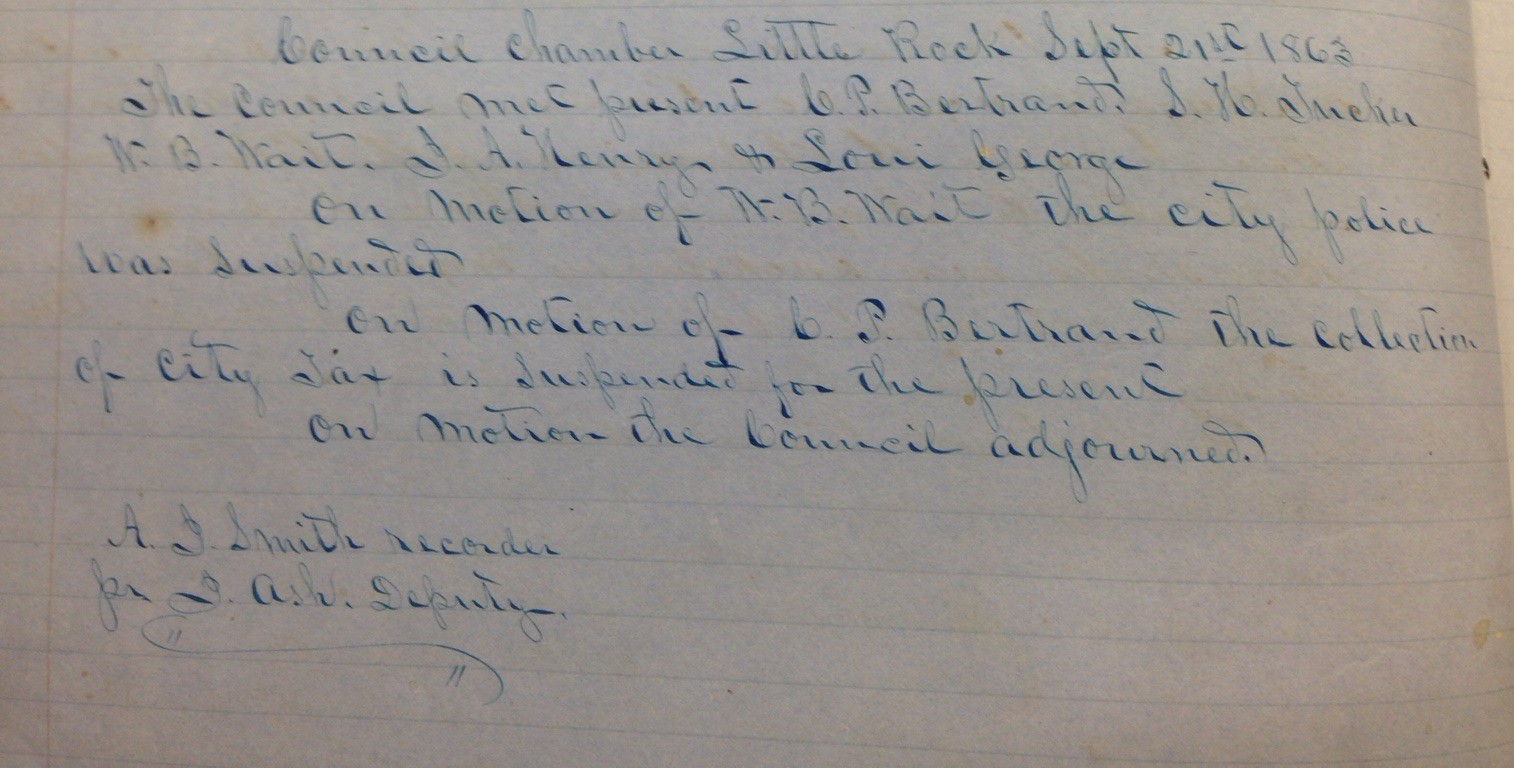
LR1863 minutes of closureFollowing the Battle of Little Rock, the City of Little Rock ceased operations on September 21, 1863.

Planning for this had started in August, which would suggest that civic leaders were none too confident in the ability of Confederate forces to hold on to the city.  At the August 24, 1863, City Council meeting it was reported that the City’s funds (presumably Confederate) had been “placed in the hands of a reliable party who is well known to the Council.”  The identity of this “reliable party” has never been disclosed.

On September 21, the Council met and took three votes.  The first was to suspend the operation of City police (which at the time was not an official police force, it was a constable and some volunteers). The second was to suspend the collection of City taxes.  The final vote was to adjourn.

There is no record of Mayor William Ashley being present at this meeting.  Recorder A. J. Smith (the equivalent of City Clerk today) was not present.  The minutes were signed by “J. Ash, Deputy.” Records do not indicate if that gentleman was officially Deputy Recorder or if he had simply been deputized to take minutes at the meeting.  The five City Council members present were C. P. Bertrand (a former mayor and step-son of Little Rock’s first Mayor, Matthew Cunningham), S. H. Tucker, W. B. Walt, I. A. Henry (would would also serve on the first City Council after the war in 1866), and Lou George.

Little Rock Look Back: Matthew Cunningham MD, LR’s First Mayor. And Doctor. And Husband of First Woman. And Father of First Baby. And….

M_Cunningham_fFuture Little Rock Mayor Dr. Matthew Cunningham was born on July 5, 1782 in Pennsylvania. After receiving his medical degree from the University of Pennsylvania, he ended up in New York City.

It was there he met and married a young widow, Eliza Wilson Bertrand. After a brief stint in St. Louis, Dr. Cunningham was one of the first settlers of Little Rock in February 1820. He became the first physician in Little Rock.

In September 1820, Mrs. Cunningham and her children joined him. She became the first female in the Little Rock settlement. Dr. and Mrs. Cunningham had a son, Chester, who was the first white baby born in Little Rock. (Though not supported by any public records, there is some unsubstantiated thought that one of the African American slaves they had gave birth to a child before Chester was born.) The Cunninghams had several other children.  One daughter, Matilda, would marry Little Rock businessman Peter Hangar.  (The Hangar Hill neighborhood is named after Peter Hangar.)

In 1831, Dr. Cunningham was elected the first Mayor of Little Rock. He won the race 23 to 15 over Rev. W. W. Stevenson. The first City Council meeting took place at the Cunningham house on the block which is the southwest corner of what is now 3rd and Main Streets. Records are incomplete as to where on the block the Cunningham house was located, but a plaque is on 3rd Street near Main on the side of the Fulk Building which Cranford Johnson Robinson Woods is now renovating for their future office space.

Dr. Cunningham served one year as Mayor. He lived until June 15, 1851 and is buried at Mount Holly Cemetery. His wife, son, and the Hangar family are buried next to him.  His stepson – Charles P. Bertrand – also served as Mayor of Little Rock.