Little Rock Look Back: Louis Armstrong speaks out

As the Civil Rights movement started taking hold in the mid-1950s, many African American entertainers were vocal in their support.  Louis Armstrong stayed silent.  Until, that is, September 17, 1957.

That night, in Grand Forks, North Dakota, Armstrong blasted President Dwight Eisenhower for his lack of action to make Governor Orval Faubus obey the law.  This was in an interview conducted by a 21 year old University of North Dakota journalism student named Larry Lubenow.

Journalist David Margolick wrote about the incident in The New York Times in September 2007 in conjunction with the 50th anniversary of the integration of Little Rock Central High School.  He recounted how the story, written for the Grand Forks Herald, was picked up all over the country.  The entire Margolick piece can be read here.  Margolick tells that when Armstrong was given the chance to back off the comments, he asserted that he meant all of it.

On September 24, 1957, the night that the 101st Airborne was being mobilized to come into Little Rock, Armstrong sent Eisenhower a telegram again criticizing him for lack of action.  He used colorful language which sarcastically spoofed the “Uncle Tom” moniker which some of his critics had bestowed when they felt he was not doing enough for Civil Rights.  The Eisenhower Presidential Library has a copy of that telegram.  The incident between Satchmo and Ike was the basis for two different plays: Terry Teachout’s Satchmo at the Waldorf and Ishmael Reed’s The C Above C Above High C.

Black History Month – Jesse Belvin and Robinson Center

jesse-belvin-2The name Jesse Belvin is largely forgotten. As a songwriter in the 1950’s he wrote “Earth Angel.” He also had an R&B hit with “Goodnight My Love.”  If he is recalled for anything today, it is tragically for being part of the mythical “27” club of musicians who died at the age 27.

On February 5, 1960, he appeared in a concert at Robinson Auditorium for what was billed as the “First Rock & Roll Concert of 1960.”  The headliner for the concert was Jackie Wilson.  The next morning, Belvin died at age 27 in a car accident outside of Hope on his way to his next concert in Texas.  Also killed in the wreck were Belvin’s wife, the man driving the car, and a couple in another car which Belvin’s car struck.

Many urban legends have sprung up about the concert at Robinson. Some, no doubt, fueled by Little Rock’s racially divided then-recent past in September 1957.  Most of these purport that the concert in which he appeared was the first integrated concert in Little Rock. Most rumors also state that Belvin had received threats leading up to the concert, that a riot took place at the concert or at least was stopped several times by disruptions caused by white agitators, that Belvin and others were run out of town, and that the accident was caused by damage inflicted to his tires before leaving Little Rock.  There are several variations of these purported facts.

While it is true Belvin performed at Robinson Auditorium the night before he died, it was not before a racially mixed audience.  It was not until August 1961 that the first concert took place in Robinson that did not have segregated seating, and that was a one-time only event.  It would not be standard practice at Robinson Auditorium until the 1965 passage of the Civil Rights Act.

While the Arkansas Gazette and Arkansas Democrat at the time did not shy away from covering racial issues (each with their own slant), neither paper mentions anything about the discord at the concert.  They do discuss Belvin’s subsequent accident near Hope.  It was apparently caused when the driver of the car containing Belvin and his wife fell asleep at the wheel. (If the tires had been damaged in Little Rock, there is no way the car would have made it to Hope.)

In this day of the internet where it is easy for myths to fester into fact, it is hard to dispel rumors.  What is true is that a life was tragically cut short, and that Jesse Belvin’s last concert was on the stage of Robinson Auditorium.

Black History Month – Louis Armstrong and Robinson Center

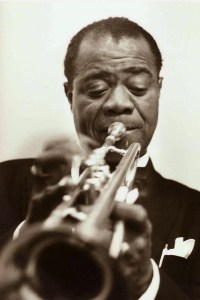
louis-armstrong3Louis Armstrong played Robinson Auditorium several times during his career.  He also played other venues in Little Rock.

As the Civil Rights movement started taking hold in the mid-1950s, many African American entertainers were vocal in their support.  Armstrong stayed silent.  Until, that is, September 17, 1957.  That night, in Grand Forks, North Dakota, he blasted President Dwight Eisenhower for his lack of action to make Governor Orval Faubus obey the law.  This was in an interview conducted by a 21 year old University of North Dakota journalism student named Larry Lubenow.

Journalist David Margolick wrote about the incident in The New York Times in September 2007 in conjunction with the 50th anniversary of the integration of Little Rock Central High School.  He recounted how the story, written for the Grand Forks Herald, was picked up all over the country.  The entire Margolick piece can be read here.  Margolick tells that when Armstrong was given the chance to back off the comments, he asserted that he meant all of it.

On September 24, 1957, the night that the 101st Airborne was being mobilized to come into Little Rock, Armstrong sent Eisenhower a telegram again criticizing him for lack of action.  He used colorful language which sarcastically spoofed the “Uncle Tom” moniker which some of his critics had bestowed when they felt he was not doing enough for Civil Rights.  The Eisenhower Presidential Library has a copy of that telegram.  The incident between Satchmo and Ike was the basis for two different plays: Terry Teachout’s Satchmo at the Waldorf and Ishmael Reed’s The C Above C Above High C.
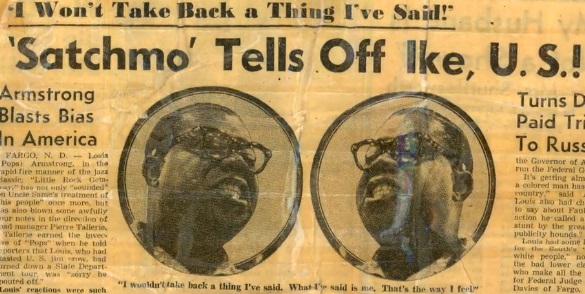
Armstrong would again play a part in Little Rock’s Civil Rights history.  In September 1966, he played the first major concert in Robinson Auditorium that was before a fully integrated audience.  Since the early 1960s, there had been a few sporadic concerts which had been before integrated audiences. But the policy of the Auditorium Commission remained that the building was to be segregated.  Following the approval of the 1964 Civil Rights Act, public facilities had to be integrated. Louis Armstrong played before a full house at Robinson Auditorium that night.  With Orval Faubus still Arkansas’ governor, Armstrong was not too interested in staying in Little Rock very long. He left town quickly after the concert was concluded.

Little Rock Look Back: Louis Armstrong

SatchmoLouis Armstrong was born on August 4, 1901 in New Orleans.  As he rose to fame, he would play Little Rock numerous times in a variety of venues.

As the Civil Rights movement started taking hold in the mid-1950s, many African American entertainers were vocal in their support.  Armstrong stayed silent.  Until, that is, September 17, 1957.  That night, in Grand Forks, North Dakota, he blasted President Dwight Eisenhower for his lack of action to make Governor Orval Faubus obey the law.  This was in an interview conducted by a 21 year old University of North Dakota journalism student named Larry Lubenow.

Journalist David Margolick wrote about the incident in The New York Times in September 2007 in conjunction with the 50th anniversary of the integration of Little Rock Central High School.  He recounted how the story, written for the Grand Forks Herald, was picked up all over the country.  The entire Margolick piece can be read here.  Margolick tells that when Armstrong was given the chance to back off the comments, he asserted that he meant all of it.

On September 24, 1957, the night that the 101st Airborne was being mobilized to come into Little Rock, Armstrong sent Eisenhower a telegram again criticizing him for lack of action.  He used colorful language which sarcastically spoofed the “Uncle Tom” moniker which some of his critics had bestowed when they felt he was not doing enough for Civil Rights.  The Eisenhower Presidential Library has a copy of that telegram.  The incident between Satchmo and Ike was the basis for two different plays: Terry Teachout’s Satchmo at the Waldorf and Ishmael Reed’s The C Above C Above High C.
Armstrong would again play a part in Little Rock’s Civil Rights history.  In September 1966, he played the first major concert in Robinson Auditorium that was before a fully integrated audience.  Since the early 1960s, there had been a few sporadic concerts which had been before integrated audiences. But the policy of the Auditorium Commission remained that the building was to be segregated.  Following the approval of the 1964 Civil Rights Act, public facilities had to be integrated. Louis Armstrong played before a full house at Robinson Auditorium that night.

Little Rock Look Back: Jesse Belvin in concert at Robinson Auditorium

Ark Gazette 60.02.05 (Fri)The name Jesse Belvin is largely forgotten. As a songwriter in the 1950’s he wrote “Earth Angel.” He also had an R&B hit with “Goodnight My Love.”  If he is recalled for anything today, it is tragically for being part of the mythical “27” club of musicians who died at the age 27.

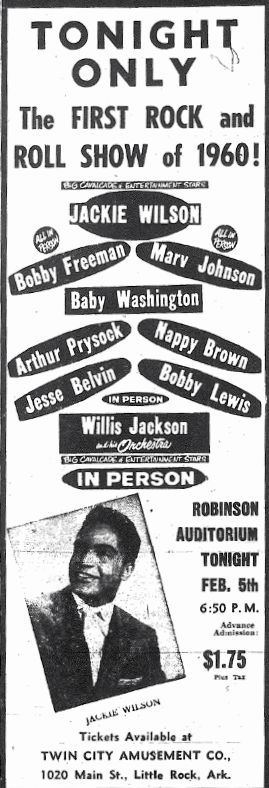
On February 5, 1960, he appeared in a concert at Robinson Auditorium for what was billed as the “First Rock & Roll Concert of 1960.”  The headliner for the concert was Jackie Wilson.  The next morning, Belvin died at age 27 in a car accident outside of Hope on his way to his next concert in Texas.  Also killed in the wreck were Belvin’s wife, the man driving the car, and a couple in another car which Belvin’s car struck.

Many urban legends have sprung up about the concert at Robinson. Some, no doubt, fueled by Little Rock’s racially divided then-recent past in September 1957.  Most of these purport that the concert in which he appeared was the first integrated concert in Little Rock. Most rumors also state that Belvin had received threats leading up to the concert, that a riot took place at the concert or at least was stopped several times by disruptions caused by white agitators, that Belvin and others were run out of town, and that the accident was caused by damage inflicted to his tires before leaving Little Rock.  There are several variations of these purported facts.

While it is true Belvin performed at Robinson Auditorium the night before he died, it was not before a racially mixed audience.  It was not until August 1961 that the first concert took place in Robinson that did not have segregated seating, and that was a one-time only event.  It would not be standard practice at Robinson Auditorium until the 1965 passage of the Civil Rights Act.

Rebecca Miller, in her blog https://jackiewilsonlover.wordpress.com/, goes into great detail debunking many of the supposed “facts” about the February 5, 1960, concert at Robinson.  While the Arkansas Gazette and Arkansas Democrat at the time did not shy away from covering racial issues (each with their own slant), neither paper mentions anything about the discord at the concert.  They do discuss Belvin’s subsequent accident near Hope.  It was apparently caused when the driver of the car containing Belvin and his wife fell asleep at the wheel.

In this day of the internet where it is easy for myths to fester into fact, it is hard to dispel rumors.  What is true is that a life was tragically cut short, and that Jesse Belvin’s last concert was on the stage of Robinson Auditorium.

Commemorate the 50th Anniversary of the 1964 Civil Rights Act tonight from 6pm to 8pm at the Mosaic Templars Cultural Center

To commemorate the 50th Anniversary of the 1964 Civil Rights Act, the Arkansas Psychological Association and Mosaic Templars Cultural Center will hold an event to discuss the importance of psychologically healthy workplaces and honor two local civil rights advocates, political and social justice activist Mary Brown “Brownie” Williams Ledbetter, and psychologist and member of the Little Rock Nine, Dr. Terrence Roberts, from 6 to 8 p.m. Wednesday, July 2, at Mosaic Templars.

BrownieLedbetterThe free and public event is designed to raise the awareness of the effect of discrimination in the workplace on the groups named in the 1964 Civil Rights Act which was signed into law by President Lyndon B. Johnson on July 2, 1964. A reception will follow.

Ledbetter is being honored posthumously for her work through the Arkansas Public Policy Panel. She served as volunteer executive director until her retirement in 1999.

Terrence RobertsRoberts is best known as being one of the nine students to desegregate Little Rock’s Central High School, but as an adult, he became a psychologist and through his private practice he has counseled organizations on equitable practices in both industry and business including serving as a desegregation consultant to the Little Rock School District.

The UALR Institute on Race and Ethnicity, Office of Governor Mike Beebe, City of Little Rock, Central High School National Historic Site, and Social Justice Initiative at Philander Smith College are all sponsors of the event.For more information, contact Dr. Patricia L. Griffen, president of the ArPA at 501.223.8883.