
Tonight at the Clinton School – Devery Anderson discusses the 1955 murder of Emmett Till

Emmett Till bookThis evening at 6pm at the Clinton School, Devery Anderson discusses his book on the murder of Emmett Till. A book signing will follow.

Emmett Till: The Murder That Shocked the World and Propelled the Civil Rights Movement offers the first truly comprehensive account of the 1955 murder and its aftermath. It tells the story of Emmett Till, the fourteen-year-old African American boy from Chicago brutally lynched for a harmless flirtation at a country store in the Mississippi Delta. His death and the acquittal of his killers by an all-white jury set off a firestorm of protests that reverberated all over the world and spurred on the civil rights movement. Like no other event in modern history, the death of Emmett Till provoked people all over the United States to seek social change.

For six decades the Till story has continued to haunt the South as the lingering injustice of Till’s murder and the aftermath altered many lives. Fifty years after the murder, renewed interest in the case led the Justice Department to open an investigation into identifying and possibly prosecuting accomplices of the two men originally tried. Between 2004 and 2005, the Federal Bureau of Investigation conducted the first real probe into the killing and turned up important information that had been lost for decades.

This book will stand as the definitive work on Emmett Till for years to come. Incorporating much new information, the book demonstrates how the Emmett Till murder exemplifies the Jim Crow South at its nadir. The author accessed a wealth of new evidence. Anderson has made a dozen trips to Mississippi and Chicago to conduct research and interview witnesses and reporters who covered the trial. In Emmett Till Anderson corrects the historical record and presents this critical saga in its entirety.
Fourteen new names added to 2015 Arkansas Civil Rights Heritage Trail

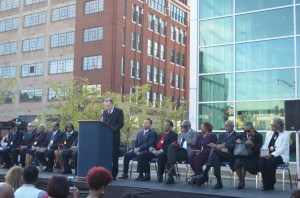
2015 ACRHTLast month, the University of Arkansas at Little Rock Institute on Race and Ethnicity unveiled the 2015 Arkansas Civil Rights Heritage Trail markers. This year’s theme is “Politics and Law” to commemorate the 50th anniversary of the passage of the Voting Rights Act of 1965.

The fourteen new markers are installed at Scott and Markham Streets near the Statehouse Convention Center.

Established in the summer of 2011, the Arkansas Civil Rights Heritage Trail honors those who made significant contributions to civil rights in Arkansas. The trail raises public awareness of the long and rich legacy of Arkansas’s civil rights history.

A 12-inch bronze marker is placed in the sidewalk for each honoree. The trail begins in front of the Old State House Convention Center on Markham Street and will eventually extend to the William J. Clinton Presidential Center and Park and other points throughout the downtown corridor.

This year’s 14 honorees are:

  • Annie Mae Bankhead, who was a community activist in Pulaski County’s black College Station neighborhood
  • Wiley Branton, Sr., who was head of the Southern Regional Council’s Voter Education Project in the 1960s
  • Charles Bussey, who was leader of the Veterans Good Government Association and became Little Rock’s first black mayor in 1980
  • William Harold Flowers, who laid the foundations for the Arkansas State Conference of National Association for the Advancement of Colored People branches
  • Jeffrey Hawkins, who was for decades the unofficial mayor of Little Rock’s black East End neighborhood
  • Irma Hunter Brown, who was the first black woman elected to the Arkansas General Assembly
  • Scipio Africanus Jones, a leading black Republican who defended 12 prisoners for their role in the 1919 Elaine Race Riot
  • Mahlon Martin, who was the first black city manager of Little Rock
  • I.S. McClinton, who was head of the Arkansas Democratic Voters Association, a forerunner of today’s Black Democratic Caucus
  • Richard L. Mays and Henry Wilkins III, who were among the first blacks elected to the Arkansas General Assembly in the 20th century in 1972
  • Olly Neal, who was the first black district prosecuting attorney in Arkansas and later served on the Arkansas Court of Appeals
  • Lottie Shackelford, who was the first black woman mayor of Little Rock
  • John Walker, who for more than five decades has been involved in civil rights activism in the courts, most notably in school desegregation cases

Dr. John Kirk is the director of the Institute.  At the November ceremony, he spoke along with UALR Chancellor Joel Anderson. At a reception following the ceremony, Senator Joyce Elliott gave a toast in honor of the 14 and several of the honorees or their descendants spoke.

Little Rock Look Back: Ike in Little Rock

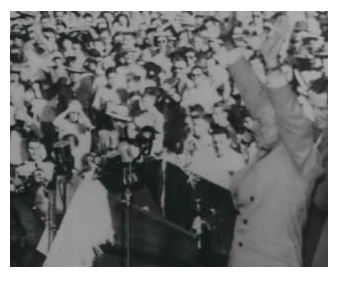
Detail from UPI photo of General Eisenhower following his address.

Detail from UPI photo of General Eisenhower following his address.

If Ike, Little Rock and September are considered, it is usually in reference to his role in the desegregation of Little Rock Central High in September 1957.  But five years earlier, he appeared in Little Rock on September 3, 1952.

General Eisenhower’s speech to 14,000 in MacArthur Park was the final leg in his swing through the South on his campaign for the White House.  He became the third presidential candidate to visit MacArthur Park in 1952 following General MacArthur (in his ill-fated attempt to gain traction as a GOP candidate during the delegate selection process) and Democratic nominee Adlai Stevenson.

He visited every southern state except Mississippi on this campaign jaunt.  In comments that neither he nor his audience could have foreseen as prescient, Eisenhower declared that he deplored the government meddling in areas in which it did not belong.  This remark was made in reference to race relations.  His stance was that some rights of minorities should be protected, but it was not necessarily the role of the federal government.

Ike proffered that if white southerners did not protect the rights of African Americans they were in danger of losing their own rights, too.  In the era of the Cold War when people were worried about the imminent loss of rights, this message seems to have crafted to appeal to those concerns.  While Eisenhower did not shy away from addressing civil rights, his Democratic opponent Adlai Stevenson was silent on the issue.  But with Alabama segregationist Senator John Sparkman as his running mate, it put Stevenson in a difficult position to try to bring it up.

In the end, Ike lost most of the South.  He did carry Maryland, Virginia, Tennessee and Florida. The only states Stevenson won were in the South.  Eisenhower’s 43.74% of the Arkansas popular vote was the highest any Republican had garnered since General Grant carried the state in 1868 and 1872.