Little Rock Look Back: Elizabeth Eckford

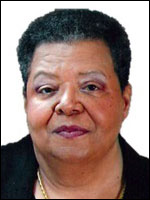
After 60 years, the most dramatic images of the 1957 crisis at Little Rock Central High School remain those of 15-year-old Elizabeth Eckford, being taunted as she walked through a hate-filled mob, on her way to school.  Today, Ms. Eckford recalls how difficult it was for her parents, Oscar and Birdie, to allow her to continue the struggle to integrate the Little Rock schools.

Born on October 4, 1941, she grew up in Little Rock.  Because all of the city’s high schools closed her senior year, Ms. Eckford moved to St Louis, where she obtained her GED. She attended Knox College in Illinois, and received her BA in History from Central State University in Wilberforce, Ohio.  While in college, Ms. Eckford became one of the first African Americans to work in a local St. Louis bank, in a non-janitorial position, and later she worked as a substitute teacher, in Little Rock public schools.

Ms. Eckford, a veteran of the U.S. Army, has also worked as a substitute teacher in Little Rock public schools, test administrator, unemployment interviewer, waitress, welfare worker, and military reporter.  Along with her fellow Little Rock Nine members, she is a recipient of the NAACP’s Spingarn Medal and the prestigious Congressional Gold Medal.  Together with one of her former tormenters, Ms. Eckford also received a Humanitarian award, presented by the National Conference for Community and Justice (NCCJ), following their meeting 34 years after an apology.  The award recognizes forgiveness and atonement.  They talked to students for two years, and, together, attended a 12-week racial healing course.

Ms. Eckford has started to walk through the painful past in sharing some of her story.  She has said that true reconciliation can occur if we honestly look back on our shared history. She believes that the lessons learned from Little Rock Central High School must continue to be shared with new generations, reminding audiences that “the dead can be buried, but not the past.”  Ms. Eckford continues her interest in education by sharing her story with school groups, and challenges students to be active participants in confronting justice, rather than being passive observers.

Ms. Eckford lives in Little Rock, and is a probation officer for the First Division Circuit Court of Pulaski County.

Little Rock Look Back: LR Voters ratify closing of high schools

fedgovark

Signs placed outside of Little Rock’s high schools erroneously cited the federal government as the source of school closures.

On September 27, 1958, voters in Little Rock approved the continuation of the closure of the city’s high schools.

Using legislation passed by the General Assembly in a hastily called special session in summer of 1958, Governor Orval Faubus had ordered the closure of Little Rock’s four public high schools in order to keep them from being desegregated.  But that state law only allowed the closure of Central, Hall, Horace Mann and Technical high schools on a temporary basis. In order for them to be closed permanently, the city’s voters must approve it by a vote.

The election date was to be set by Governor Faubus.  Originally scheduled for Tuesday, October 7, the date was moved to September 27.  Speculation for the new date selection centered on:

  • Faubus wanted it to be prior to the October 1 poll tax deadline so that only people who had paid their poll tax for the prior year were eligible
  • The election was on a Saturday.  Though Tuesday was the most common day of the week for elections, in the late 1950s Saturdays were used on elections as well.  The school board elections, for instance, were on Saturdays in some years.
  • On September 27, 1958, the Arkansas Razorbacks had a home football game in Fayetteville.

These were all designed to stifle voter turnout. In addition, the state law required a majority of eligible voters to approve reopening the schools.  The law also spelled out the confusing wording of the ballot question.  As historian Sondra Gordy points out in her book FINDING THE LOST YEAR, the ballot question was about only being for or against integration of the schools – it did not say anything about closure or opening of schools.

While the newly formed Women’s Emergency Committee did try to educate voters about the issue and encourage a vote to reopen the schools, this nascent group was less than a fortnight old by the Saturday election day.  In addition, the Governor campaigned for the remaining closure of the schools including in television appearances.

On that Saturday, Little Rock voters voted 19,470 to keep schools segregated to 7,561 to integrate them.

It would be a long road ahead to reopen the schools.  It would take two more elections before the City’s four public high schools would reopen.

Little Rock Look Back: Gloria Ray Karlmark

Gloria Ray Karlmark is the youngest daughter of H. C. Ray, son of a former slave, and founder of the Arkansas Agricultural Extension Service for Negroes, and Julia M. Ray, a Sociologist and a graduate of Tuskegee Institute and Philander Smith College. Mrs. Karlmark’s father was Laboratory Assistant to George Washington Carver, and received his degree in Horticulture under Booker T. Washington at Tuskegee Institute.  Mrs. Karlmark’s mother was fired when she refused to withdraw her from Little Rock Central High School in 1957-1958.  When Central High School remained closed, on an order from Governor Faubus the following year, Mrs. Karlmark moved to Kansas City, Missouri, where she graduated in 1960 from the newly integrated Kansas City Central High School.

Mrs. Karlmark went on to graduate from Illinois Institute of Technology (IIT), Chicago, after which she joined the IIT Research Institute as Assistant Mathematician on the APT IV Project (robotics, numerical control, and online technical documentation).  This included work at Boeing in Seattle, McDonnell-Douglas in Santa Monica, and NASA Automation center in St. Louis.

In 1969, she and her husband took a sabbatical year following the trail of the Maya Indians from Mexico through Central America by car.  Soon after, they immigrated to Sweden.  In the years that followed, the Karlmark family was blessed with a son and a daughter.

Recruited to join IBM’s Nordic Laboratory, Mrs. Karlmark completed the Svenska Patent och Registreringsverket “Patent Examiner” Program in 1975, and joined IBM’s International Patent Operations as European Patent Attorney.

In 1976, she co-founded Computers in Industry, and international journal of practice and experience of computer applications in industry affiliated with UNESCO and the International Federation of Information Processing-IFIP.  She served some 15 years as Editor-in-Chief.

In the years leading up to her retirement in 1994, Mrs. Karlmark also worked for Philips International in management as a specialist in Belgium, the Netherlands, France, Germany, Spain, and Scotland.  She and her family currently reside in Europe.

Little Rock Look Back: Ike sends troops to Little Rock

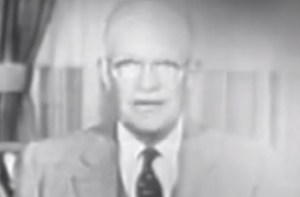
On September 24, 1957, President Dwight Eisenhower ordered the 101st Airborne to Little Rock to ensure that the Little Rock Nine would be able to enter Central High School.

In a thirteen minute televised White House address to the nation, President Eisenhower stated he had acted to prevent “mob rule.”  The President made his decision about the troops while vacationing in Rhode Island. But he flew to Washington DC to deliver the address from the White House. In his remarks, he stated that he felt it was important to discuss this action from the house of Lincoln.

Following the President’s noontime decision, 1,000 members of the 101st Airborne Division were flown to Little Rock.  In addition, all 10,000 members of the Arkansas National Guard were “federalized.”

Earlier in the day, Little Rock Mayor Woodrow Mann had pleaded with the President and US Attorney General for federal intervention.  He stated that the Little Rock police could not quell the crowds alone.

Little Rock Look Back: Little Rock Nine in Central for a few hours

centralentranceOn Monday, September 23, 1957, the Little Rock Nine entered Central High School for a few hours.
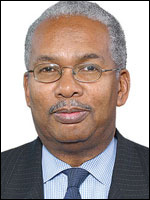
The previous Friday, Federal District Judge Ronald Davies ruled that Governor Faubus had used the National Guard to keep the Little Rock Nine out of the school.  At this point, the Governor withdrew the troops.  The duty of maintaining any order on the site and ensuring the safety of the students now fell solely on the Little Rock Police Department.

To minimize interactions with aggressive protestors who were outside of the school, the Nine were escorted into the side of the school.  Word quickly spread that they had made it into the building.  This caused the 1,000 or more people out front to become more hostile.

Threats were called into the building. Some parents of white children called wanting to get their students out of the building.  Some students snuck out of the building, while at the same time some of the crowd were trying to sneak in.  The situation was tense and getting more so by the minute.

Little Rock Mayor Woodrow Mann and police leadership were concerned about the ability of the City to protect the Nine and maintain order.  The Fire Department refused to use water from a firehose to disperse the crowd.

For the safety of the Little Rock Nine the students were removed from the building after having been in it only a few hours.


Little Rock Look Back: Ernest G. Green

Ernest G. Green is the Managing Director of Public Finance for Lehman Brothers in Washington, D.C.  Featured in the 2006 list of Black Enterprise Magazine’s “75 Most Powerful Blacks on Wall Street”, Mr. Green has served as senior investment banker on transactions for such key clients as the City of New York, State of New York, City of Chicago, Port of Oakland, City of Atlanta, State of Connecticut, Detroit Wayne County Airport, Denver Airport, and the Washington Metropolitan Airport Authority.

Mr. Green served as Assistant Secretary of Labor for Employment and Training during the Carter Administration.  President Clinton appointed him to serve as Chairman of the African Development Foundation.  Secretary of Education, Richard W. Riley, appointed him Chairman of the Historically Black Colleges and Universities Capital Financing Advisory Board.

Born in Little Rock, on September 22, 1941, Mr. Green was the first African American to earn his high school diploma from Central High School. At the age of seventeen he was awarded the NAACP’s Spingarn Medal, as one of the Little Rock Nine. In 1995, he was awarded the Distinguished Eagle Scout Award.  Mr. Green is also a recipient of the Urban League’s Frederick Douglass Freedom Medal, and the John D. Rockefeller Public Service Award. On November 9, 1999, with the Little Rock Nine, he was presented by President Clinton with the Congressional Gold Medal.

Several books, movies and documentaries have chronicled Mr. Green and his eight classmates’ historic year at Central High School in Little Rock — the most recent being the “Ernest Green Story”, produced and distributed by the Walt Disney Corporation.

Mr. Green holds a B.S. in Social Science and Masters in Sociology from Michigan State University, and honorary doctorates from Michigan State University, Tougaloo College, and Central State University.  He currently serves on the Board of Directors of Fisk University, Quality Education for Minorities (QEM) Network, Clark Atlanta University Board of Trustees and the African American Experience Fund Board of Trustees among other distinctions.

Mr. Green and his wife Phyllis live in Washington, D. C.  He is the proud father of Adam, Jessica and McKenzie Ann.

Little Rock Look Back: Jefferson Thomas

Jefferson Thomas was a track athlete at all-black Dunbar Junior High School in Little Rock when he volunteered to integrate all-white Central High School as a sophomore in 1957.  A few days before he entered the school, he celebrated his fifteenth birthday, having been born on September 19, 1942.

Mr. Thomas was a quiet, soft spoken, unique, and special person.  He had a subtle, infectious sense of humor that served him well throughout his life.  He would find that sense of humor and his love for humanity severely tested by the hate and violence directed toward him by some of the white students at Central High School.  Mr. Thomas graduated from Central High School in May 1960.

He served as the narrator of the Oscar winning documentary short, “Nine from Little Rock.”

Mr. Thomas married in 1965 and has one child (Jefferson, Jr.), still living in Los Angeles.  Mr. Thomas, Sr. was inducted into the United States Army in 1966.  He returned to civilian life in the summer of 1968.

After obtaining a Bachelor Degree in Business Administration from Los Angeles State College, Mr. Thomas went to work as an Accounting Clerk and later, Supervisor for Mobil Oil Corporation.  When Mobil Oil moved its Credit Card Operations, Mr. Thomas remained in Los Angeles, and entered Federal Service as an Accounting Clerk with the Department of Defense.  The DOD relocated parts of its LA operations to Columbus, Ohio, in 1989.  He sold his business and moved to Columbus.

After moving to Columbus, Mr. Thomas continued his commitment to serve the local community, Mr. Thomas took time to serve as a volunteer mentor in the Village to Child Program, co-sponsored by Ohio Dominican University.

He was a frequent speaker at numerous high schools, colleges and universities throughout the country, and an eager mentor to young people.  He was the recipient of numerous awards from local and federal governmental agencies.  These awards include the NAACP Spingarn Medal, and Congressional Gold Medal, this Nation’s longest-running tradition of honor, for helping make democracy work.  He was especially proud of the life-size sculpture of the Little Rock Nine at the Arkansas State Capital in Little Rock, the first in the state honoring living citizens.

Jefferson Thomas retired in September 2004, after 27 years of Federal Service. He departed this life in 2010.  His wife, Mary, still resides in Columbus, Ohio.