
 While later known more as a punchline due to personal fallibilities, for decades Wilbur D. Mills was one of the most powerful men in the world. As the chair of the House Ways and Means Committee from 1958 to 1975, he was the architect not only of an overhaul of the tax code, but also determined ways to finance Medicare, Medicaid, and many other federal programs of the Eisenhower, Kennedy, Johnson, Nixon and Ford years.
Wilbur Daigh Mills was born in Kensett on May 24, 1909. When Mills went to Congress at the age of 29, he was the youngest man elected to that time. A scant four years later he joined the Ways and Means Committee.
Because Mills rarely had an opponent (only 1942, 1966, and 1974), he was able to focus on learning the ins and outs of the tax code. As long as he delivered some federal dollars to his largely rural district every so often, he did not have to preoccupy himself with the daily issues many in Congress face. It was not until 1963, when Arkansas lost two of its six congressional seats, that Mills had Little Rock in his district. Prior to that, Searcy had been the largest city he represented. (There had been concern that Rep. Dale Alford, who had upset incumbent Brooks Hays in 1958 before losing his seat due to reapportionment four years later might challenge Mills. But Alford opted to retire instead of taking on the powerful Mills.)
President Kennedy’s visit to Little Rock and Greers Ferry in October 1963 was the result of bargaining with Congressman Mills over some tax policy. Mills gave in to JFK a bit, and JFK agreed to come to Arkansas to speak in Little Rock and at the dedication of two dams. In recognition of his national clout, Mills was briefly considered a contender for the 1972 Democratic nomination for President.
Though he probably struggled with alcoholism for years, he had been able to keep his behavior in check until 1974 when his car was stopped in Washington DC for not having its headlights on. Though Mills was not driving, he was inebriated. Another occupant of the car, a stripper with the stage name Fanne Fox ran from the car and frolicked in the Tidal Basin. It became fodder for worldwide headlines.
The incident happened about a month before Election Day, when Mills was facing Republican Judy Petty. A contrite Mills spent the remaining days in the campaign in Arkansas and won re-election by 59% of the vote. (Though later in November, he again was in the headlines when Fox pulled him on stage with her at a club in Boston.) In January 1975, he stepped down as Ways and Means Chair.
In 1976, he opted to retire from Congress and did not seek another term. In retirement, he practiced law in Washington DC before eventually moving back to Kensett full-time. He died in 1992.
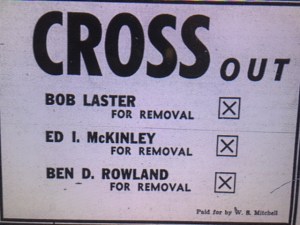 May 23, 1959, was a Saturday. It was also two days before the School Board recall election. With it being a Saturday, it was the last full day for door knocking as supporters for all sides were busy trying to get out the vote.
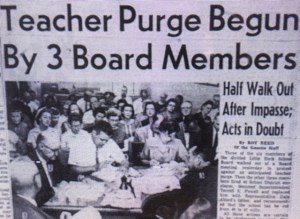 On Tuesday, May 5, 1959, the deeply divided Little Rock School Board met to consider contracts for the coming year. The topic of contract renewal had been on the April agenda, but with two of the six members out of town, it had been delayed.
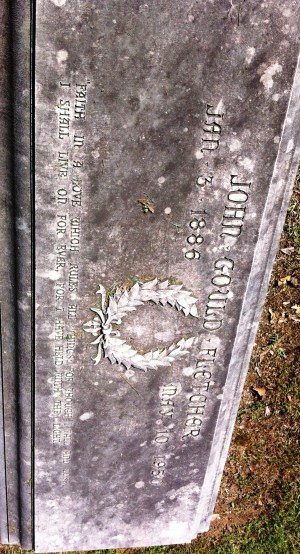 The Pulitzer Prizes are to be announced tomorrow (Monday, April 15). This year marks the 102nd anniversary of the prizes, though not all of the current categories have been around since 1917.
 The other Pulitzer Prize winner buried in Mount Holly is J. N. Heiskell, the longtime editor of the Arkansas Gazette. It was Heiskell, in fact, who asked Fletcher to compose the poem about Arkansas. Heiskell served as editor of the Gazette from 1902 through 1972. He died at the age of 100 in 1972.
 The regularly scheduled Little Rock School Board election of 1958 took place on Saturday, December 6 of that year. While other school boards throughout the state generally had just their regular two positions on the ballot that day, Little Rock had a unique situation with all six seats being open.
 Little Rock Culture Vulture