
Little Rock Look Back: Harry S. Truman

HST in LR2

Truman speaking at War Memorial Park

On May 8, 1884, future US President Harry S. Truman was born in Lamar, Missouri.

Truman spent most of his youth on the family farm.  Serving in World War I, he saw combat in France and rose to the rank of Captain.  After the war, he returned to Missouri and became involved in Democratic Party politics.  After serving as a county official, he was elected US Senator in 1935 backed by the powerful Kansas City Pendergast machine.

In 1941, he headed a Senate Committee which exposed corruption and fraud in wartime contracts.  He also worked to show he was not just a puppet of the Pendergast machine (which was crucial once Pendergast went to prison).  In 1944, Democratic leaders were trying to knock the incumbent Vice President, Henry Wallace, off the ticket as FDR’s running mate.  Wallace was viewed as too far to the left.  Truman was a compromise candidate and was chosen to serve as FDR’s running mate.

He took office as Vice President in March 1945.  When President Roosevelt died in April 1945, they had spent little time together.  He oversaw the dropping of the atomic bomb on Japan in his hopes of ending World War II with fewer soldier casualties.

Following the war, he supported the creation of the United Nations, sought to contain communism through the Truman Doctrine, and worked to rebuild Europe.  In his quest to stem the spread of communism, he involved the US in the Korean War.

Domestically, he struggled with civil rights issues (including integrating the military) and labor issues (including the threat to draft striking railway workers into the military). His election in 1948 for a full four-year term is often seen as the biggest upset in US Presidential political history.

At the time he became President, Truman was still living in a small apartment with his wife and daughter.  Though they lived in the White House for a bit, they later vacated it for the Blair House so that the structure could be completely renovated.

By the approach of the 1952 presidential election, Truman’s popularity had waned again.  He half-heartedly ran in the New Hampshire primary because he did not like any of the candidates currently in the field.  After finishing second to Sen. Estes Keafauver, he announced he would not be a candidate.  He left office in 1953 and returned to Missouri.

From 1953 onward, he served as the senior statesman and father confessor of the Democratic Party.  Many political leaders made pilgrimages to visit him.  In 1965, President Johnson signed the bill establishing Medicare at the Truman Library with President and Mrs. Truman in attendance.

He died on December 26, 1972, after having been admitted to the hospital earlier in the month for pneumonia.

Truman made two visits to Little Rock while President.  In June 1949, he attended an Army division reunion and spoke at the dedication of War Memorial Park.  In 1952, he visited Little Rock while in the state to speak at the dedication of Bull Shoals Dam and Norfork Dam.
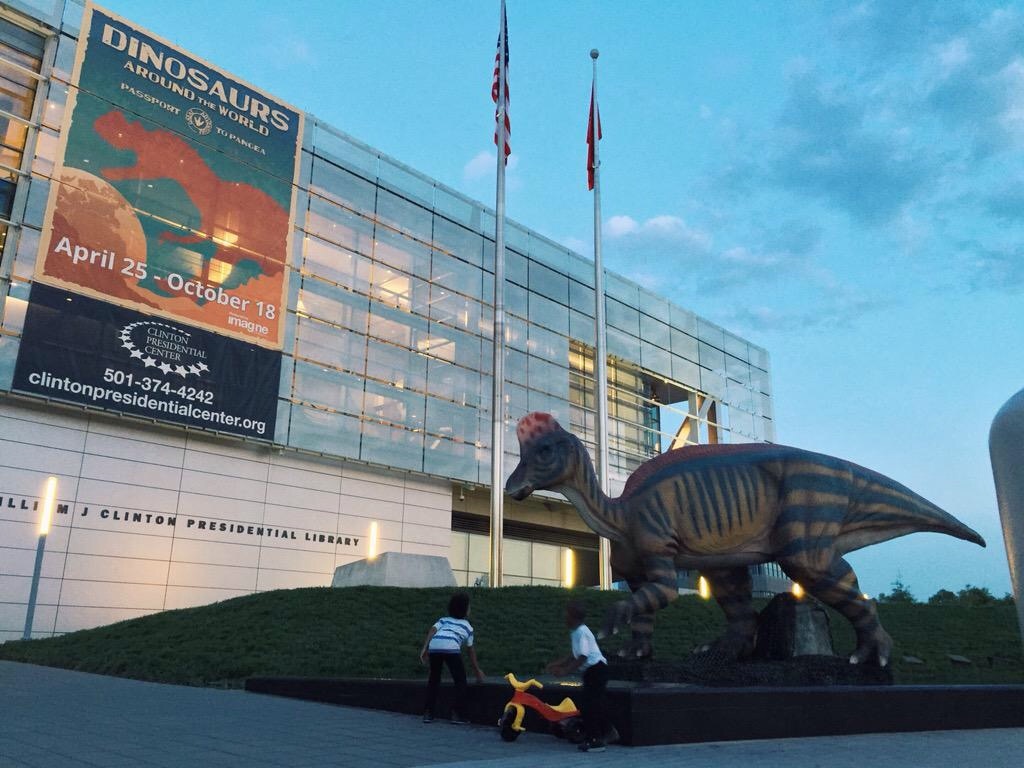
 

Dinosaurs Abound at Clinton Center now through October

Clinton Dinos

Photo by the Clinton Presidential Center

The Clinton Presidential Center presents Dinosaurs Around the World through October 18.

Dinosaurs Around the World takes you back in time on a dinosaur adventure and a tour of an Earth very different from today – a time before the continents as we know them existed, when lush landscapes covered Africa and greenery was the norm in Antarctica! With 13 life-sized animatronics, a multi-layered narrative, fossils, authentic casts, cutting-edge research and immersive design elements, you’ll experience the Age of Reptiles as it comes to life!
Dinosaurs Around the World invites you to grab your prehistoric passport to Pangea and discover how continental splits driven by plate tectonics, land bridges revealed after sea level fluctuations, and new landforms created by volcanic activity allowed dinosaurs to disperse to all corners of the globe. These left each of the seven continents with its own unique selection of these giant reptiles. During their 172 million year reign, dinosaurs adapted into a variety of forms including enormous long-necked herbivores, the mighty T. rex, and more.
“We are thrilled to host the global premiere of Dinosaurs Around the World and look forward to sharing this interactive and scientific exhibit with our visitors,” said Stephanie S. Streett, executive director of the Clinton Foundation. “Our summer exhibits are highly anticipated by the community because they are specifically designed to appeal to the entire family.”
In addition to advanced animatronics, Dinosaurs Around the World also features information about the geologic time scale, geology, geography, and climatology. The exhibition questions how the dinosaurs lived on each continent, how they interacted with each other, how geography impacted their behavior and diets, and what the continents were really like at the time.
The exhibit also features an area that chronicles the accomplishments of four U.S. Presidents who worked to preserve the fossil-rich areas in North America where dinosaurs once roamed. Exhibit artifacts include items from the administrations of Presidents Bill Clinton, Dwight D. Eisenhower, Franklin D. Roosevelt, and Harry S. Truman. This display includes a dinosaur skull replica on loan from the Grand Staircase-Escalante National Monument, an area that President Clinton designated as a national monument in 1996.
Dr. Gregory M. Erickson, a world-renowned dinosaur paleontologist, is the Senior Scientific Advisor for Dinosaurs Around the World. Dr. Erickson received his Bachelor of Science degree from the University of Washington, a Master’s degree from Montana State University, and a Ph. D. in Integrative Biology from the University of California, Berkeley and conducted post-doctoral research at Stanford University and Brown University before joining the faculty at Florida State University in Tallahassee. Dr. Erickson is currently the curator for the Florida State University Museum and holds research appointments with the American Museum of Natural History in New York, The Field Museum in Chicago, and University of Alaska’s Museum of the North in Fairbanks. Dr. Erickson is working with Imagine Exhibitions as an advisor, writer, and editor of the paleontology copy for the Company’s Dinosaurs Around the World exhibition.
Dinosaurs Around the World is open daily to the public from 9 a.m. to 5 p.m., Monday through Saturday, and 1 to 5 p.m. on Sunday, through October 18, 2015. Tickets are available to purchase at the Clinton Center.

Little Rock Look Back: FDR

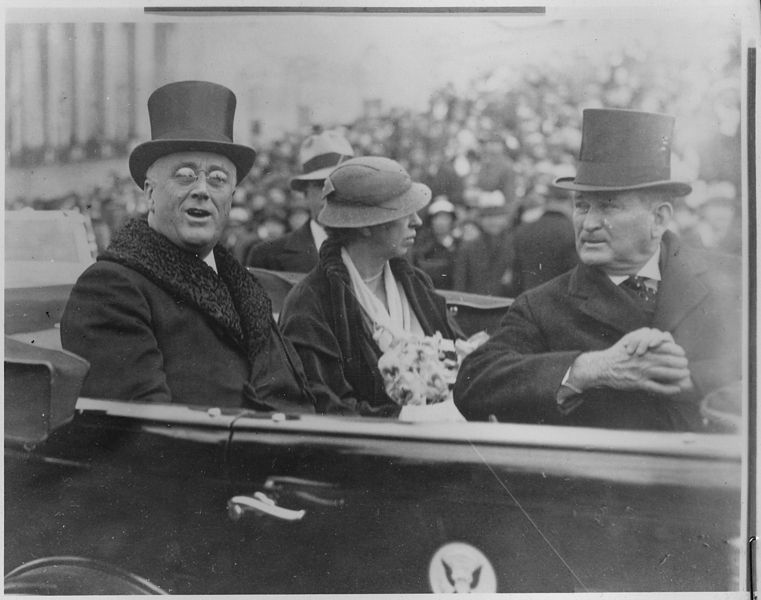
Gov. & Mrs. Roosevelt with Sen. Robinson en route to FDR taking oath as president.

Gov. & Mrs. Roosevelt with Sen. Robinson en route to FDR taking oath as president.

On January 30, 1882, future U.S. President Franklin Delano Roosevelt was born.  In 1936, he visited Little Rock as part of a statewide tour in conjunction with Arkansas’ Centennial celebration.  While in the state he spent time outside of Hot Springs at Couchwood, the vacation home of Arkansas Power & Light founder Harvey Couch, who was the chair of the Centennial activities.

In honor of President Roosevelt’s visit, a portion of Highway 365 in Little Rock was designated Roosevelt Road. He followed part of that road while in the Capital City before making a public appearance.

President Roosevelt’s address on June 10, recounted Arkansas’ territorial and statehood history. At the end he paid tribute to his Senator Joseph Taylor Robinson.  The Senator was a friend and confidant who often led the charge for FDR programs in congress.  Indeed, it would be New Deal programs which would allow for the construction of a municipal auditorium in Little Rock, which would be named in memory of Sen. Robinson after his death in the summer of 1937.  (As the Democratic leader of the Senate, it had been Robinson who accompanied FDR and Eleanor in the motorcade to the 1933 Presidential inauguration ceremony.)

FDR’s visit to Arkansas had political implications as well.  The late Senator Huey Long of neighboring Louisiana had been arguably FDR’s biggest adversary in Washington.  Long was very popular in rural areas of Arkansas and had campaigned for Hattie Caraway when she ran for re-election to the Senate, to the dismay of many of Arkansas’ Democratic establishment.  Harvey Couch had worked to bring about a detente between FDR and Long prior to the latter’s assassination in 1935.  But between a lingering mistrust of FDR by Long supporters and discontent from some sectors based on New Deal programs, it was important for FDR to shore up Democratic support in Arkansas.  At the time the state had nine electoral votes.

FDR would return to Central Arkansas in 1943 to review troops at the military facility named for Sen. Robinson.  That would be his final visit to Arkansas before his death in April 1945.

Little Rock Look Back: TR in LR

TheodoreRooseveltOn October 25, 1905, President Teddy Roosevelt, recently elected to a four year term in his own right, made an appearance in Little Rock.

He was greeted at the train station by Governor Jeff Davis and was the guest of honor in a parade up Main Street to City Park (now MacArthur Park) in where a public meeting was held featuring remarks by the President.  During this remarks, speaking to a largely Democratic crowd, the Republican Roosevelt noted: “The candidate is the candidate of a party; but if the president is worth his salt he is the president of the whole people.”

According to media reports at the time, Main Street from Markham to Tenth was a solid mass of cheering spectators for the parade.  This was the first time a sitting President had spent time in Little Rock away from a train station. The only other incumbent President to visit had been Benjamin Harrison.

He would make three more visits to Arkansas.  In 1910, he spoke at the Arkansas State Fair in Hot Springs.  In April and September 1912, he made several campaign stops in the state as he was running to reclaim the presidency, this time heading the Progressive (or Bull Moose) ticket.  Though Roosevelt’s successor, William Howard Taft, would visit briefly once in office and once after leaving office, it would not be until Roosevelt’s cousin Franklin Delano Roosevelt visited in 1936 that another sitting President spent much time in the state after TR’s 1905 visit.