
Little Rock Look Back: Implosion of the Grady Manning and the Marion

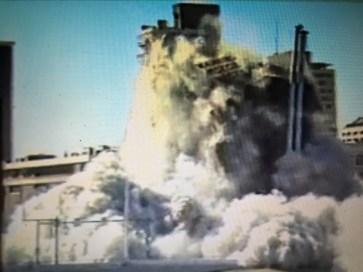
On February 17, 1980, a cold and clear Sunday morning, over seven decades of Arkansas history came tumbling down as the Hotel Marion and Grady Manning Hotel were imploded.

Thousands of people watched from places in downtown Little Rock and along the Arkansas River.  Many more were able to watch from live coverage carried on KATV, KARK and KTHV.  Those that missed it were able to see the replays multiple times on the news.

It was the first large-scale implosion in Little Rock’s history.  (It was likely the first implosion, but there could have been a small one that is not known.)  The two hotels were torn down to make way for the construction of the Excelsior Hotel and the Statehouse Convention Center.

The Hotel Marion, named after the builder Herman Kahn for his wife, opened in 1907. For four years it was Arkansas’ tallest structure.  It was the largest and grandest hotel in the City. For decades it would be the host to many dignitaries, conventions, and gala celebrations.

The Grady Manning Hotel was originally known as the Hotel Ben McGhee when it opened in 1930.   Manning was the head of the company which owned both the Marion and Ben McGhee properties.  Upon his untimely death by drowning in September 1939, the property was subsequently renamed in his memory.

The Manning Hotel, though taller, was never as grand a hotel as the Marion.  It was more of a mid-range property in pricing.

By the 1970s, both hotels were suffering from neglect and disinterest.  Changes in the lodging industry combined with a decline in downtown Little Rock had left both facilities with little business.

When Little Rock civic and government leaders decided to construct a larger convention center downtown with an adjacent hotel, it was decided that neither of these facilities could be properly renovated to be part of the project.  Instead, the land on which they stood (and the space in between) would be prime for the new hotel and center.

So, on the cold Sunday morning, the explosives were detonated, and the buildings came down.   Sunday morning was chosen because it would have the least impact on traffic flows since it would cause numerous streets to be closed for safety reasons.  The blast was delayed due to a rumor that someone might be in one of the buildings.  After checking both sites and finding them empty, the charges were set off.

And the Marion and Grady Manning became as much a memory as the long gone people who had once populated them.

The University of Arkansas’ Pryor Center for Oral and Visual History has a video of the implosion.

Little Rock Look Back: Farewell to the Hotel Marion and the Grady Manning Hotel

Manning Implosion.JPGOn February 17, 1980, a cold and clear Sunday morning, over seven decades of Arkansas history came tumbling down as the Hotel Marion and Grady Manning Hotel were imploded.  Thousands of people watched from places in downtown Little Rock and along the Arkansas River.  Many more were able to watch from live coverage carried on KATV, KARK and KTHV.  Those that missed it were able to see the replays multiple times on the news.

It was the first large-scale implosion in Little Rock’s history.  (It was likely the first implosion, but there could have been a small one that is not known.)  The two hotels were torn down to make way for the construction of the Excelsior Hotel and the Statehouse Convention Center.

The Hotel Marion, named after the builder Herman Kahn for his wife, opened in 1907. For four years it was Arkansas’ tallest structure.  It was the largest and grandest hotel in the City. For decades it would be the host to many dignitaries, conventions, and gala celebrations.

The Grady Manning Hotel was originally known as the Hotel Ben McGhee when it opened in 1930.   Manning was the head of the company which owned both the Marion and Ben McGhee properties.  Upon his untimely death by drowning in September 1939, the property was subsequently renamed in his memory.

The Manning Hotel, though taller, was never as grand a hotel as the Marion.  It was more of a mid-range property in pricing.

By the 1970s, both hotels were suffering from neglect and disinterest.  Changes in the lodging industry combined with a decline in downtown Little Rock had left both facilities with little business.

When Little Rock civic and government leaders decided to construct a larger convention center downtown with an adjacent hotel, it was decided that neither of these facilities could be properly renovated to be part of the project.  Instead, the land on which they stood (and the space in between) would be prime for the new hotel and center.

So, on the cold Sunday morning, the explosives were detonated, and the buildings came down.   Sunday morning was chosen because it would have the least impact on traffic flows since it would cause numerous streets to be closed for safety reasons.  The blast was delayed due to a rumor that someone might be in one of the buildings.  After checking both sites and finding them empty, the charges were set off.

And the Marion and Grady Manning became as much a memory as the long gone people who had once populated them.

The University of Arkansas’ Pryor Center for Oral and Visual History has a video of the implosion.
RobinsoNovember: Grady Manning

h-grady-manningIn 1938, the first Auditorium Commission was appointed to oversee the administration of Robinson Auditorium.  At the time, it was anticipated that the auditorium would be ready to open by no later than September 1939.  (Actually, the building was originally supposed to have been opened by June 1938 in order to fulfill a funding request.)

The first chairman of the Auditorium Commission was H. Grady Manning.  He was founder and president of Southwest Hotels, which included the Hotel Marion, Ben McGehee, Albert Pike, and Lafayette Hotels in Little Rock as well as the Arlington and Majestic Hotels in Hot Springs.

Manning was a native of Scott County. He moved to Fort Smith to attend a business college. To help defray expenses, he started working at the hotel in which he was staying. Enjoying this, he decided to make hotels his career.  Manning then moved to Hot Springs and worked at the Eastman Hotel before moving to Niagara Falls to work at the Queen Royal Hotel.  He returned to Arkansas in 1917 and became the assistant manager at the Hotel Marion.  In 1919, he became the manager of the Basin Park Hotel in Eureka Springs before moving to Fort Smith and managing the Goldman Hotel.

In the 1920s, he founded Southwest Hotels, Inc. which then started building and acquiring existing properties.  He and his wife, Ruth, resided in the Hotel Marion.  His daughter, Joy, grew up at the hotel.  With the proximity of his hotels to the forthcoming auditorium and his understanding of the convention business, Manning was a natural fit to lead the new auditorium commission.  As construction woes delayed the opening of the building, Manning struggled to keep the commission together.  The commission, by state statute, was not charged to oversee a construction project, but instead to administer a functioning building.

On Labor Day, 1939, Manning and his wife were enjoying the day at Lake Hamilton with some friends.  The boat they were in capsized, and Manning drowned at the age of 47.  The City was in mourning.  A City Council resolution was passed to memorialize his contributions.  In addition to being signed by Mayor J. V. Satterfield, it was signed by three members of the City Council–Aldermen E. W. Gibb, S. Major Dent, and Charles Davis.

Later in September, the remaining four members of the Auditorium Commission resigned. Since they had no building to manage and no leader, they decided it was best to disband.  Mayor Satterfield declined to name their replacements until the building got closer to opening.

A few years after his death, the Ben McGehee was renamed the Grady Manning Hotel.  That hotel, and the Hotel Marion were imploded in February 1980 to make way for the Statehouse Convention Center and the Excelsior Hotel.