Tony Awards Week – History of theatre in Little Rock

Joe E. Brown in HARVEY

Joe E. Brown in HARVEY

Little Rock existed as a theatre town for over 100 years prior to the Tony Awards.  But since this is Tony Awards week, “let’s start at the very beginning, a very good place to start” (words by my favorite lyricist Oscar Hammerstein II).

The first documented theatrical performance was on November 4, 1834, and in August 1838 the construction of the first theatre in Little Rock was announced.  Through Little Rock’s early years a variety of spaces were used for performances including the City Hall on Markham near Main Street which had been built in 1867.

The opening of the Capital Theatre in December 1885 would be Little Rock’s first large-scale, non-church space for performances and gatherings.  The Capital had a seating capacity of approximately 2,000 seats.  Designed to house theatrical productions, it also played host to civic events ranging from high school graduations (for both the white and African American high schools) to public memorials.  For instance, in 1901 it was the site of a public memorial for the recently assassinated President William McKinley.  In time, the Capital Theatre (which was situated on land that is now occupied by a portion of the Statehouse Convention Center) would be joined by a variety of other theatres, public houses, vaudeville houses and lodge halls.

The 1908 “temporary” City Auditorium probably played host to theatrical performances, but records do not exist for it.  The amphitheatre in Forest Park was home to many theatrical performances including appearances by Sarah Bernhardt.  Judy Baker Goss’s play Fond Farewell looked at one of Bernhardt’s visit to Little Rock.  (In the local production of that play, Bernhardt was played by Judy Trice, the mother of a three-time Tony winner Will Trice. His father, Bill Trice, played a Little Rock City Council member smitten with the actress.)

When Robinson Auditorium opened in 1940, it had space to host theatrical productions in the main music hall as well as in the lower level “little theatre.”  By that time, there were a variety of community theatre groups performing.  The first national tour to play in Robinson was Springtime for Henry starring Edward Everett Horton.

The first Tony winning production to play Robinson was the national tour of Harvey starring Joe E. Brown.  Brown, in fact, received a special Tony for starring in the national tour of the play.
Robinson Redux March

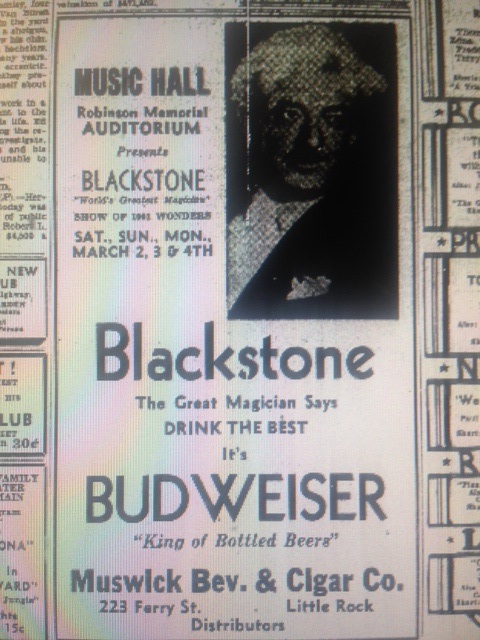
Blackstone adWhile Robinson Center Music Hall is closed for renovations, the Culture Vulture blog is taking a look back at previous bookings in the facility each month.

March 1940 was the first full month that Robinson Auditorium was open.  The month started with Blackstone the magician in performances from March 2 through 4. In addition to his appearance touted by the auditorium, Muswick Beverage & Cigar Company promoted his appearance, and the fact that he endorsed Budweiser beer.  Later that month, appearances included the Shrine Circus, the AAU girls basketball championship, and the Saint Louis Symphony.

March 1950 was a particularly busy month. It featured singer Vaughn Monroe on the 6th and the Arkansas State Symphony playing Beethoven’s Ninth Symphony on the 7th.  On the lower level, a circus took up residency from the 7th through 10th.  Back upstairs in the music hall, Ballet Theatre visited performing Balanchine’s “Theme and Variations” featuring ballerina Nora Kaye and conductor Max Goberman.  The month concluded on the 27th with James Dunn starring in the Pulitzer Prize winning Harvey.

In 1955, Jose Greco and His Spanish Dancers entertained audiences on March 7. Five years later, the Chicago Ballet was featured on March 26, 1960. Earlier that month (the 16th), Max Rudolf conducted the Cincinnati Symphony Orchestra. March 1965 feautured the Chicago Opera Ballet (on the 2nd) and an evening of country music stars including Buck Owens and Kitty Wells (on the 10th).

In March 1970, the national tour of the Broadway musical Mame starring Sheila Smith launched the month on the 6th and 7th. Later that month The Florida Boys were in concert. March 1975 saw much activity at Robinson Center. Guy Lombardo and his orchestra appeared on the 2nd and Richard Fredricks, baritone, gave a recital on the 4th, under the auspices of the Community Concert Series. On March 5 & 6, a statewide touring production of South Pacific played at Robinson. Produced by Vince Insalaco, it starred Judy Pryor (now Judy Trice) as Little Rock native Nellie Forbush. The month closed out with the national tour of Fiddler on the Roof.

March 1980 saw Dawn Wells starring in Neil Simon’s Chapter Two on the 8th. The Arkansas Symphony Orchestra performed on the 15th and 16th with pianist Lorin Hollander as guest artist. Five years later, Marilyn Horne appeared with the ASO on March 2, 1985. At the same time that evening, the Shriners Ball was taking place on the lower level. Later that month a national tour of Sophisticated Ladies stopped by Robinson on the 12th. The ASO returned on March 20 & 21 with pianist Garrick Ohlsson.

The Sharks and the Jets lept on the stage on March 20, 1990, as a tour of West Side Story came to Robinson Center. The month concluded with pianist Jose Carlos Cocarelli in concert with the ASO.

Marilyn Horne returned to Little Rock, ten years and one day after her previous appearance, and performed with the ASO again on March 3, 1995. The month also included The Will Rogers Follies on March 10-12, Jazz Explosion II (with George Duke, Dianne Reeves, Phil Perry, Howard Hewett, and George Howard) on March 15, and the ASO in concert with cellist Jeffrey Solow on March 18 & 19. On March 22, the musical Raisin was performed. The cast included Peabo Bryson, Jeffrey Osborne and Lynette Hawkins.

As the 2000s rolled around, Robinson Center continued to feature an eclectic mix. In March 2000, Ann Hampton Callaway performed with the ASO on March 4 & 5. Later that month the original cast of Red, White & Tuna played at Robinson from March 14 through 19. In 2005, the national tour of Mamma Mia! played at Robinson from March 1-6. Later that month the ASO performed Broadway a la Carte with an eveningn of songs from the Great White Way (on March 18 & 19).

In 2010, the ASO performed a concert version of Porgy & Bess on March 12 & 13. It was the first time that title had ever been performed in its entirity in Arkansas. Irish dance took the stage the next night as Lord of the Dance took up residence at Robinson Center.

ROCKing the TONY AWARDS – Joe E. Brown

Rock the Tonysharveybrown3JOE E. BROWN

Little Rock connection: Appeared at Robinson Auditorium in the national tour of Harvey in 1948.

Tony Awards connection: At the 1948 Tonys, received a special Tony Award for touring in Harvey while the original play still was on Broadway.  He had previously played the role on Broadway earlier in the run (succeeding original star Frank Fay). The original production of Harvey was directed by Antoinette Perry, after whom the awards were named.

The photo on the right was a publicity photo showing Brown taking down a painting of Fay with Harvey to mark the fact that Brown was taking over the role.