
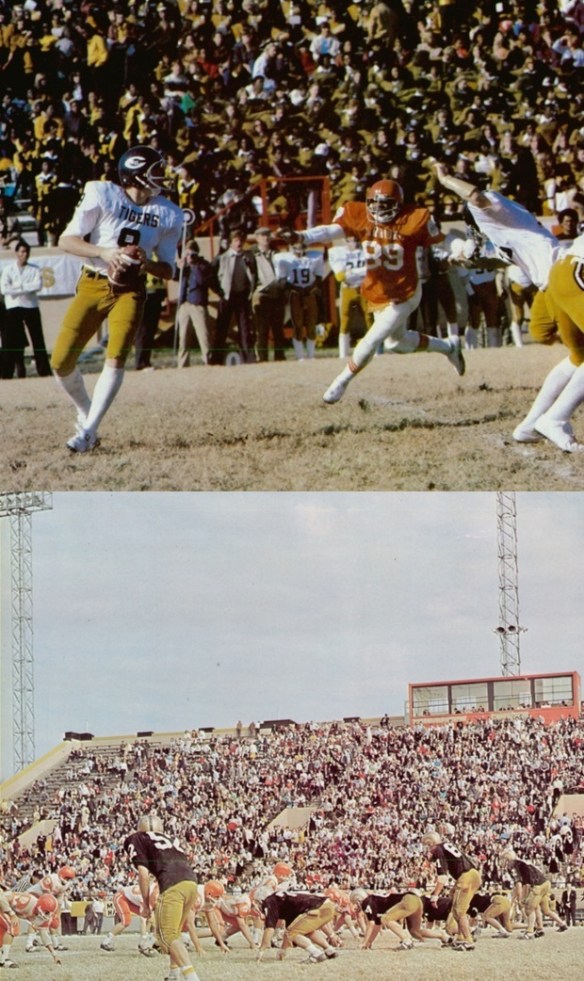
 101 years ago, Little Rock High School (then located on Scott Street) kicked off a 69-year tradition of playing football on Thanksgiving Day. (Though the date of Thanksgiving floats anywhere from the 22nd to the 28th, as with this year, Thanksgiving Day 1914 was on November 26.)
From 1914 until 1933, the Little Rock High School Tigers played a variety of different schools. Then from 1934 until 1957, they played North Little Rock. From 1958 until 1982, the Little Rock Central Tigers took on the Warriors of Little Rock Hall.
Thanksgiving Day football was a tradition not just for high schools in Little Rock but also all levels throughout the state and country. The Friday after Thanksgiving, newspapers carried stories and scores for professional, college and high school football. It was probably the only day of the year to see all three levels of football covered in the paper, and often high school games received the most ink. This mix of football continued for decades. In 1969, there were four football games played in Pulaski County on Thanksgiving Day: Little Rock Hall vs. Little Rock Central, Little Rock Catholic vs. North Little Rock, Horace Mann vs. Scipio Jones, and the Arkansas Razorbacks vs. Texas Tech.
By the 1970s, both high school and college football games on Thanksgiving were on the wane. While college games on Turkey Day have regained some popularity, they are nowhere near approaching the level they once had. High school football on Thanksgiving disappeared in Arkansas following the 1982 game between Hall and Central. That rivalry had been the final series on Turkey Day to still be played.
While they lasted, Thanksgiving Day high school football games were civic focal points. They were about bragging rights. For students who had grown up attending the games, the chance to play or cheer in a Turkey Day classic was a rite of passage. Alumni home from college or visiting the family for Thanksgiving would descend on the stadium ensuring the largest attendance of the season.
High school football on Thanksgiving Day in Little Rock tells the tale of not just football; it reflects changes in the city and society. What started out as two small high schools from neighboring cities changed as both schools grew. The addition of a second Little Rock high school reflected the city’s growth. (Indeed the 1954 Little Rock High School yearbook, in discussing the school’s new designation as Central High, mentions vaguely that the second high school would be built at some yet to be determined location in “west” Little Rock.)
The presence of segregated high schools in separate but unequal football rivalries (lasting nearly two decades after the Supreme Court’s Brown v. Board decision) is an indictment of an unjust parallel education system. As Little Rock continued to grow and diversify, the two high schools playing on Thanksgiving were no longer always the predominant schools in football – or other activities. With state championships once again on the line, the last few years of the Hall and Central Thanksgiving rivalry were, in a way, a return to the halcyon days of the early faceoffs (though this time, thankfully, with fully integrated teams). In addition to trading the top spots in football, the two schools were piling accolades. In fact, all three Little Rock public high schools had achieved a stasis that inadvertently rotated areas of excellence academically, athletically and artistically fairly equally among the three.
There were undercurrents at work that hinted at future instabilities to come. Indeed by 1982, the same year of the final game, Little Rock had filed suit against the North Little Rock and the Pulaski County Special School Districts claiming the schools in those neighboring districts were siphoning off white students from the Little Rock schools. The ensuing realignment of schools and districts would probably have brought an end to Central vs. Hall games even if athletic reclassification had not.
Central is now over twice the size of Hall, Parkview is a magnet school, two formerly county high schools (and several elementary schools and junior highs) were brought into the LR school district in the late 1980s. Where once the Little Rock high schools were roughly equal in enrollment, they now are so varied they play in three different classifications.
It is up to the alternative historians to envision what continued Turkey Day classics would have looked like after 1982. Little Rock has grown and diversified. There are five public high schools and five private high schools playing football within the Little Rock city limits each season. With all these competing interests it is unlikely to envision the same citywide level of interest in one football game.
But back in the day…


 Little Rock Culture Vulture