
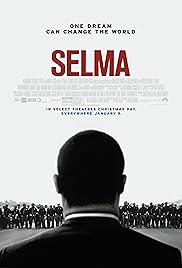
SELMA on CALS Ron Robinson Theatre screen tonight as part of “Movies of a Movement” series

Selma PosterTonight (February 21) at the CALS Ron Robinson Theater, there is the chance to view SELMA, the 2014 movie about Dr. Martin Luther King, Jr.’s campaign to secure equal voting rights via an epic march from Selma to Montgomery, Alabama, in 1965.. The screening starts at 6:30.  Admission is $5.00

This movie is a part of the CALS Movies of a Movement: the Civil Rights & Social Change Collection.

The unforgettable true story chronicles the tumultuous three-month period in 1965, when Dr. Martin Luther King, Jr. led a dangerous campaign to secure equal voting rights in the face of violent opposition. The epic march from Selma to Montgomery culminated in President Johnson signing the Voting Rights Act of 1965, one of the most significant victories for the civil rights movement.

Direced by Ava DuVernay, it stars David Oyelowo as Dr. King and Carmen Ejogo as Coretta Scott King. Others in the cast include Tom Wilkinson, Giovanni Ribisi, Andre Holland, Ruben Santiago-Hudson, Colman Domingo, Common, Lorraine Toussaint, Dylan Baker, Niecy Nash, Tim Roth, and Stephen Root.  John Lavelle plays former Arkansas Gazette reporter Roy Reed who covered Selma for The New York Times.

Rock the Oscars 2019: Roy Reed

It is possible that journalist extraordinaire Roy Reed appears in archival footage of the Oscar winning documentary “Nine from Little Rock” (Documentary, Short-1964) and Oscar nominated Eyes on the Prize: Bridge to Freedom 1965 (Documentary, Feature-1988).  First for the Arkansas Gazette and then for The New York Times, Reed was an eyewitness to history being made.  What is not in doubt is that he is a character in the Oscar winning film Selma.  In that movie, he was played by actor John Lavelle.

Roy Reed was born on February 14, 1930, in Hot Springs and grew up in Garland County. After attending Ouachita Baptist College and the University of Missouri (from which he would receive a Bachelor’s and a Master’s in Journalism), Reed worked for a newspaper in Joplin and served in the US Army.  In 1956, he returned to Arkansas to work for the Arkansas Gazette.

While he did not specifically cover the integration of Little Rock Central High in 1957, he was part of the paper’s coverage of civil rights. He later was assigned to cover the Faubus administration.  In 1965, he was hired by The New York Times and covered the South. He covered the historic Freedom March to the state Capitol in Montgomery in March 1965.  After spending 1965 and 1966 in the South, he was assigned to the Times’ Washington DC bureau.  In 1969, he moved to New Orleans to open a Southern bureau for the paper.  He remained in the Crescent City until 1976, when he was transferred to the London bureau.

After retiring in 1978, he moved to Northwest Arkansas and taught journalism at the University of Arkansas until 1995.  Reed continued to write essays and books including Faubus: The Life and Times of an American Prodigal (1997),  Looking Back at the Arkansas Gazette: An Oral History (2009) and Beware of Limbo Dancers: A Correspondent’s Adventures with the New York Times (2012).  Reed died in December 2017.

Rock the Oscars: Roy Reed

It is possible that journalist extraordinaire Roy Reed appears in archival footage of the Oscar winning documentary “Nine from Little Rock” (Documentary, Short-1964) and Oscar nominated Eyes on the Prize: Bridge to Freedom 1965 (Documentary, Feature-1988).  First for the Arkansas Gazette and then for The New York Times, Reed was an eyewitness to history being made.  What is not in doubt is that he is a character in the Oscar winning film Selma.  In that movie, he was played by actor John Lavelle.

Roy Reed was born on February 14, 1930, in Hot Springs and grew up in Garland County. After attending Ouachita Baptist College and the University of Missouri (from which he would receive a Bachelor’s and a Master’s in Journalism), Reed worked for a newspaper in Joplin and served in the US Army.  In 1956, he returned to Arkansas to work for the Arkansas Gazette.

While he did not specifically cover the integration of Little Rock Central High in 1957, he was part of the paper’s coverage of civil rights. He later was assigned to cover the Faubus administration.  In 1965, he was hired by The New York Times and covered the South. He covered the historic Freedom March to the state Capitol in Montgomery in March 1965.  After spending 1965 and 1966 in the South, he was assigned to the Times’ Washington DC bureau.  In 1969, he moved to New Orleans to open a Southern bureau for the paper.  He remained in the Crescent City until 1976, when he was transferred to the London bureau.

After retiring in 1978, he moved to Northwest Arkansas and taught journalism at the University of Arkansas until 1995.  Reed continued to write essays and books including Faubus: The Life and Times of an American Prodigal (1997),  Looking Back at the Arkansas Gazette: An Oral History (2009) and Beware of Limbo Dancers: A Correspondent’s Adventures with the New York Times (2012).  Reed died in December 2017.