

Joe E. Brown in HARVEY
Little Rock existed as a theatre town for over 100 years prior to the Tony Awards. But since this is Tony Awards week, “let’s start at the very beginning, a very good place to start” (words by my favorite lyricist Oscar Hammerstein II).
The first documented theatrical performance was on November 4, 1834, and in August 1838 the construction of the first theatre in Little Rock was announced. Through Little Rock’s early years a variety of spaces were used for performances including the City Hall on Markham near Main Street which had been built in 1867.
The opening of the Capital Theatre in December 1885 would be Little Rock’s first large-scale, non-church space for performances and gatherings. The Capital had a seating capacity of approximately 2,000 seats. Designed to house theatrical productions, it also played host to civic events ranging from high school graduations (for both the white and African American high schools) to public memorials. For instance, in 1901 it was the site of a public memorial for the recently assassinated President William McKinley. In time, the Capital Theatre (which was situated on land that is now occupied by a portion of the Statehouse Convention Center) would be joined by a variety of other theatres, public houses, vaudeville houses and lodge halls.
The 1908 “temporary” City Auditorium probably played host to theatrical performances, but records do not exist for it. The amphitheatre in Forest Park was home to many theatrical performances including appearances by Sarah Bernhardt. Judy Baker Goss’s play Fond Farewell looked at one of Bernhardt’s visit to Little Rock. (In the local production of that play, Bernhardt was played by Judy Trice, the mother of a three-time Tony winner Will Trice. His father, Bill Trice, played a Little Rock City Council member smitten with the actress.)
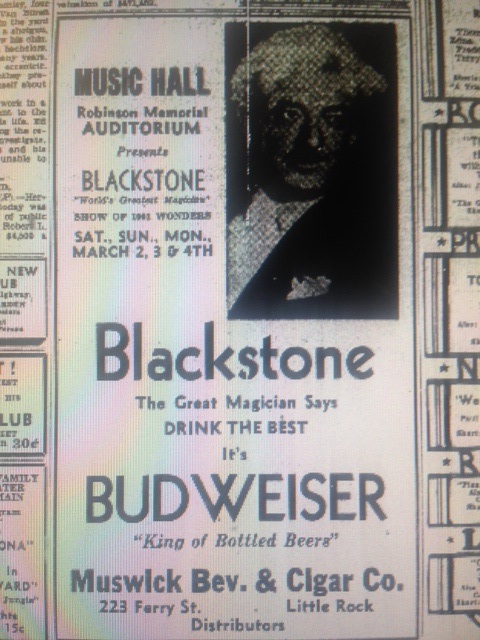
When Robinson Auditorium opened in 1940, it had space to host theatrical productions in the main music hall as well as in the lower level “little theatre.” By that time, there were a variety of community theatre groups performing. The first national tour to play in Robinson was Springtime for Henry starring Edward Everett Horton.
The first Tony winning production to play Robinson was the national tour of Harvey starring Joe E. Brown. Brown, in fact, received a special Tony for starring in the national tour of the play.

 Little Rock Culture Vulture