
Little Rock Look Back: 27 students attempt to integrate LR schools in 1956

Arkansas Democrat photo by staff photographer Mr. Bisgood.

On Monday, January 23, 1956, twenty-seven African American students attempted to integrate four Little Rock schools.  By the end of the day, all four school principals had refused entry and some of the students had met with LRSD Superintendent Virgil Blossom.

Eight girls who were students at Horace Mann High School arrived at Central High at 9:30 am accompanied by Daisy Bates and Frank W. Smith both of the NAACP.  One male student attempted to integrate Little Rock Technical High School.  Four students arrived at Forest Heights Junior High (accompanied by three adults) and fourteen students attempted to integrate Forest Park Elementary (accompanied by four adults).  Neither the Arkansas Gazette nor the Arkansas Democrat broke down the age or gender of the junior high and elementary students.

Though all were referred to meet with Mr. Blossom, only the young women from Horace Mann visited with him.  After the conversation both he and Mrs. Bates declared the conversation had been friendly.   Mr. Blossom, in denying the request, noted that the Little Rock School District had a plan for integration. To allow them to integrate immediately would have been going against the plan.  The integration plan was connected to the completion of the new high school.  If it were ready to open in the fall of 1957, then integration at the high schools would start then.  The newspapers noted that there was no timeline for when it would extend down to the junior high and elementary levels.

That evening, Rev. J. C. Crenchaw, the president of the Little Rock NAACP, issued a statement.  In it he expressed frustration that the LRSD was vague on its timeline for integration.  He noted that the students lived near the schools which they tried to integrate and were therefore forced to travel several extra miles each day to attend school.  He also commented that the young man who attempted to enroll at Tech was not afforded the training available there at his current school.

The Arkansas Democrat ran a photo of the meeting with Mr. Blossom.  It identified the seven students who were pictured.  No mention was made as to whether the eighth student was present but not photographed, or if she did not attend the meeting.  As was the practice at the time, the addresses of the students were listed by their names.  Based on those addresses, the students lived between 0.4 and 0.9 miles from Central High School and were between 2.1 and 3.2 miles away from Horace Mann High School.  Of the seven students in the photo, two were seniors, three were juniors, and three were sophomores.  None of the students named became part of the Little Rock Nine who did integrate Central High twenty-one months later.

On January 24, the Gazette editorial writer opined they were glad for the amicable nature of the conversations. They hoped it did not affect the good race relations in Little Rock.  The writer concluded by saying they did not want it to incite extremists (but did not specify if they viewed the extremists as being for or against integration.)
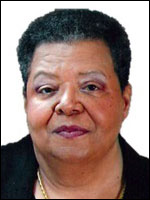
Little Rock Look Back: Elizabeth Eckford

After 60 years, the most dramatic images of the 1957 crisis at Little Rock Central High School remain those of 15-year-old Elizabeth Eckford, being taunted as she walked through a hate-filled mob, on her way to school.  Today, Ms. Eckford recalls how difficult it was for her parents, Oscar and Birdie, to allow her to continue the struggle to integrate the Little Rock schools.
Born on October 4, 1941, she grew up in Little Rock.  Because all of the city’s high schools closed her senior year, Ms. Eckford moved to St Louis, where she obtained her GED. She attended Knox College in Illinois, and received her BA in History from Central State University in Wilberforce, Ohio.  While in college, Ms. Eckford became one of the first African Americans to work in a local St. Louis bank, in a non-janitorial position, and later she worked as a substitute teacher, in Little Rock public schools.

Ms. Eckford, a veteran of the U.S. Army, has also worked as a substitute teacher in Little Rock public schools, test administrator, unemployment interviewer, waitress, welfare worker, and military reporter.  Along with her fellow Little Rock Nine members, she is a recipient of the NAACP’s Spingarn Medal and the prestigious Congressional Gold Medal.  Together with one of her former tormenters, Ms. Eckford also received a Humanitarian award, presented by the National Conference for Community and Justice (NCCJ), following their meeting 34 years after an apology.  The award recognizes forgiveness and atonement.  They talked to students for two years, and, together, attended a 12-week racial healing course.

Ms. Eckford has started to walk through the painful past in sharing some of her story.  She has said that true reconciliation can occur if we honestly look back on our shared history. She believes that the lessons learned from Little Rock Central High School must continue to be shared with new generations, reminding audiences that “the dead can be buried, but not the past.”  Ms. Eckford continues her interest in education by sharing her story with school groups, and challenges students to be active participants in confronting justice, rather than being passive observers.

Ms. Eckford lives in Little Rock, and is a probation officer for the First Division Circuit Court of Pulaski County.

Little Rock Look Back: US Supreme Court announces Cooper v. Aaron decision

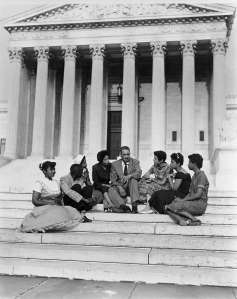
Thurgood Marshall, of the NAACP, sits on the steps of the Supreme Court Building after he filed an appeal in the integration case of Little Rock’s Central High School. The students are, from left: Melba Pattillo, Jefferson Thomas, Gloria Ray, escort Daisy Bates, Marshall, Carlotta Walls, Minnijean Brown, and Elizabeth Eckford. (AP Photo, file)

On September 29, 1958, the U.S. Supreme Court issued its decision in Cooper v. Aaron. That decision held that Little Rock public officials were required to implement a desegregation plan in compliance with the Brown v. Board decision.

The Court found that “the federal judiciary is supreme in the exposition of the law of the Constitution” and all state officials must adhere to the Court’s decisions and follow the rules laid down in those decisions in similar future cases.

The genesis for the Cooper v. Aaron court case was the Little Rock School Board seeking a delay in further implementation of the plan to integrate schools.

After the events of 1957-1958, the School Board was reluctant to have another year of integration, even if it were severely limited. The school board caved to this political pressure, filing a request for a two-and-a-half-year delay in implementing desegregation. The district court granted the request, but the court of appeals reversed. Chief Justice Earl Warren called a Special Term of the Supreme Court into session to consider the case. The stage was set for Cooper v. Aaron.

In their decision, the Warren Court made it clear that resistance to Brown would not be tolerated. The Court went on to state that “the federal judiciary is supreme in the exposition of the Constitution” and “the interpretation of the Fourteenth Amendment enunciated by this Court in the Brown case is the supreme law of the land.”

Little Rock Look Back: Gloria Ray Karlmark

Gloria Ray Karlmark is the youngest daughter of H. C. Ray, son of a former slave, and founder of the Arkansas Agricultural Extension Service for Negroes, and Julia M. Ray, a Sociologist and a graduate of Tuskegee Institute and Philander Smith College. Mrs. Karlmark’s father was Laboratory Assistant to George Washington Carver, and received his degree in Horticulture under Booker T. Washington at Tuskegee Institute.  Mrs. Karlmark’s mother was fired when she refused to withdraw her from Little Rock Central High School in 1957-1958.  When Central High School remained closed, on an order from Governor Faubus the following year, Mrs. Karlmark moved to Kansas City, Missouri, where she graduated in 1960 from the newly integrated Kansas City Central High School.

Mrs. Karlmark went on to graduate from Illinois Institute of Technology (IIT), Chicago, after which she joined the IIT Research Institute as Assistant Mathematician on the APT IV Project (robotics, numerical control, and online technical documentation).  This included work at Boeing in Seattle, McDonnell-Douglas in Santa Monica, and NASA Automation center in St. Louis.

In 1969, she and her husband took a sabbatical year following the trail of the Maya Indians from Mexico through Central America by car.  Soon after, they immigrated to Sweden.  In the years that followed, the Karlmark family was blessed with a son and a daughter.

Recruited to join IBM’s Nordic Laboratory, Mrs. Karlmark completed the Svenska Patent och Registreringsverket “Patent Examiner” Program in 1975, and joined IBM’s International Patent Operations as European Patent Attorney.

In 1976, she co-founded Computers in Industry, and international journal of practice and experience of computer applications in industry affiliated with UNESCO and the International Federation of Information Processing-IFIP.  She served some 15 years as Editor-in-Chief.

In the years leading up to her retirement in 1994, Mrs. Karlmark also worked for Philips International in management as a specialist in Belgium, the Netherlands, France, Germany, Spain, and Scotland.  She and her family currently reside in Europe.

Little Rock Look Back: Ernest G. Green

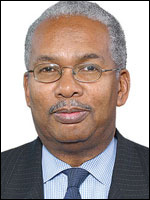
Ernest G. Green is the Managing Director of Public Finance for Lehman Brothers in Washington, D.C.  Featured in the 2006 list of Black Enterprise Magazine’s “75 Most Powerful Blacks on Wall Street”, Mr. Green has served as senior investment banker on transactions for such key clients as the City of New York, State of New York, City of Chicago, Port of Oakland, City of Atlanta, State of Connecticut, Detroit Wayne County Airport, Denver Airport, and the Washington Metropolitan Airport Authority.

Mr. Green served as Assistant Secretary of Labor for Employment and Training during the Carter Administration.  President Clinton appointed him to serve as Chairman of the African Development Foundation.  Secretary of Education, Richard W. Riley, appointed him Chairman of the Historically Black Colleges and Universities Capital Financing Advisory Board.

Born in Little Rock, on September 22, 1941, Mr. Green was the first African American to earn his high school diploma from Central High School. At the age of seventeen he was awarded the NAACP’s Spingarn Medal, as one of the Little Rock Nine. In 1995, he was awarded the Distinguished Eagle Scout Award.  Mr. Green is also a recipient of the Urban League’s Frederick Douglass Freedom Medal, and the John D. Rockefeller Public Service Award. On November 9, 1999, with the Little Rock Nine, he was presented by President Clinton with the Congressional Gold Medal.

Several books, movies and documentaries have chronicled Mr. Green and his eight classmates’ historic year at Central High School in Little Rock — the most recent being the “Ernest Green Story”, produced and distributed by the Walt Disney Corporation.

Mr. Green holds a B.S. in Social Science and Masters in Sociology from Michigan State University, and honorary doctorates from Michigan State University, Tougaloo College, and Central State University.  He currently serves on the Board of Directors of Fisk University, Quality Education for Minorities (QEM) Network, Clark Atlanta University Board of Trustees and the African American Experience Fund Board of Trustees among other distinctions.

Mr. Green and his wife Phyllis live in Washington, D. C.  He is the proud father of Adam, Jessica and McKenzie Ann.

Little Rock Look Back: Minnijean Brown Trickey

On September 11, 1941, Minnijean Brown was born.

Although all of the Nine experienced verbal and physical harassment during their year at Central, Brown was first suspended, and then expelled for retaliating against the daily torment. She moved to New York and lived with Drs. Kenneth B. and Mamie Clark, the African American psychologists whose social science findings played a critical role in the Brown v. Board of Education Supreme Court case.

After graduating from the New Lincoln School in 1959, Mrs. Brown Trickey studied journalism at Southern Illinois University.  She received a Bachelor of Social Work in Native Human Services from Laurentian University and Master of Social Work at Carleton University, in Ontario Canada.

Mrs. Brown Trickey has pursued a career committed to peacemaking, environmental issues, developing youth leadership and social justice advocacy.  She served in the Clinton Administration as Deputy Assistant Secretary for Workforce Diversity at the Department of the Interior.   She has taught social work at Carleton University and community colleges in Canada.

Mrs. Brown Trickey is the recipient of numerous awards for her community work for social justice, including Lifetime Achievement Tribute by the Canadian Race Relations Foundation, and the International Wolf Award for contributions to racial harmony.  With the Little Rock Nine, she received the NAACP Spingarn Medal and the Congressional Gold Medal.

She is the subject of a documentary, Journey to Little Rock: the Untold Story of Minnijean Brown Trickey, which has received critical acclaim in international film festivals in Africa, the UK, the U.S., South America and Canada.  She was featured in People Magazine, Newsweek, the Ottawa Citizen, the BBC, the Canadian Broadcasting Corp, Donahue, as well as on numerous other television, radio and in print media.  She appeared with the Little Rock Nine on Oprah and the Today Show.

Mrs. Brown Trickey currently resides in Canada, and is the Shipley Visiting Writer for Heritage Studies at Arkansas State University. She is the mother of six children, Morning Star, Isaiah, Sol, Ethan, Spirit and Leila Trickey.

Little Rock Look Back: Duke Ellington refuses to play in segregated Robinson

Newspaper ad for the concert that was not to be

In August 1961, it was announced that Duke Ellington would perform in concert at Robinson Center.  He had previously played there in the 1940s and early 1950s.  His concert was set to be at 8:30 pm on Tuesday, September 5.

Due to the changes of times, the NAACP had a relatively new rule that they would boycott performers who played at segregated venues.  When it became apparent that Robinson would remain segregated (African Americans restricted to the balcony), the NAACP announced they would boycott any future Ellington performances if he went ahead and played Robinson.

The music promoters in Little Rock (who were white) petitioned the Robinson Auditorium Commission asking them to desegregate Robinson – even if for only that concert.  The Commission refused to do so.  Though the auditorium was finding it harder to book acts into a segregated house, they felt that if it were integrated, fewer tickets would be sold.

On September 1, 1961, Ellington cancelled the concert.

Robinson remained segregated until a 1963 judge’s decision which integrated all public City of Little Rock facilities (except for swimming pools).