Little Rock Look Back: Satchmo Criticizes Ike over Little Rock

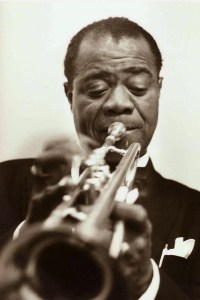
As the Civil Rights movement started taking hold in the mid-1950s, many African American entertainers were vocal in their support.  Louis Armstrong generally stayed silent.  Until, that is, September 17, 1957.
That night, in Grand Forks, North Dakota, Armstrong blasted President Dwight Eisenhower for his lack of action to make Governor Orval Faubus obey the law.  This was in an interview conducted by a 21 year old University of North Dakota journalism student named Larry Lubenow.

Journalist David Margolick wrote about the incident in The New York Times in September 2007 in conjunction with the 50th anniversary of the integration of Little Rock Central High School.  He recounted how the story, written for the Grand Forks Herald, was picked up all over the country.  The entire Margolick piece can be read here.  Margolick tells that when Armstrong was given the chance to back off the comments, he asserted that he meant all of it.

On September 24, 1957, the night that the 101st Airborne was being mobilized to come into Little Rock, Armstrong sent Eisenhower a telegram again criticizing him for lack of action. (It appears this was sent by Armstrong without knowledge of the President’s plans for intervention.) Armstrong used colorful language which sarcastically spoofed the “Uncle Tom” moniker which some of his critics had bestowed when they felt he was not doing enough for Civil Rights.  The Eisenhower Presidential Library has a copy of that telegram.

The incident between Satchmo and Ike was the basis for two different plays: Terry Teachout’s Satchmo at the Waldorf and Ishmael Reed’s The C Above C Above High C.

Little Rock Look Back: Ike meets with Orval

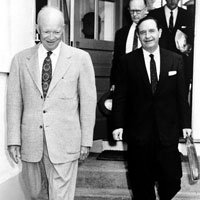
On September 14, 1957, in an attempt to end the stalemate in Arkansas, President Dwight D. Eisenhower met with Arkansas Governor Orval Faubus.  The meeting was brokered by Rep. Brooks Hays, whose district included Little Rock.
The meeting took place in Newport, Rhode Island, where the President was vacationing.  After exchanging pleasantries, the President and Governor adjourned to the Presidents office where they met privately for about twenty minutes.  During that conversation, Faubus proclaimed to the President that he was a law abiding citizen and discussed his own World War II service.  President Eisenhower suggested to Faubus that as a law abiding citizen, he should change the National Guard’s orders so that they protected the Little Rock Nine, not kept them from the building.  He reminded Faubus that the Justice Department was prepared to issue a injunction against him and that the governor would undoubtedly lose in court.

Following their conversation, Congressman Hays and U.S. Attorney General Herbert Brownell Jr.  joined the two in a larger office and continued conversations for approximately another 100 minutes.

When the meeting was over, the President felt like Faubus had agreed to refocus the mission of the National Guard and allow the Little Rock Nine to enter.  The President’s statement to the press thanked Faubus for his cooperation.  Upon returning to Little Rock, Faubus issued his own statement which did not address the President’s statement directly.  He did not even mention the National Guard or the students.

Apparently, President Eisenhower felt betrayed by the Governor’s actions.

The stage was set for these two to continue their face off.

Little Rock Look Back: 1959 Labor Day Bombings

Labor Day Bomb

ARKANSAS GAZETTE photos showing the exterior and interior of the LRSD building after the bomb blast.

A

On September 7, 1959, a peaceful Labor Day in Little Rock was shattered by the explosions of three dynamite bombs.

The locations were Fire Chief Gene Nalley’s driveway on Baseline Road at 10:20pm, Baldwin Company offices at Fourth and Gaines at 10:53pm (where Little Rock Mayor Werner Knoop was a partner–the company is now known as Baldwin Shell), and the School District offices at 10:58pm (then located at Eighth and Louisiana streets).

Given the three targets, it was fairly quickly assumed that there was a connection between the bombings and the lingering effects of the 1957 integration crisis. In light of that, police officers were stationed at the homes of all Little Rock City Directors and School Board members.

The investigation into the bombings turned up a purported fourth location for a bomb. That was the office of Letcher Langford. (Culture Vulture Editorializing Note:  This could have been a ploy to throw investigators off the scent. Langford was the only City Director who had been backed by segregationist candidates and had been openly hostile to the Women’s Emergency Committee — to the point of threatening them with legal action for not disclosing their membership rolls.)

Investigators determined that the bombing had been planned in late August by members of the Ku Klux Klan.  Five individuals were arrested.  They were J. D. Sims, Jesse Raymond Perry, John Taylor Coggins, Samuel Graydon Beavers, and E. A. Lauderdale.  The latter had twice been an unsuccessful candidate for the City Board of Directors.

Sims pleaded guilty and started serving a prison term later in September 1959.  Perry, Coggins and Beavers all went to trial in October and November.  Each was found guilty. Their terms ranged from three to five years.  Lauderdale was convicted, but appealed his decision. Though the Arkansas Supreme Court upheld the verdict against him, he did not start serving his sentence until the court decision in February 1961.

Governor Faubus commuted the sentences of Perry, Coggins and Beavers.  All three served less than six months.  Lauderdale’s sentence was reduced by Faubus so that he, too, was eligible for release after six months.  Sims, who was first to plead, served the longest: nearly two years.

Sadly, this would not be the last bombing in Little Rock tied to 1957. In February 1960, Carlotta Walls’ house was bombed.

Little Rock Look Back: Sermons, TV Shows Dominate Final Day of 1959 Recall Campaign

A rainy Sunday afternoon did not stop STOP canvassers on May 24, 1959.

Sunday, May 24, 1959, was election eve for the Recall Campaign.  As such, the election figured into some Sunday morning sermons.  Reverend M. L. Moser Jr. spoke from the pulpit of his church and described the issue of segregation as Biblical. As many had before him, and would after him, he used the story of Noah’s three sons as a way to justify segregation of the races.

(Supposedly one of the sons was the father of the white race, one the father of the African American race, and one the father of the Asian race.  In this narrative, no explanation is given for other variations such as Native Americans and other indigenous people or persons from the sub-continent of India.  Also excluded is the likely race of everyone in the story – those who live in the Middle East.)

At Trinity Episcopal Cathedral, Dean Charles A. Higgins prayed for the schools but did not tell his parishioners how to vote.  Rev. Aubrey G. Walton at First Methodist Church spoke about the schools needing to be free from politics and pressure groups.  (Though Rev. Walton did later appear that evening on a STOP sponsored TV show.)

Embattled School Board president Ed McKinley refused requests from the media and others to divulge his plans for the future of the Little Rock School District.  Earlier he had stated he had an idea on how the schools could be reopened and segregated, but still remain in compliance with the courts.  Across the river, segregationists were planning a rally in North Little Rock to head off any plans for future integration on the north side.  Congressman Alford had already agreed to speak at this rally.

In paid time on TV, Governor Faubus spoke at length in a criticism of the Arkansas Gazette. He called the fired teachers pawns in a larger game.  He noted in his remarks that he did not expect to sway any votes by this point.

Not to be outdone, STOP was on all three TV stations. Sometimes the program was aired on more than one station simultaneously.  In an appearance sponsored by STOP, William S. Mitchell noted that May 24 was coincidentally Children’s Day.  He noted that never before in Little Rock history had so many people volunteered for a cause as those who had worked on STOP and with STOP.  The Women’s Emergency Committee, PTA Council, labor unions, and numerous other organizations had come together to raise money, knock on doors, and otherwise get the word out.

Finally, it was all over but the voting.  Nineteen days of outrage, exasperation, and hyperbole was coming to an end.  When dawn broke, it would be election day.

Little Rock Look Back: End near for 1959 School Board Recall Election

May 23, 1959, was a Saturday. It was also two days before the School Board recall election.  With it being a Saturday, it was the last full day for door knocking as supporters for all sides were busy trying to get out the vote.

Both sides were confident of victory.  Before a crowd of 1,000 in MacArthur Park, segregationists Rep. Dale Alford and Mississippi congressman John Bell Williams berated Harry Ashmore and the Arkansas Gazette.

STOP chair Dr. Drew Agar and campaign chair William Mitchell predicted it would be the largest turnout in Little Rock school election history.  They also stated that Gov. Faubus’ TV appearance criticizing STOP had actually pushed people over to their side.

Echoing Agar and Mitchell, the Pulaski County Election Commission predicted 30,000 of the district’s 42,000 registered voters would cast ballots.  The previous record of 27,000 had been cast in September 1958 when voters decided to keep the high schools closed.  By contrast, 14,300 voted in the December 1958 election which had selected the six school board members now on the ballot for recall.  On May 22, the final day of absentee ballot voting, 205 absentee votes had been cast bringing it to a total of 455 absentee ballots.

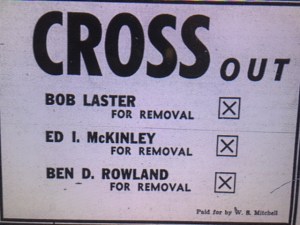
William S. Mitchell, who in addition to being a renowned attorney, apparently had a wicked sense of humor.  He used CROSS’s name against them in ads (placed throughout the newspaper) which urged voters to “Cross” out the names of the three candidates being backed by CROSS.

Little Rock Look Back: Dan T. Sprick

Future Little Rock Mayor Dan T. Sprick was born on May 19, 1902.  He served three terms on the Little Rock City Council (from 1935 to 1941).  In 1945, he was elected Mayor of Little Rock and served one term. During his tenure on the City Council, he was the sole vote against locating Robinson Auditorium at Markham and Broadway.  He had favored another location.

He was not alone, however, in being held in contempt of court and spending part of the day in jail.  On Monday, December 4, a dozen of Little Rock’s aldermen (which included Sprick) reported to the county jail to serve sentences for contempt of court. The previous Monday, the twelve council members had voted against an ordinance which had been ordered by the judge in an improvement district matter. The other aldermen had either voted in the affirmative or had been absent. Because the twelve had refused to change their votes since that meeting, the judge ordered them jailed.  After the aldermen changed their votes later in the day, they were freed.

His tenure as Mayor was relatively quiet. He took office the same month that World War II ended. While in office, the Sprick administration was marked by growth in the city budget and in city positions. As a part of that growth, there were many more new purchases taking place which had prompted extra scrutiny of the City’s purchasing procedures. A thorough investigation toward the end of his tenure found no malfeasance or misfeasance, it did note that the city needed to do a better job of anticipating cash flow. Much of the City’s focus during the Sprick tenure was on growth and keeping up infrastructure needs.

Sprick later served for ten years in the Arkansas State Senate (from 1961 to 1970).  During his tenure in the Senate, Sprick was closely aligned with Gov. Orval Faubus.  When the Little Rock high schools had been closed a year to ensure segregation, Sprick had served on the board of a private school set up by some of the leaders of the segregation movement.

His time in the Senate was also marked by controversy.  He was one of three Senators to opposed Muhammad Ali’s speaking at the University of Arkansas at Fayetteville.  After an Arkansas Gazette editorial lambasted him, Sprick sued the paper for libel. The Gazette settled with him out of court because his health was poor.

One of the landmark pieces of legislation he guided through the Arkansas General Assembly allowed cities to collect advertising and promotion taxes.  The 1972 and 1973 upgrades to Robinson Center were funded by this tax (as have some subsequent upgrades). So the building he voted against while on the LR City Council benefited from legislation he championed while in the General Assembly.

Sprick died in January 1972.

Little Rock Look Back: 44 Teachers fired by divided LRSD School Board in 1959

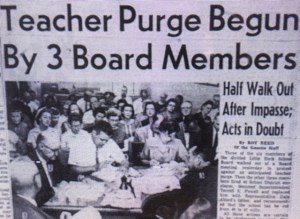
Arkansas Gazette coverage of the teacher purge

On Tuesday, May 5, 1959, the deeply divided Little Rock School Board met to consider contracts for the coming year.  The topic of contract renewal had been on the April agenda, but with two of the six members out of town, it had been delayed.

The 1958-1959 school year had been anything but routine in Little Rock.  To keep the high schools segregated, the city’s four high schools had been closed – first by action of Governor Orval Faubus and then by Little Rock voters.  Frustrated by actions taken at the State level, the School Board had resigned en masse by November 1958, except for the one member who had won a surprise write-in election to unseat Congressman Brooks Hays.  A new school board was elected in December and was equally divided between segregationists and those who felt the law and federal court rulings should be followed.

The May 5, 1959, School Board meeting began at 9am with a room packed full of spectators and was carried live on the radio.  There had been rumblings that the pro-segregation school board members were going to try to fire any teachers they viewed as in favor of desegregation.  Every vote in the morning session ended with a 3/3 vote as Everett Tucker, Russell Matson and Ted Lamb voted one way and the other three: Ed McKinley, Robert Laster and Ben Rowland, voted the other.

After lunch, Tucker, Matson and Lamb decided to leave the meeting. They saw no way to break the stalemate that was paralyzing the discussions. Upon advice of attorneys, they walked out. With only three members remaining, they three thought it end the meeting for lack of quorum.

School Board President Ed McKinley declared the remaining members a quorum. The trio alternated between open and closed sessions. At the end of the day, they had fired forty-four LRSD employees who they viewed as integrationists.  This included 39 whites and five African Americans.  Twenty-seven worked at Central High, while the other seventeen were scattered across other Little Rock schools.  Seven principals, thirty-four teachers, and three secretaries made up the group.  The meeting had lasted the entire day.  The afternoon Arkansas Democrat (with a mid-day deadline) carried a story pondering whether teachers would be fired.

At the same meeting, Superintendent Terrell Powell was fired.  He had taken the reins of the district in December 1958 after having been Hall High’s first principal.  Mr. Powell was replaced by Tom Alford, a former Jacksonville superintendent who was the father of congressman (and former LRSD school board member) Dale Alford.

During a portion of the school board meeting (which was at the corner of Eighth Street and Louisiana Street), phone calls were being made from the LRSD headquarters to a house a few blocks away.  That house was the home of Adolphine Fletcher Terry.  She was hosting an executive board meeting of the Women’s Emergency Committee that day.

Not ones to shy away on anything, the WEC executive board voted to condemn the firings and support the teachers.  Fairly quickly, the Parent Teachers Association of Little Rock, the Arkansas Education Association, League of Women Voters, and Little Rock Ministerial Alliance joined in the call condemning the action.  Leadership at the Little Rock Chamber of Commerce also joined in decrying the purge.

And the fallout was just beginning……