
Learn more about Native American Heritage at Historic Arkansas Museum

HAMCollectionHeadPotNovember is Native American Heritage Month.  It’s a great time of year to visit Historic Arkansas Museum and explore their permanent exhibit “We Walk In Two Worlds: The Caddo, Osage and Quapaw in Arkansas.”

And remember – Admission to the galleries at Historic Arkansas Museum is FREE!

This exhibit tells the story of Arkansas’s first people–the Caddo, Osage and Quapaw Indian tribes–from early times to today. More than 150 objects, such as pottery, clothing and weapons, are on display.

The exhibit has six thematic areas that are arranged chronologically.  Along with objects and a historical timeline are passages of relevant research from archeologists, historians and ethnographers.

Throughout the exhibit, is the dominant presence of the Native American voice, from each of Arkansas’s three prominent tribes. During the two years of exhibit development, many tribal members were interviewed and it is this voice that informs, educates and guides visitors through the exhibit. Historic Arkansas Museum chief curator and deputy director Swannee Bennett said, “What makes this exhibit unique is that it is a story of the Arkansas Native American told in large part with an Indian voice.”

This permanent exhibit enables the museum to tell the bigger story of Arkansas’s frontier history. “We Walk in Two Worlds is a milestone as the State of Arkansas officially partners with the Caddo, Osage and Quapaw Nations and the Smithsonian’s National Museum of the American Indian to tell this story of struggle and endurance.” said museum director Bill Worthen.
Sculpture Vulture: Native Knowledge

Native American Face

November is Native American Heritage Month.  One way to learn more about Native Americans in Little Rock’s history is to visit Riverfront Park.

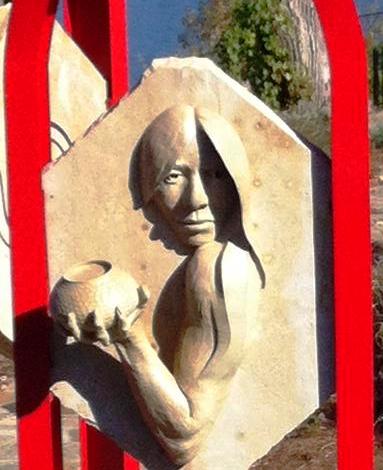
There are several exhibits in the park that discuss the importance of Native Americans in this region prior to and since the settlement of Little Rock.  Denny Haskew’s Native Knowledge is a tribute to the Caddo, Osage, and Quapaw Native American Cultures of Arkansas.

It is sited near the Quapaw Line and La Petite Roche.  The location is important because the Quapaw Line was used as demarcation to separate the Quapaw Tribe from land available for white settlers.  It ran from La Petite Roche due south.  In addition, La Petite Roche was a stop along the “Trail of Tears” as Native American tribes were resettled from their original homes in the American Southeast to points west.

Three bronze twice life-size representational sculptures are mounted on 6” thick hexagonal buff colored sandstone panels suspended between I-beam arches representing the outline of theout canoes of the Osage, Caddo and Quapaw. The bronze sculptures are patinated to match the stone panels giving the appearance of being carved from stone. The back of each panel is etched with a pottery design from each of the three tribes mentioned above.

Commemorate Native American Heritage Month at Historic Arkansas Museum

HAMCollectionHeadPotNovember is Native American Heritage Month.  It’s a great time of year to visit Historic Arkansas Museum and explore their permanent exhibit “We Walk In Two Worlds: The Caddo, Osage and Quapaw in Arkansas.”

And remember – Admission to the galleries at Historic Arkansas Museum is FREE!

This exhibit tells the story of Arkansas’s first people–the Caddo, Osage and Quapaw Indian tribes–from early times to today. More than 150 objects, such as pottery, clothing and weapons, are on display.

The exhibit has six thematic areas that are arranged chronologically.  Along with objects and a historical timeline are passages of relevant research from archeologists, historians and ethnographers.

Throughout the exhibit, is the dominant presence of the Native American voice, from each of Arkansas’s three prominent tribes. During the two years of exhibit development, many tribal members were interviewed and it is this voice that informs, educates and guides visitors through the exhibit. Historic Arkansas Museum chief curator and deputy director Swannee Bennett said, “What makes this exhibit unique is that it is a story of the Arkansas Native American told in large part with an Indian voice.”

This permanent exhibit enables the museum to tell the bigger story of Arkansas’s frontier history. “We Walk in Two Worlds is a milestone as the State of Arkansas officially partners with the Caddo, Osage and Quapaw Nations and the Smithsonian’s National Museum of the American Indian to tell this story of struggle and endurance.” said museum director Bill Worthen.