Little Rock Look Back: Little Rock takes possession of Robinson Auditorium

10.+citylittlerock-2On January 25, 1940, the City of Little Rock officially took complete possession of the Joseph Taylor Robinson Memorial Auditorium. By assuming custody of the structure from the contractor and the PWA, the City accepted responsibility for any of the remaining work to be completed.  This event happened one day shy of the third anniversary of the election which approved plans to issue bonds for an auditorium.

E. E. Beaumont, the Auditorium Commission chairman, stated that an opening date could not be set until more work was completed. A major unfinished task was the laying of the front sidewalk which had been delayed due to cold weather.

The night before Little Rock took possession, Robinson Auditorium had been a topic of discussion at the Little Rock Chamber of Commerce annual meeting. The new Chamber president Reeves E. Ritchie (who as an Arkansas Power & Light executive had been engaged in the lengthy discussions about the installation of the steam line and transformers of the building) pledged that the Chamber would work to bring more and larger conventions to Little Rock at the Joseph Taylor Robinson Memorial Auditorium.

Little Rock Look Back: Robinson Auditorium Groundbreaking

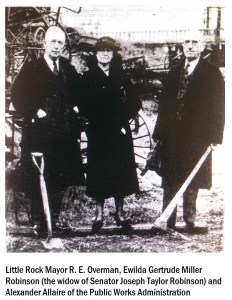
122437 GroundbreakOn December 24, 1937, at 11:30 a.m., Little Rock Mayor R. E. Overman, Ewilda Gertrude Miller Robinson (the widow of Senator Joseph Taylor Robinson) and  Alexander Allaire of the PWA turned dirt to participate in the brief groundbreaking ceremony for Little Rock’s municipal auditorium.  That morning, the Arkansas Gazette ran a brief story on the upcoming groundbreaking.  The story mentioned that the building would be named in memory of the late beloved Arkansas politician.  This appears to be the first public pronouncement of the Robinson name for this civic structure.

Among others in attendance at the groundbreaking were Mrs. Charles Miller (sister-in-law of Mrs. Robinson), Mr. and Mrs. Grady Miller (brother and sister-in-law of Mrs. Robinson), the mayor’s wife, the three architects (George Wittenberg, Lawson Delony and Eugene John Stern), and D. H. Daugherty and Will Terry of the City’s Board of Public Affairs.

Construction had to start by January 1, 1938, in order to receive PWA funds.  By breaking ground on December 24, there was over a week to spare.  The site had been selected in late October 1937, and the purchase had not been finalized.  But the PWA did give permission for the City to let a contract for excavation, demolition and filling on the site.

The groundbreaking took place at the corner of Garland and Spring Streets which was on the northeast corner of the block set aside for the auditorium.  Today, Spring Street does not extend north of Markham; the street was closed to make way for the parking structure and what is now the Doubletree Hotel.  Garland Street is basically an alley that runs parallel to Markham north of City Hall, Robinson Auditorium and the Doubletree Hotel.

Little Rock Look Back: Bonds sold for Robinson Center in 1937

clr-res-1418On December 20, 1937, the Little Rock City Council adopted Resolution 1,418 which authorized the sale of municipal bonds to fund the municipal auditorium.

Earlier that year, Little Rock voters had authorized the sale of $468,000 of Municipal Auditorium Bonds.  Since that January election, city leaders had been undertaking various steps to plan for the project.  Finally, they were ready to sell the bonds.  On December 20, a public sale was held.  The US federal government made a bid for the purchase of $418,000 of the bonds. It was the only bid received.

The sale was accompanied by an Emergency Clause so that it would go into effect immediately.  The clause noted: “It is ascertained and declared that by reason of the present economic conditions many citizens of the City are out of work, and the improvements herein provided would furnish work for a large number of persons and thereby add to the peace and happiness of the City; further, that the City has no Municipal Auditorium or facilities for large conventions or gatherings…”

The offer by the US Government to purchase the bonds was in addition to an outright grant of $342,000 to help fund the auditorium.

While there would be other issues in financing and funding the project, the sale of the bonds on December 20, 1937, set things in motion which led to the February 16, 1940, opening.

Little Rock Look Back: LR votes to Restore Robinson!

restore-robinson-121013On Tuesday, Dec. 10, 2013, voters of Little Rock overwhelmingly chose to renovate the historic Joseph Taylor Robinson Memorial Auditorium.

By a vote of 5,183 For and 1,800 Against, Little Rock citizens approved a plan to use a portion of the city’s existing 2 percent restaurant and hotel tax to repay bonds for a renovation of Robinson Center.  The campaign was chaired by businessman Charles Stewart, restaurateur Capi Peck and former LR Mayor Jim Dailey.

Robinson has long been a landmark in central Arkansas. Construction of the Joseph T. Robinson Memorial Auditorium began in 1938 (after a December 1937 groundbreaking under a deadline) and officially opened February 1940. The structure was a PWA (Public Works Administration) project, and is an excellent example of the Art Deco style architecture of the time. The building was added to the National Register of Historic Places in 2007.

The facility is owned by the City of Little Rock and managed by the Little Rock Convention & Visitors Bureau.

The 1940 structure suffered from a wide array of deficiencies, including stage loading and unloading, stage size, acoustical insufficiency, dressing room access and inadequate wing space within the performance hall. Also, structural, mechanical and electrical issues, public circulation and outdated conference center spaces existed within the facility.

Knowing the center is in need of major upgrades if the facility is to continue to serve central Arkansas into the future, the Little Rock Advertising and Promotion Commission (LRA&P) empanelled a Robinson Center Concept Team in October 2011. The group was tasked with evaluating all aspects of the existing facility, researching user needs, proposing conceptual solutions and estimating the cost and construction schedule of the proposed additions and renovations. The concept team was led by Mike Steelman of SCM Architects, PLLC, and included representatives from WD&D Architects, Shuler Shook Theatre Planners, Jaffe-Holden Acoustical Consultants, TME Inc. Mechanical and Electrical Engineers, ECI Inc. Structural Engineers, McClelland Consulting Engineers Inc. Civil Engineers, East Harding Construction, HVS Consulting and Hunt Construction Group.

Additionally, stakeholder and tenant organizations representing the Arkansas Symphony Orchestra, Celebrity Attractions of Tulsa, Oklahoma and the Double Tree Hotel participated in the planning. The concept team findings were presented publicly on June 5, 2012.

On January 17, 2013 the LRA&P announced the selection of Polk Stanley Wilcox Architects, partnered with Ennead Architects, as the architectural and design team for the future renovations. On March 28, 2013 CDI Contractors LLC, partnered with Hunt Construction Group, were selected by LRA&P as the general contractors and construction managers.

On September 23, 2013 the final schematic renderings and cost estimates were presented publicly. The schematic plans depict major interior upgrades within the performance hall including additional volume to create a two-balcony setup, increased lobby space, acoustical improvements, theatrical upgrades, loading dock expansion, a larger stage area, and new dressing room facilities. Additionally, an enhanced modern ballroom and small conference center was unveiled. New technology, mechanical systems, and outdoor plaza spaces were included in the presentation.

Construction would begin on July 1, 2014.  It reopened on schedule and on budget on November 10, 2016.

RobinsoNovember: Election set to create auditorium

muni aud elect ad editedOn November 30, 1936, Little Rock Mayor R. E. Overman asked the City Council to call a special election for January 1937 for approval of the issuance of bonds for a municipal auditorium.  Prior to asking the aldermen to call the election, the mayor had been in Washington DC to visit with Public Works Administration (PWA) officials. The mayor was assured that the auditorium project would be approved for federal funds.

While the mayor was meeting with federal officials, architects Eugene Stern, George Wittenberg and Lawson Delony were meeting with local PWA officials in Little Rock.  They were reviewing the plans for the funding request.  Though there were still a few refinements to be completed in the documents, the local officials seemed satisfied.  With these assurances in hand, Mayor Overman moved forward with putting the request before the City Council.

Though there were many things discussed at length during the November 30 City Council meeting, there was virtually no conversation regarding the structure before the 15-0 vote by the City Council to refer the auditorium bonds to the voters.  There were three different bond programs to be put before the voters in January 1937: a municipal auditorium, expansion of the public library and creation of a park for African Americans.

The bonds for the auditorium would be $468,000 in general obligation bonds which would be paid off between 1940 and 1971.  This was toward a total cost of $760,000 for the entire project.  At the time of the initial auditorium application in 1935, the mayor had noted that if the PWA failed to approve funding for the entire project, it could be submitted to the voters for the issuance of municipal bonds.  This was ultimately the course of action that would come to pass.  The PWA grant would only cover a portion of the project.  The government did agree it would purchase the financing bonds if no other entity did.

The election would be held on January 26, 1937.

Little Rock Look Back: Groundbreaking for Robinson Auditorium

122437 GroundbreakOn December 24, 1937, at 11:30 a.m., Little Rock Mayor R. E. Overman, Ewilda Gertrude Miller Robinson (the widow of Senator Joseph Taylor Robinson) and  Alexander Allaire of the PWA turned dirt to participate in the brief groundbreaking ceremony for Little Rock’s municipal auditorium.  That morning, the Arkansas Gazette ran a brief story on the upcoming groundbreaking.  The story mentioned that the building would be named in memory of the late beloved Arkansas politician.  This appears to be the first public pronouncement of the Robinson name for this civic structure.

Among others in attendance at the groundbreaking were Mrs. Charles Miller (sister-in-law of Mrs. Robinson), Mr. and Mrs. Grady Miller (brother and sister-in-law of Mrs. Robinson), the mayor’s wife, the three architects (George Wittenberg, Lawson Delony and Eugene John Stern), and D. H. Daugherty and Will Terry of the City’s Board of Public Affairs.

Construction had to start by January 1, 1938, in order to receive PWA funds.  By breaking ground on December 24, there was over a week to spare.  The site had been selected in late October 1937, and the purchase had not been finalized.  But the PWA did give permission for the City to let a contract for excavation, demolition and filling on the site.

The groundbreaking took place at the corner of Garland and Spring Streets which was on the northeast corner of the block set aside for the auditorium.  Today, Spring Street does not extend north of Markham; the street was closed to make way for the parking structure and what is now the Doubletree Hotel.  Garland Street is basically an alley that runs parallel to Markham north of City Hall, Robinson Auditorium and the Doubletree Hotel.

Little Rock Look Back: Little Rock votes to Restore Robinson

On Tuesday, Dec. 10, 2013, voters of Little Rock overwhelmingly chose to renovate the historic Joseph Taylor Robinson Memorial Auditorium.

By a vote of 5,183 For and 1,800 Against, Little Rock citizens approved a plan to use a portion of the city’s existing 2 percent restaurant and hotel tax to repay bonds for a renovation of Robinson Center.  The campaign was chaired by businessman Charles Stewart, restaurateur Capi Peck and former LR Mayor Jim Dailey.

Robinson has long been a landmark in central Arkansas. Construction of the Joseph T. Robinson Memorial Auditorium began in 1938 (after a December 1937 groundbreaking under a deadline) and officially opened February 1940. The structure was a PWA (Public Works Administration) project, and is an excellent example of the Art Deco style architecture of the time. The building was added to the National Register of Historic Places in 2007.

The facility is owned by the City of Little Rock and managed by the Little Rock Convention & Visitors Bureau.

The 1940 structure suffered from a wide array of deficiencies, including stage loading and unloading, stage size, acoustical insufficiency, dressing room access and inadequate wing space within the performance hall. Also, structural, mechanical and electrical issues, public circulation and outdated conference center spaces existed within the facility.

Knowing the center is in need of major upgrades if the facility is to continue to serve central Arkansas into the future, the Little Rock Advertising and Promotion Commission (LRA&P) empanelled a Robinson Center Concept Team in October 2011. The group was tasked with evaluating all aspects of the existing facility, researching user needs, proposing conceptual solutions and estimating the cost and construction schedule of the proposed additions and renovations. The concept team was led by Mike Steelman of SCM Architects, PLLC, and included representatives from WD&D Architects, Shuler Shook Theatre Planners, Jaffe-Holden Acoustical Consultants, TME Inc. Mechanical and Electrical Engineers, ECI Inc. Structural Engineers, McClelland Consulting Engineers Inc. Civil Engineers, East Harding Construction, HVS Consulting and Hunt Construction Group.

Additionally, stakeholder and tenant organizations representing the Arkansas Symphony Orchestra, Celebrity Attractions of Tulsa, Oklahoma and the Double Tree Hotel participated in the planning. The concept team findings were presented publicly on June 5, 2012.

On January 17, 2013 the LRA&P announced the selection of Polk Stanley Wilcox Architects, partnered with Ennead Architects, as the architectural and design team for the future renovations. On March 28, 2013 CDI Contractors LLC, partnered with Hunt Construction Group, were selected by LRA&P as the general contractors and construction managers.

On September 23, 2013 the final schematic renderings and cost estimates were presented publicly. The schematic plans depict major interior upgrades within the performance hall including additional volume to create a two-balcony setup, increased lobby space, acoustical improvements, theatrical upgrades, loading dock expansion, a larger stage area, and new dressing room facilities. Additionally, an enhanced modern ballroom and small conference center was unveiled. New technology, mechanical systems, and outdoor plaza spaces were included in the presentation.

Construction would begin on July 1, 2014, with a completion scheduled for November 2016.