Little Rock Look Back: Wilbur D. Mills

While later known more as a punchline due to personal fallibilities, for decades Wilbur D. Mills was one of the most powerful men in the world.  As the chair of the House Ways and Means Committee from 1958 to 1975, he was the architect not only of an overhaul of the tax code, but also determined ways to finance Medicare, Medicaid, and many other federal programs of the Eisenhower, Kennedy, Johnson, Nixon and Ford years.

Wilbur Daigh Mills was born in Kensett on May 24, 1909.  When Mills went to Congress at the age of 29, he was the youngest man elected to that time.  A scant four years later he joined the Ways and Means Committee.

Because Mills rarely had an opponent (only 1942, 1966, and 1974), he was able to focus on learning the ins and outs of the tax code. As long as he delivered some federal dollars to his largely rural district every so often, he did not have to preoccupy himself with the daily issues many in Congress face.  It was not until 1963, when Arkansas lost two of its six congressional seats, that Mills had Little Rock in his district. Prior to that, Searcy had been the largest city he represented.  (There had been concern that Rep. Dale Alford, who had upset incumbent Brooks Hays in 1958 before losing his seat due to reapportionment four years later might challenge Mills. But Alford opted to retire instead of taking on the powerful Mills.)

President Kennedy’s visit to Little Rock and Greers Ferry in October 1963 was the result of bargaining with Congressman Mills over some tax policy.  Mills gave in to JFK a bit, and JFK agreed to come to Arkansas to speak in Little Rock and at the dedication of two dams.  In recognition of his national clout, Mills was briefly considered a contender for the 1972 Democratic nomination for President.

Though he probably struggled with alcoholism for years, he had been able to keep his behavior in check until 1974 when his car was stopped in Washington DC for not having its headlights on. Though Mills was not driving, he was inebriated.  Another occupant of the car, a stripper with the stage name Fanne Fox ran from the car and frolicked in the Tidal Basin.  It became fodder for worldwide headlines.

The incident happened about a month before Election Day, when Mills was facing Republican Judy Petty.  A contrite Mills spent the remaining days in the campaign in Arkansas and won re-election by 59% of the vote.  (Though later in November, he again was in the headlines when Fox pulled him on stage with her at a club in Boston.) In January 1975, he stepped down as Ways and Means Chair.

In 1976, he opted to retire from Congress and did not seek another term.  In retirement, he practiced law in Washington DC before eventually moving back to Kensett full-time.  He died in 1992.

Little Rock Look Back: JFK100

100 years ago today, John Fitzgerald Kennedy was born to Joe and Rose Kennedy, the second of nine children. Groomed for leadership by his parents, he was thrust even more into the path of political greatness following the World War II death of his elder brother Joe Jr.  A war hero himself, following his leadership after the attack of PT-109, he was first elected to Congress from Massachusetts in 1946. He would be re-elected in 1948 and 1950.  In 1952, he challenged incumbent Senator Henry Cabot Lodge and beat him.  He was re-elected to the Senate in 1958.

Kennedy had been seen as a strong potential Vice Presidential candidate for the Democrats in 1956. But his father discouraged this fearing that a loss to Eisenhower/Nixon would set him back in the future.  In 1960, the young, dashing Senator from the Bay State sought the Democratic nomination.  After a contentious primary season where he often ran against senate colleagues, Kennedy headed into the Democratic convention with the most delegates.  He added his chief rival, Texas Senator Lyndon Baines Johnson as his running mate.

After a close election, the Kennedy-Johnson ticket bested Vice President Richard Nixon and his running mate Henry Cabot Lodge (the selfsame former Senator who had been defeated by Kennedy 8 years earlier).

Following the oldest President (at the time), the young Kennedy administration seemed to captivate the country.  During his 1000 days in office, Kennedy faced many challenges both foreign (Bay of Pigs, Cuba missile crisis, start of Vietnam) and domestic (civil rights, organized crime). His ambitious “New Frontier” focused on education, additional services to rural areas and medical care for the elderly.  He also focused on getting the US to the moon.

On the personal front, in 1953 he married Jacqueline Bouvier. In addition to their daughter Caroline and son John Jr., who survived their father, the Kennedy’s had a miscarriage, a stillborn daughter, and son Patrick who died after two days.

Together with Franklin Roosevelt and Ronald Reagan, JFK embodied not only his generation but the mood of the country.  And his quotes resonate today including:

My fellow Americans, ask not what your country can do for you, ask what you can do for your country.

Let every nation know, whether it wishes us well or ill, that we shall pay any price, bear any burden, meet any hardship, support any friend, oppose any foe to assure the survival and the success of liberty.

Ich bin ein Berliner

On October 3, 1963, President Kennedy delivered remarks at the Arkansas State Fairgrounds.  Only a few weeks later, he would be felled by an assassins bullet in Texas.  In the speech, the President praised Arkansas’ congressional delegation including Senators John McClellan and J. William Fulbright and Congressmen Took Gathings, Bill Trimble, Wilbur Mills and Oren Harris.  Each of these men held senior leadership positions in key committees.  The main focus of the speech was to discuss President Kennedy’s vision for a new economy in the South.

The President was actually in the state to speak at the dedication of the Greers Ferry Dam. He agreed to make that appearance as a part of a negotiation with Congressman Mills as they were deadlocked over changes to the tax code.  He had previously visited Little Rock in 1957 when he came to the state to address the Arkansas Bar Association meeting in Hot Springs.

Little Rock Look Back: November 8 Presidential Election Arkansas Newspapers

November 8 has been a Presidential Election Day in Arkansas six times.  The first time such a date happened in the US, Arkansas did not participate because it was 1864.  The times it has happened have been 1892, 1904, 1932, 1960, 1988, and today.

A look back at newspaper headlines from the previous years tells a lot about not only the elections, but also the way news was delivered.  For the 1892 and 1904 elections, only the Arkansas Gazette is available.  Though the Arkansas Democrat existed, it did not yet publish every day.  Tuesdays do not appear to have been dates it was published.  (The Gazette itself would not be at seven days until the early 1900s when it finally started publishing a Monday edition.)

elex-ag-1892The 1892 election day Gazette intersperses news stories with advertisements.  One headline states poetically:  “Ballots: Like flakes of snow they will gently fall throughout the Union today.”  Another headline stated “Confident.  Democrats everywhere feel assured of Grover Cleveland’s election today.”  Indeed, Cleveland returned to the White House in 1892 after four years of Benjamin Harrison.

elex-ag-04By 1904, most front page advertising at the Gazette had been banished from the front page, although an small box ad for Blass Department Store is at the top.  Only three of the seven columns on the front page have above-the-fold headlines devoted to election stories, and two of those are about the State of New York.  This reflects new editor J. N. Heiskell’s desire to have the Gazette be national in scope. While early Gazettes often relied on national news to fill space, by the post Reconstruction era, the focus was largely on local news.   The lone local headline was “Arkansas will go Democratic” which was certainly a foregone conclusion at the time.  While Arkansas did go Democratic, Theodore Roosevelt kept the presidency in the hands of the GOP.  Interestingly another headline was about efforts to get Prohibition adopted in the state.  It would become an election issue for years to come.

elex-ag-32By 1932, both the Gazette and Democrat published Election Day editions.  The Gazette’s stories included predictions that FDR would win and a record number of ballots would be cast.  There were also separate stories which highlighted the final day of campaigning for both FDR and Hoover.  One of Mr. Heiskell’s above-the-fold editorials encouraged voting No on a variety of measures which dealt with public school financing, sales tax reduction, bond issuance, and reorganization of county election commissions and state government.

elex-ad-32The afternoon Democrat featured stories on Hoover and FDR in the last hours of the campaigns. Like the Gazette it anticipated a record turnout and showed that Pulaski County was experiencing heavy turnout.  The headline trumpeted that FDR had a lead as early results were starting to trickle in.  The Democrat also offered succinct analysis of key battleground states.  In the end, FDR did carry 42 of the 48 states in an election that saw a record of 38,582, 531 people casting votes for one of the two top candidates.

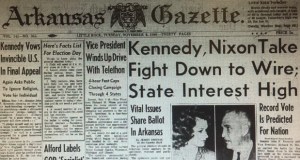
elex-ag-60The 1960 election ended up being one of the closest in popular vote in US history, with only 112,827 votes separating JFK from Nixon.  The Gazette headline was “Kennedy, Nixon take fight down to wire; State interest high.”  The front page also featured stories about Kennedy’s and Nixon’s last full day on the campaign trail.  A box on the front page reminded readers that liquor stores and beer sales could not take place during polling hours. Only persons who had paid their 1960 poll tax were eligible to vote–with an exception made for those who turned 21 after the poll tax deadline and through election day.  The last reminder was that the names of the parties, but not the candidates themselves, would appear on the ballot in the presidential race.

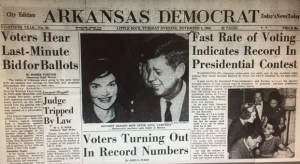
elex-ad-60The afternoon Democrat ran a large photo of Jackie and JFK after they had voted and a slightly smaller one of the Nixon family voting.  Two stories discussed the record turnout that appeared to be taking place — one was on a national scale, and the other was focused on Arkansas.  There was also a story on last minute campaigning.  In the end, over 68,000,000 votes were cast which was a record at the time.

elex-ag-88The most recent presidential election to take place on November 8 was in 1988.  It featured Vice President George H. W. Bush against Massachusetts Governor Michael Dukakis.  The Gazette (covering its final presidential election — though no one knew it at the time) featured a story on Bush and Dukakis in the final day of campaigning.  It also featured a guide to watching the returns and discussed how the networks made their decisions about calling states.  There was also a box highlighting key battleground states which included Massachusetts, Pennsylvania, New York, Illinois and Texas.  Interestingly, two of those were the home states of the candidates.

elex-ad-88By 1988, the Democrat had been a morning paper for several years going head to head with the Gazette.  It carried its own photos of Bush and Dukakis on the final full day of campaigning.  An inside story was highlighted on the cover which featured a Monday rally in Little Rock with Texas Senator Lloyd Bentsen (Dukakis’ running mate).  The 1988 campaign was long, by the standards of the time, but would be considered abbreviated today.  The 1988 election would mark the third consecutive presidential election that the GOP candidate carried Arkansas.

Little Rock Look Back: JFK in ARK

JFK LRNinety-nine years ago today, John Fitzgerald Kennedy was born.  After a too brief 1,000 days in the Presidency, he is memorialized by the John F. Kennedy Center for the Performing Arts which was designed by Arkansas native Edward Durell Stone.

On October 3, 1963, President John F. Kennedy delivered remarks at the Arkansas State Fairgrounds.  Only a few weeks later, he would be felled by an assassins bullet in Texas.  In the speech, the President praised Arkansas’ congressional delegation including Senators John McClellan and J. William Fulbright and Congressmen Took Gathings, Bill Trimble, Wilbur Mills and Oren Harris.  Each of these men held senior leadership positions in key committees.  The main focus of the speech was to discuss President Kennedy’s vision for a new economy in the South.

The President was actually in the state to speak at the dedication of the Greers Ferry Dam. He agreed to make that appearance as a part of a negotiation with Congressman Mills as they were deadlocked over changes to the tax code.  He had previously visited Little Rock in 1957 when he came to the state to address the Arkansas Bar Association meeting in Hot Springs.

John Fitzgerald Kennedy was born on May 29, 1917, the second of nine children. Groomed for leadership by his father Joe and mother Rose, he was thrust even more into the path of political greatness following the World War II death of his elder brother Joe Jr.  A war hero himself, following his leadership after the attack of PT-109, he was first elected to Congress from Massachusetts in 1946. He would be re-elected in 1948 and 1950.  In 1952, he challenged incumbent Senator Henry Cabot Lodge and beat him.  He was re-elected to the Senate in 1958.

Kennedy had been seen as a strong potential Vice Presidential candidate for the Democrats in 1956. But his father discouraged this fearing that a loss to Eisenhower/Nixon would set him back in the future.  In 1960, the young, dashing Senator from the Bay State sought the Democratic nomination.  After a contentious primary season where he often ran against senate colleagues, Kennedy headed into the Democratic convention with the most delegates.  He added his chief rival, Texas Senator Lyndon Baines Johnson as his running mate.

After a close election, the Kennedy-Johnson ticket bested Vice President Richard Nixon and his running mate Henry Cabot Lodge (the selfsame former Senator who had been defeated by Kennedy 8 years earlier).

Following the oldest President (at the time), the young Kennedy administration seemed to captivate the country.  During his 1000 days in office, Kennedy faced many challenges both foreign (Bay of Pigs, Cuba missile crisis, start of Vietnam) and domestic (civil rights, organized crime). His ambitious “New Frontier” focused on education, additional services to rural areas and medical care for the elderly.  He also focused on getting the US to the moon.

On the personal front, in 1953 he married Jacqueline Bouvier. In addition to their daughter Caroline and son John Jr., who survived their father, the Kennedy’s had a miscarriage, a stillborn daughter, and son Patrick who died after two days.

Together with Franklin Roosevelt and Ronald Reagan, JFK embodied not only his generation but the mood of the country.  And his quotes resonate today including:

My fellow Americans, ask not what your country can do for you, ask what you can do for your country.

Let every nation know, whether it wishes us well or ill, that we shall pay any price, bear any burden, meet any hardship, support any friend, oppose any foe to assure the survival and the success of liberty.

Ich bin ein Berliner

Four Elections which shaped 20th Century focus of Clinton School lecture tonight

Pivotal Tuesdays: Four Elections that Shaped the Twentieth Century

6pm, November 16 – Clinton School Sturgis Hall

In her book, “Pivotal Tuesdays,” Margaret O’Mara looks back at four pivotal presidential elections of the past 100 years to show how they shaped the twentieth century. Exploring personalities, critical moments, and surprises of the elections of 1912, 1932, 1968, and 1992, this book shows how elections are windows into changing economic times and how history is made when ordinary people cast their ballots. A book signing will follow.

Margaret O’Mara is an associate professor of History at the University of Washington in Seattle, specializing in the political and economic history of the twentieth century United States. Her research and writing focuses on the history of the high-tech industry, the history of American politics, and the connections between the two. In addition to her academic work, she has collaborated with government, business, and civic organizations on a range of projects exploring how innovation drives growth and change.

Little Rock Look Back: John Fitzgerald Kennedy

JFK LROn October 3, 1963, President John F. Kennedy delivered remarks at the Arkansas State Fairgrounds.  Only a few weeks later, he would be felled by an assassins bullet in Texas.  In the speech, the President praised Arkansas’ congressional delegation including Senators John McClellan and J. William Fulbright and Congressmen Took Gathings, Bill Trimble, Wilbur Mills and Oren Harris.  Each of these men held senior leadership positions in key committees.  The main focus of the speech was to discuss President Kennedy’s vision for a new economy in the South.

The President was actually in the state to speak at the dedication of the Greers Ferry Dam. He agreed to make that appearance as a part of a negotiation with Congressman Mills as they were deadlocked over changes to the tax code.  He had previously visited Little Rock in 1957 when he came to the state to address the Arkansas Bar Association meeting in Hot Springs.

John Fitzgerald Kennedy was born on May 29, 1917, the second of nine children. Groomed for leadership by his father Joe and mother Rose, he was thrust even more into the path of political greatness following the World War II death of his elder brother Joe Jr.  A war hero himself, following his leadership after the attack of PT-109, he was first elected to Congress from Massachusetts in 1946. He would be re-elected in 1948 and 1950.  In 1952, he challenged incumbent Senator Henry Cabot Lodge and beat him.  He was re-elected to the Senate in 1958.

Kennedy had been seen as a strong potential Vice Presidential candidate for the Democrats in 1956. But his father discouraged this fearing that a loss to Eisenhower/Nixon would set him back in the future.  In 1960, the young, dashing Senator from the Bay State sought the Democratic nomination.  After a contentious primary season where he often ran against senate colleagues, Kennedy headed into the Democratic convention with the most delegates.  He added his chief rival, Texas Senator Lyndon Baines Johnson as his running mate.

After a close election, the Kennedy-Johnson ticket bested Vice President Richard Nixon and his running mate Henry Cabot Lodge (the selfsame former Senator who had been defeated by Kennedy 8 years earlier).

Following the oldest President (at the time), the young Kennedy administration seemed to captivate the country.  During his 1000 days in office, Kennedy faced many challenges both foreign (Bay of Pigs, Cuba missile crisis, start of Vietnam) and domestic (civil rights, organized crime). His ambitious “New Frontier” focused on education, additional services to rural areas and medical care for the elderly.  He also focused on getting the US to the moon.

On the personal front, in 1953 he married Jacqueline Bouvier. In addition to their daughter Caroline and son John Jr., who survived their father, the Kennedy’s had a miscarriage, a stillborn daughter, and son Patrick who died after two days.

Together with Franklin Roosevelt and Ronald Reagan, JFK embodied not only his generation but the mood of the country.  And his quotes resonate today including:

My fellow Americans, ask not what your country can do for you, ask what you can do for your country.

Let every nation know, whether it wishes us well or ill, that we shall pay any price, bear any burden, meet any hardship, support any friend, oppose any foe to assure the survival and the success of liberty.

Ich bin ein Berliner


Little Rock Look Back: President Ronald W. Reagan

RWR 40On February 6, 1911, future U.S. President Ronald Wilson Reagan was born. His life took him from small town Illinois, to Hollywood in the last days of the Golden Age of the studio system, to politics, to the California State House, to the White House.

On November 3, 1984, he became the first sitting U.S. President to spend a night in Little Rock. He stayed at the Excelsior Hotel (now Marriott Downtown) before making a campaign speech on November 4.  His only special requests for the room were jelly beans and ginger ale.  His speech was in the Statehouse Convention Center, which had opened less than two years earlier.

In 1980, Reagan had become only the third Republican to win Arkansas’ electoral votes (after Grant in 1868 and 1872 and Nixon in 1972). He was expected to easily win them again in 1984.  The main purpose of his speech on the Saturday before election Day was to drum up support for other GOP candidates in the state.  While he carried the state and the electoral votes, none of his preferred candidates won their races in 1984.

Four years later, on October 27, 1988, he flew in to Little Rock to make remarks at Central Flying Service. The purpose this time was to campaign on behalf of GOP nominee George H. W. Bush. As Reagan had done in 1980 and 1984, Bush carried the state and won the Presidency.

In 1992, after native son Bill Clinton defeated Bush in his bid for re-election, Reagan welcomed Clinton to his office in Los Angeles.  Having served as Governor of California, he was able to relate to Clinton’s impending transition from Governor to President.

In 2004, months before the Clinton Library opened, Reagan succumbed to the ravages of Alzheimer’s Disease.  He had publicly disclosed he had the illness in 1994 during the second year of Clinton’s first term.  Though the Clinton Library was not open yet, the Clinton Foundation set up a memorial book at Curran Hall for people to stop by and sign. The book was then sent to the Reagan Presidential Library.