Little Rock Look Back: John Tyler

640px-WHOportTylerOn March 29, 1790, future US President John Tyler was born.

Upon the death of President William Henry Harrison, as Vice President he assumed the office of President.  The language in the U.S. Constitution was open to interpretation as to whether he was President or merely acting as President.  He insisted he was President which established the precedent (until a subsequent amendment formalized the procedure he had put into place).  His detractors, including many in his own Whig Party, referred to him as “His Accidency.”

Tyler was a strong proponent of Manifest Destiny and westward expansion.  He actively sought to bring the Republic of Texas into the U.S.  Because of his interest in this, the Tyler Administration was a benefit to Arkansas. As the western border of the US (and a neighbor to Texas), Arkansas was an important stop for commercial and political leaders on the road to and from Texas.

He is memorialized in Little Rock with Tyler Street.  An easy way to remember which street is Tyler and which is Taylor (a couple of blocks away): Tyler Street has Saint John’s Seminary as a terminus. So the street named after John Tyler, ends at the Saint John’s campus.

As of this writing, two of his grandsons are still alive.  Born in 1924 and 1928, they make Tyler the earliest U.S. President with living grandchildren.  Many of his successors do not have living grandchildren.

Sandwiching in History at St. John’s Seminary today

Today the Sandwiching in History program visits the St. John’s Seminary, located at 2500 N. Tyler Street.  Sandwiching in History is sponsored by the Arkansas Historic Preservation Program.

StJohn3This campus was built in 1916 to house Little Rock College for Boys until it closed in 1929. From 1930 until it closed in 1967 St. John Home Mission Seminary was located at this site.

In 1968, the campus was renamed St. John Catholic Center when it became the home of the Diocese of Little Rock offices. Today it also serves as a retreat center and residence for retired diocesan priests.

The “Sandwiching In History program is a series of tours that seeks to familiarize people who live and work in central Arkansas with the historic structures and sites around us. The tours take place on Fridays at noon, last less than an hour, and participants are encouraged to bring their lunches so that they can eat while listening to a brief lecture about the property and its history before proceeding on a short tour.

The Arkansas Historic Preservation Program is an agency of the Department of Arkansas Heritage.

Architeaser – April 16

Yesterday’s Architeaser featured Byrne Hall on the St. John’s campus in the Heights.  The building currently houses the offices of the Arkansas Symphony Orchestra.  Yesterday the ASO concluded the 2011-2012 MasterWorks series.  This evening at the Clinton Presidential Center, this year’s final River Rhapsodies Chamber Concert will be held at 7pm.

This week we will look at some of the animals in Little Rock which are not at the Little Rock Zoo.

Sculpture Vulture: Statuary at St. John’s

Last week’s Sculpture Vulture looked at the state of St. John the Baptist on the St. John Catholic Center campus.  Today’s looks at three other statues on the ground.  Though there are other sculptures and icons inside worship spaces on the grounds of St. John’s, these are outdoors and are therefore more properly discussed as public art rather than solely as religious iconography.

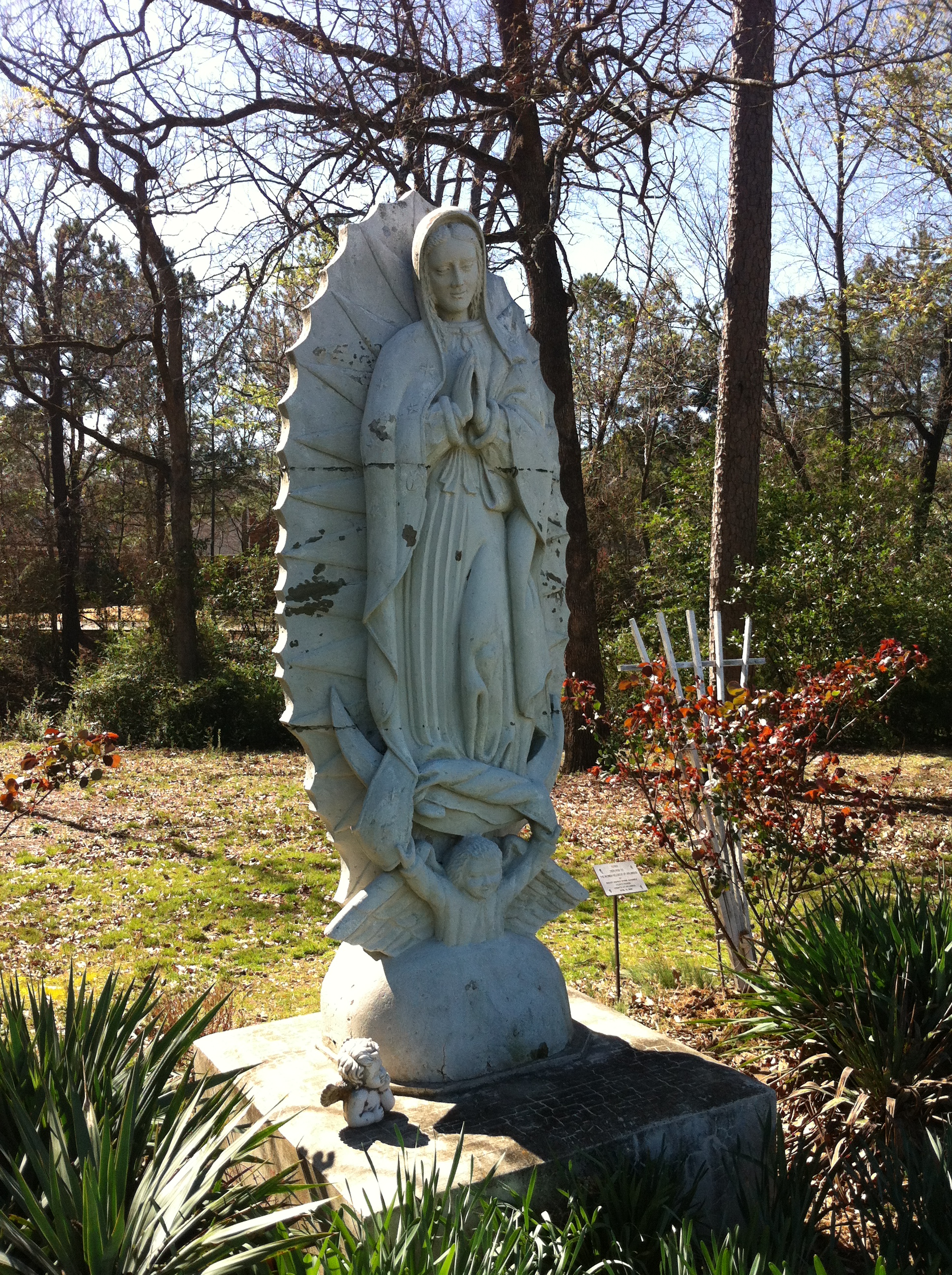
Near the campus entrance is a statue of the Virgin Mary with her hands clasped as if in prayer.  Behind her are radiating beams of light. At the base of the statue is a cherub who is actually supporting the pedestal on which she stands.  Another cherub is off to the side. It is possible that there is a missing cherub who was originally on the other size to balance out the statue.

There is another statue of Mary on the campus.  In August 1988 a statue was dedicated in honor of the Marian Year which ran from June 1987 through August 1988.  It was donated by the Bishop and priests of the Diocese of Little Rock and dedicated by Most Rev. Andrew J. McDonald, who was Bishop at the time.  It depicts Mary with her arms at her sides and hands open and outstretched.

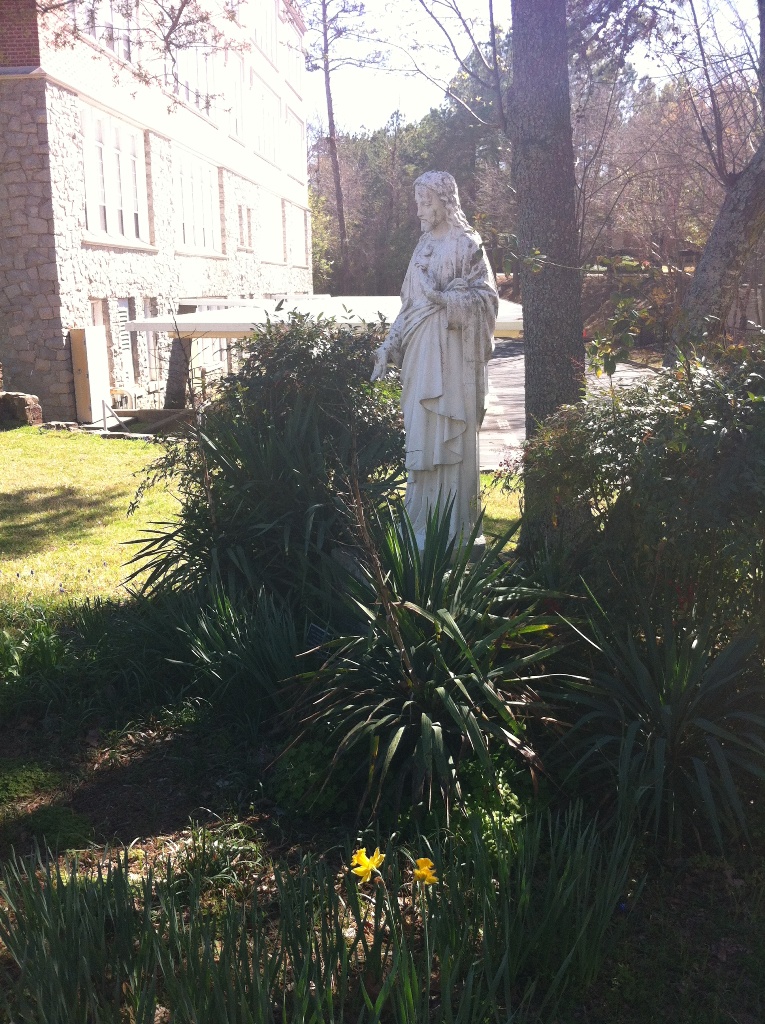
The other statue is that of Christ as an adult. It is located near the Marian Year statue.  Given in memory of Barbara Anderson, it features Christ with one hand outstretched and the other hand pointing to his heart.

Sculpture Vulture: St. John the Baptist

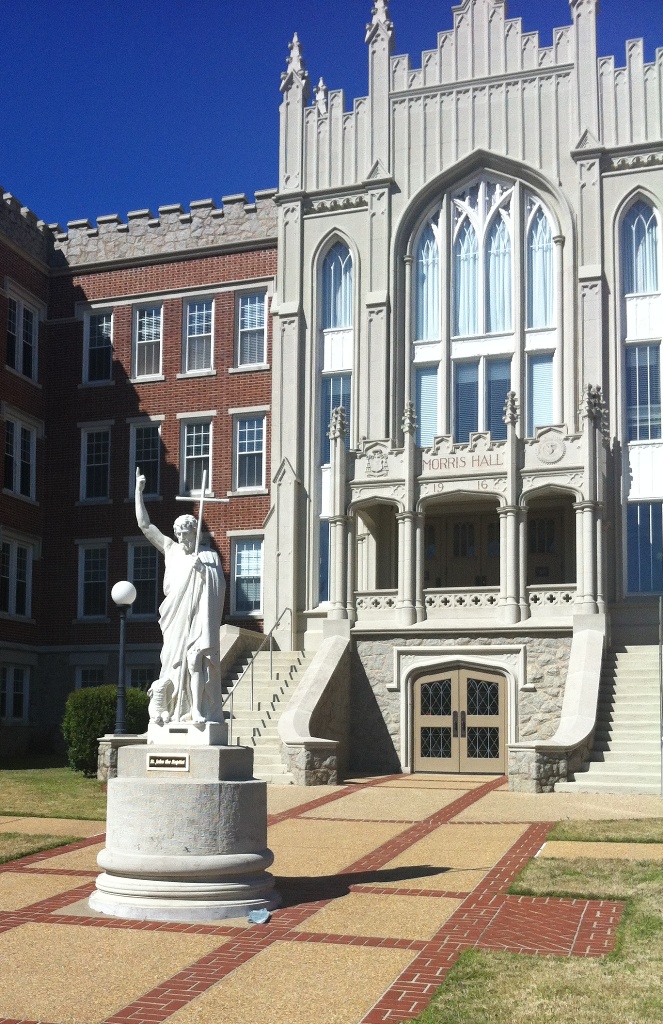
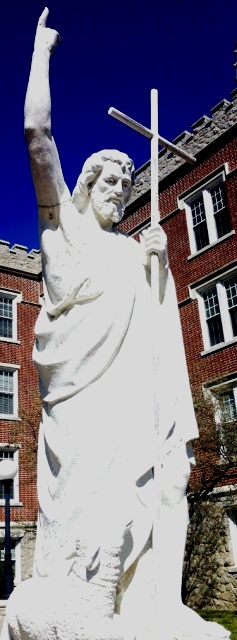
On the grounds of the St. John Catholic Center are several sculptures.  Today’s entry focuses on the statue which is the focal point of the campus.  The statue of St. John the Baptist sits in front of the Morris Hall.  The campus was founded in the Heights in 1916.

St. John is depicted holding a crucifix in one hand.  With the other hand he is pointing to the sky in the manner of an exhortation.  At his feet is a lamb  looking up at him.  Interestingly, for a person who is depicted in the Bible as wearing camel’s hair, this John is wearing a robe.

Once, St. John the Baptist watched over the seminarians on the campus. Today he is more likely to watch over the various walkers, joggers, pets and others who use the greenspace on the grounds.  In addition, the Arkansas Symphony Orchestra offices are currently located in a building on the St. John campus.

The statue was erected in memory of Thomas Lafferty an early Little Rock business leader.