Little Rock Look Back: Mayor John Widgery

LR sealOn June 17, 1802, future Little Rock Mayor John Widgery was born in Portland ME to Mr. and Mrs. William Widgery.  His father died in 1804.  At the age of 11, John Widgery entered Bowdoin College.  He was the youngest student admitted to the college.

Widgery studied law with his uncle, Nathan Kinsman.  He married Ann L. Woodward, who was from Boston MA.  According to Bowdoin College records, he later “wandered away into the Southwest” spending time “in the Cherokee country.”

Widgery spent most of his adult life in the south. For a time Widgery was clerk of the Mississippi House of Representatives.  He then moved to Little Rock prior to 1840.  By 1840, he was Recorder for the City of Little Rock.

According to media reports at the time, several tradesman groups encouraged Widgery to run for Mayor in January 1841.  He did run but lost to Rev. Samuel H. Webb.  The next year, Widgery ran again and this time was elected Mayor.  He took office in January 1842.  On May 24, 1842 he resigned from office.  He later served as Secretary of the Arkansas Senate (where he made $8 a day when the Senate was in session).

Widgery eventually settled in St. Louis.  He later returned up north.  He died on August 2, 1873 in Portland ME and is buried there.  He and his wife did not have any children.

No known painting or photograph of Mayor Widgery exists.

LR Look Back: HAIR flows at Robinson Auditorium

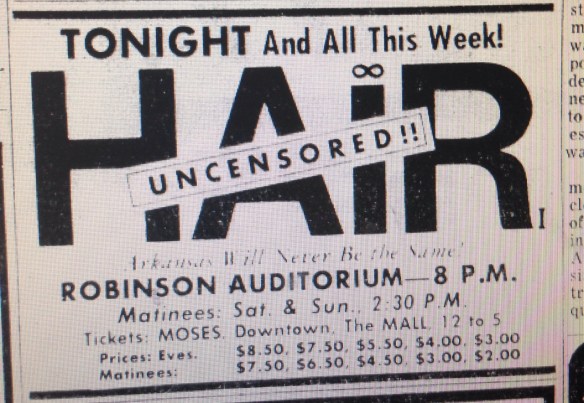
Ad for the original production of HAIR in Little Rock. Note the ticket prices. And that they could be purchased at Moses Music Shops.

Ad for the original production of HAIR in Little Rock. Note the ticket prices. And that they could be purchased at Moses Music Shops.

Forty-three years ago today, on January 18, 1972, the musical Hair settled in for a week-long run at Robinson Auditorium.  The saga to bring the national tour to Little Rock had actually begun eleven months earlier.

In February 1971, a young Little Rock attorney named Phil Kaplan petitioned the Little Rock Board of Censors to see if it would allow a production of Hair to play in the city. He was asking on behalf of a client who was interested in bringing a national tour to Arkansas’ capital city. The show, which had opened on Broadway to great acclaim in April 1968 after an Off Broadway run in 1967, was known for containing a nude scene as well for a script which was fairly liberally sprinkled with four-letter words. The Censors stated they could not offer an opinion without having seen a production.

By July 1971, Kaplan and his client (who by then had been identified as local promoter Jim Porter and his company Southwest Productions) were seeking permission for a January 1972 booking of Hair from the City’s Auditorium Commission which was charged with overseeing operations at Robinson Auditorium. At its July meeting, the Commissioners voted against allowing Hair because of its “brief nude scene” and “bawdy language.”

Kaplan decried the decision. He stated that the body couldn’t “sit in censorship of legitimate theatrical productions.” He noted courts had held that Hair could be produced and that the Auditorium Commission, as an agent for the State, “clearly can’t exercise prior censorship.” He proffered that if the production was obscene it would be a matter for law enforcement not the Auditorium Commission.

The Commission countered that they had an opinion from City Attorney Joseph Kemp stating they had the authority. One of the Commissioners, Mrs. Grady Miller (sister-in-law of the building’s namesake the late Senator Robinson, she had served on the Commission since 1940), expressed her concern that allowing Hair would open the door to other productions such as Oh! Calcutta!

On July 26, 1971, Southwest Productions filed suit against the Auditorium Commission. Four days later there was a hearing before federal Judge G. Thomas Eisele. At that hearing, Auditorium Commission member Lee Rogers read aloud excerpts from the script he found objectionable. Under questioning from Kaplan, a recent touring production of Neil Simon’s Plaza Suite was discussed. That play has adultery as a central theme of one of its acts. Rogers admitted he found the play funny, and that since the adultery did not take place on stage, he did not object to it. Among those testifying in favor of it was Robert Reddington, who was director of performing arts at the Arkansas Arts Center.

Judge Eisele offered a ruling on August 11 which compelled the Auditorium Commission to allow Hair to be performed. Prior to the ruling, some of the Auditorium Commissioners had publicly stated that if they had to allow Hair, they would close it after the first performance on the grounds of obscenity. To combat this, Judge Eisele stated that the Commission had to allow Hair to perform the entire six day engagement it sought.

Upon hearing of the Judge’s ruling, Commissioner Miller offered a succinct, two word response. “Oh, Dear!”

In the end, the production of Hair at Robinson would not be the first performance in the state.  The tour came through Fayetteville for two performances in October 1971 at Barnhill Arena.

On January 18, 1972, Hair played the first of its 8 performances over 6 days at Robinson Auditorium.  In his review the next day, the Arkansas Gazette’s Bill Lewis noted that Hair “threw out all it had to offer” and that Little Rock had survived.

The ads promoting the production carried the tagline “Arkansas will never be the same.”  Tickets (from $2 all the way up to $8.50) could be purchased at Moses Melody Shops both downtown and in “The Mall” (meaning Park Plaza). That business is gone from downtown, but the scion of that family, Jimmy Moses, is actively involved in building downtown through countless projects. His sons are carrying on the family tradition too.

Little Rock was by no means unique in trying to stop productions of Hair.  St. Louis, Birmingham, Los Angeles, Tallahassee, Boston, Atlanta, Charlotte NC, West Palm Beach, Oklahoma City, Mobile and Chattanooga all tried unsuccessfully to stop performances in their public auditoriums.  Despite Judge Eisele’s ruling against the City of Little Rock, members of the Fort Smith City Council also tried to stop a production later in 1972 in that city. This was despite warnings from City staff that there was not legal standing.

Within a few years, the Board of Censors of the City of Little Rock would be dissolved (as similar bodies also were disappearing across the US). Likewise, the Auditorium Commission was discontinued before Hair even opened with its duties being taken over by the Advertising and Promotion Commission and the Convention & Visitors Bureau staff.  This was not connected to the Hair decision; it was, instead, related to expanding convention facilities in Robinson and the new adjacent hotel.  Regardless of the reasons for their demise, both bygone bodies were vestiges of earlier, simpler and differently focused days in Little Rock.

Little Rock Look Back: John Widgery, LR’s 8th Mayor

LR sealOn June 17, 1802, future Little Rock Mayor John Widgery was born in Portland ME to Mr. and Mrs. William Widgery.  His father died in 1804.  At the age of 11, John Widgery entered Bowdoin College.  He was the youngest student admitted to the college.

Widgery studied law with his uncle, Nathan Kinsman.  He married Ann L. Woodward, who was from Boston MA.  According to Bowdoin College records, he later “wandered away into the Southwest” spending time “in the Cherokee country.”

Widgery spent most of his adult life in the south. For a time Widgery was clerk of the Mississippi House of Representatives.  He then moved to Little Rock prior to 1840.  By 1840, he was Recorder for the City of Little Rock.

According to media reports at the time, several tradesman groups encouraged Widgery to run for Mayor in January 1841.  He did run but lost to Rev. Samuel H. Webb.  The next year, Widgery ran again and this time was elected Mayor.  He took office in January 1842.  On May 24, 1842 he resigned from office.  He later served as Secretary of the Arkansas Senate (where he made $8 a day when the Senate was in session).

Widgery eventually settled in St. Louis.  He later returned up north.  He died on August 2, 1873 in Portland ME and is buried there.  He and his wife did not have any children.

No known painting or photograph of Mayor Widgery exists.

Little Rock Look Back: HAIR comes to LR in 1972

Ad for the original production of HAIR in Little Rock. Note the ticket prices. And that they could be purchased at Moses Music Shops.

Ad for the original production of HAIR in Little Rock. Note the ticket prices, and that they could be purchased at Moses Melody Shops.

It seems fitting that a touring production of Hair is the final Broadway show at Robinson Center Music Hall before it is closed for a two year renovation. The first time the show played at Robinson, it caused quite a stir. To be fair, the actual production in January 1972 did not cause a stir, it was the process leading up to it that was the source of much ado.

In February 1971, a young Little Rock attorney named Phil Kaplan petitioned the Little Rock Board of Censors to see if it would allow a production of Hair to play in the city. He was asking on behalf of a client who was interested in bringing a national tour to Arkansas’ capital city. The show, which had opened on Broadway to great acclaim in April 1968 after an Off Broadway run in 1967, was known for containing a nude scene as well for a script which was fairly liberally sprinkled with four-letter words. The Censors stated they could not offer an opinion without having seen a production.

By July 1971, Kaplan and his client (who by then had been identified as local promoter Jim Porter and his company Southwest Productions) were seeking permission for a January 1972 booking of Hair from the City’s Auditorium Commission which was charged with overseeing operations at Robinson Auditorium. At its July meeting, the Commissioners voted against allowing Hair because of its “brief nude scene” and “bawdy language.”

Kaplan decried the decision. He stated that the body couldn’t “sit in censorship of legitimate theatrical productions.” He noted courts had held that Hair could be produced and that the Auditorium Commission, as an agent for the State, “clearly can’t exercise prior censorship.” He proffered that if the production was obscene it would be a matter for law enforcement not the Auditorium Commission.

The Commission countered that they had an opinion from City Attorney Joseph Kemp stating they had the authority. One of the Commissioners, Mrs. Grady Miller (sister-in-law of the building’s namesake the late Senator Robinson who had served on the Commission since 1939), expressed her concern that allowing Hair would open the door to other productions such as Oh! Calcutta!

On July 26, 1971, Southwest Productions filed suit against the Auditorium Commission. Four days later there was a hearing before Judge G. Thomas Eisele. At that hearing, Auditorium Commission member Lee Rogers read aloud excerpts from the script he found objectionable. Under questioning from Kaplan, a recent touring production of Neil Simon’s Plaza Suite was discussed. That play has adultery as a central theme of one of its acts. Rogers admitted he found the play funny, and that since the adultery did not take place on stage, he did not object to it. Among those testifying in favor of it was Robert Reddington, who was director of performing arts at the Arkansas Arts Center.

Judge Eisele offered a ruling on August 11 which compelled the Auditorium Commission to allow Hair to be performed. Prior to the ruling, some of the Auditorium Commissioners had publicly stated that if they had to allow Hair they would close it after the first performance on the grounds of obscenity. To combat this, Judge Eisele stated that the Commission had to allow Hair to perform the entire six day engagement it sought.

Upon hearing of the Judge’s ruling, Commissioner Miller offered a succinct, two word response. “Oh, Dear!”

In the end, the production of Hair at Robinson would not be the first performance in the state.  The tour came through Fayetteville for two performances in October 1971. It played Barnhill Arena.

On January 18, 1972, Hair played the first of its 8 performances over 6 days at Robinson Auditorium.  In his review the next day, the Arkansas Gazette’s Bill Lewis noted that Hair “threw out all it had to offer” and that Little Rock had survived.

The ads promoting the production carried the tagline “Arkansas will never be the same.”  Tickets (from $2 all the way up to $8.50) could be purchased at Moses Melody Shops both downtown and in “The Mall” (meaning Park Plaza). That business is gone from downtown, but the scion of that family, Jimmy Moses, is actively involved in building downtown through countless projects. His sons are carrying on the family tradition too.

Little Rock was by no means unique in trying to stop productions of Hair.  St. Louis, Birmingham, Los Angeles, Tallahassee, Boston, Atlanta, Charlotte NC, West Palm Beach, Oklahoma City, Mobile and Chattanooga all tried unsuccessfully to stop performances in their public auditoriums.  Despite Judge Eisele’s ruling against the City of Little Rock, members of the Fort Smith City Council also tried to stop a production later in 1972 in that city. This was despite warnings from City staff that there was not legal standing.

Within a few years, the Board of Censors of the City of Little Rock would be dissolved (as similar bodies also were disappearing across the US). Likewise, the Auditorium Commission was discontinued before Hair even opened with its duties being taken over by the Advertising and Promotion Commission and the Convention & Visitors Bureau staff.  This was not connected to the Hair decision; it was, instead, related to expanding convention facilities in Robinson and the new adjacent hotel.  Regardless of the reasons for their demise, both bygone bodies were vestiges of earlier, simpler and differently focused days in Little Rock.

Over the years, Hair has returned to the Little Rock stage.  UALR has produced it at least twice.  The Weekend Theater has also mounted a production. By 2014, Hair is a period piece. For some, a wistful look at their long-gone youth while for others a romanticized time when disparate spirits could band together and change the world.

Little Rock Look Back: Mayor Matthew Cunningham

M_Cunningham_fDr. Matthew Cunningham was born on July 5, 1782 in Pennsylvania. After receiving his medical degree from the University of Pennsylvania, he ended up in New York City.

It was there he met and married a young widow, Eliza Wilson Bertrand. After a brief stint in St. Louis, Dr. Cunningham was one of the first settlers of Little Rock in February 1820. He became the first physician in Little Rock.

In September 1820, Mrs. Cunningham and her children joined him. She became the first female in the Little Rock settlement. Dr. and Mrs. Cunningham had a son, Chester, who was the first white baby born in Little Rock. (There is some thought that one of the African American slaves they had gave birth to a child before Chester was born.) The Cunninghams also had a daughter, Matilda, who would later marry Peter Hangar.  (The Hangar Hill neighborhood is named after Peter Hangar.)

In 1831, Dr. Cunningham was elected the first Mayor of Little Rock. He won the race 23 to 15 over Rev. W. W. Stevenson. The first City Council meeting took place at the Cunningham house at the southwest corner of what is now 3rd and Main Streets (where Bennett’s Military Surplus is located).

Dr. Cunningham served one year as Mayor. He lived until June 15, 1851 and is buried at Mt. Holly Cemetery. His wife, son, daughter and her family are buried next to him.  His stepson – Charles P. Bertrand – also served as Mayor of Little Rock.

LR Look Back: Mayor John Widgery

LR sealOn June 17, 1802, future Little Rock Mayor John Widgery was born in Portland ME to Mr. and Mrs. William Widgery.  His father died in 1804.  At the age of 11, John Widgery entered Bowdoin College.  He was the youngest student admitted to the college.

Widgery studied law with his uncle, Nathan Kinsman.  He married Ann L. Woodward, who was from Boston MA.  According to Bowdoin College records, he later “wandered away into the Southwest” spending time “in the Cherokee country.”

Widgery spent most of his adult life in the south. For a time Widgery was clerk of the Mississippi House of Representatives.  He then moved to Little Rock prior to 1840.  By 1840, he was Recorder for the City of Little Rock.

According to media reports at the time, several tradesman groups encouraged Widgery to run for Mayor in January 1841.  He did run but lost to Rev. Samuel H. Webb.  The next year, Widgery ran again and this time was elected Mayor.  He took office in January 1842.  On May 24, 1842 he resigned from office.  He later served as Secretary of the Arkansas Senate (where he made $8 a day when the Senate was in session).

Widgery eventually settled in St. Louis.  He later returned up north.  He died on August 2, 1873 in Portland ME and is buried there.  He and his wife did not have any children.

Architeaser May 15

Yesterday’s Architeaser was a crest on the exterior of the Lafayette Building.  Originally constructed in 1925 as a hotel, it has been a commercial structure since 1953.  Recently the building has been renovated and is now a mixed-use structure of offices and residential units.  It was designed by St. Louis architect George Barnett.

Here is today’s Architeaser.  This crest actually also contains two smaller crests within it.