
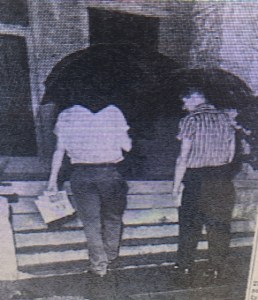
A rainy Sunday afternoon did not stop STOP canvassers on May 24, 1959.
Sunday, May 24, 1959, was election eve for the Recall Campaign. As such, the election figured into some Sunday morning sermons. Reverend M. L. Moser Jr. spoke from the pulpit of his church and described the issue of segregation as Biblical. As many had before him, and would after him, he used the story of Noah’s three sons as a way to justify segregation of the races.
(Supposedly one of the sons was the father of the white race, one the father of the African American race, and one the father of the Asian race. In this narrative, no explanation is given for other variations such as Native Americans and other indigenous people or persons from the sub-continent of India. Also excluded is the likely race of everyone in the story – those who live in the Middle East.)
At Trinity Episcopal Cathedral, Dean Charles A. Higgins prayed for the schools but did not tell his parishioners how to vote. Rev. Aubrey G. Walton at First Methodist Church spoke about the schools needing to be free from politics and pressure groups. (Though Rev. Walton did later appear that evening on a STOP sponsored TV show.)
Embattled School Board president Ed McKinley refused requests from the media and others to divulge his plans for the future of the Little Rock School District. Earlier he had stated he had an idea on how the schools could be reopened and segregated, but still remain in compliance with the courts. Across the river, segregationists were planning a rally in North Little Rock to head off any plans for future integration on the north side. Congressman Alford had already agreed to speak at this rally.
In paid time on TV, Governor Faubus spoke at length in a criticism of the Arkansas Gazette. He called the fired teachers pawns in a larger game. He noted in his remarks that he did not expect to sway any votes by this point.
Not to be outdone, STOP was on all three TV stations. Sometimes the program was aired on more than one station simultaneously. In an appearance sponsored by STOP, William S. Mitchell noted that May 24 was coincidentally Children’s Day. He noted that never before in Little Rock history had so many people volunteered for a cause as those who had worked on STOP and with STOP. The Women’s Emergency Committee, PTA Council, labor unions, and numerous other organizations had come together to raise money, knock on doors, and otherwise get the word out.
Finally, it was all over but the voting. Nineteen days of outrage, exasperation, and hyperbole was coming to an end. When dawn broke, it would be election day.
 On April 4, 1968, when Dr. King was assassinated, Little Rock did not see the unrest that many cities did. Part of that was probably due to quick action by Governor Winthrop Rockefeller.
 In 1977, Peggy S. Bosmyer was ordained an Episcopal priest at Little Rock’s Trinity Cathedral. Not only was she the first woman in Arkansas to be ordained to a full priesthood in the Episcopal Church, she was the first woman south of the Mason-Dixon line.
 The Arkansas Symphony Orchestra, Philip Mann, Music Director and Conductor, opens the 2019-2020 Intimate Neighborhood Concerts (INC) series with Songs from the Heart, Thursday, March 28 at 7:00 p.m. at Trinity Episcopal Cathedral (310 W 17th St, Little Rock).
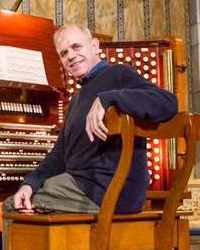 The Central Arkansas Chapter of the American Guild of Organists presents William K. Trafka in concert tonight. The program starts at 8pm at Trinity Episcopal, 310 West 17th Street.
 The Trinity Episcopal Cathedral choir presents excerpts from Mendelssohn’s ELIJAH today at 5pm.
 Tonight (January 14) at 7pm at Trinity Episcopal Cathedral, Drew Irvin, Stephen Feldman, and friends will perform the Mozart Clarinet Quintet.
 Little Rock Culture Vulture